Gabriele MarcottiJun 10, 2026, 03:41 AM ETCloseGabriele Marcotti is a senior soccer writer for ESPN.com. Read his archive here and follow him on Twitter: @Marcotti.
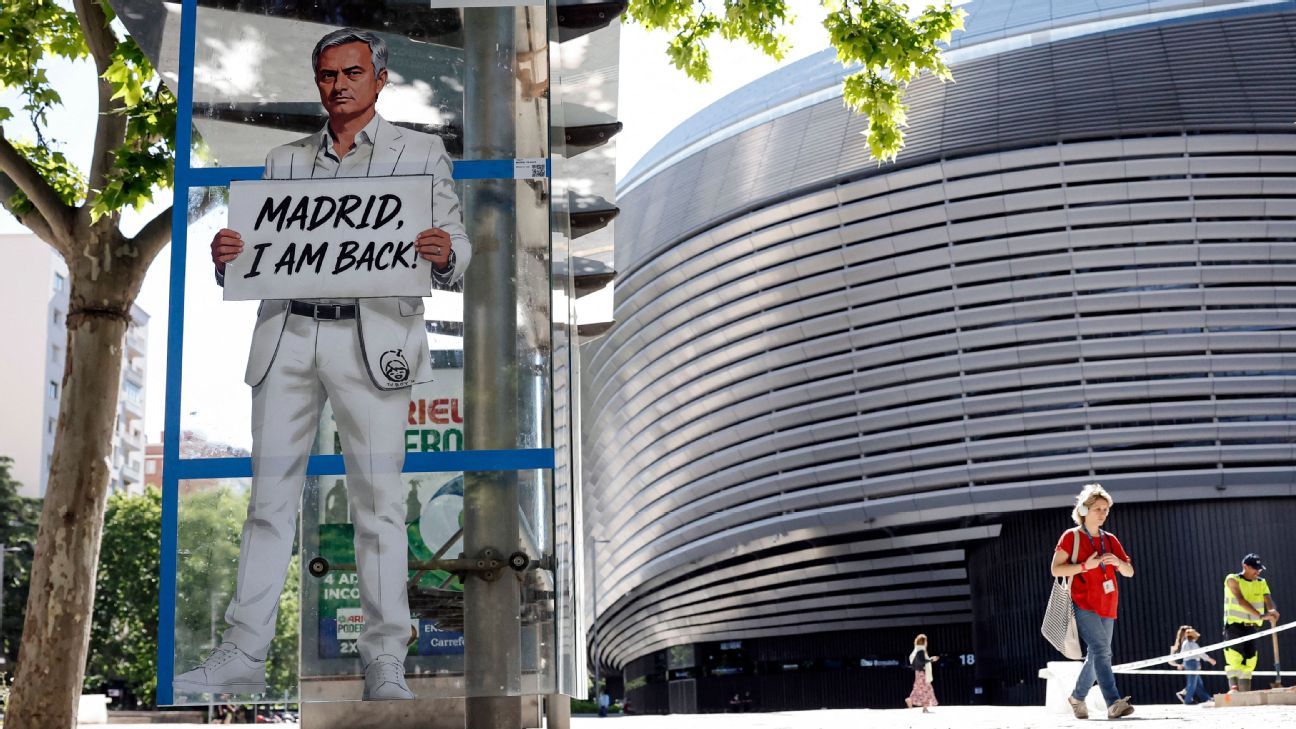
There are two battling, but not mutually exclusive, sensations around Jose Mourinho's return to Real Madrid.
One is the whiff of nostalgia. There is a hardcore of support that views his time there -- battling Pep Guardiola, Lionel Messi and Barcelona mano a mano, winning the league with record points and goals totals, each game a tinderbox of us vs. them -- as a sort of golden age. Never mind the fact that the club would go on to win four Champions League titles in the five years after his departure, the foundations of swagger and winning mentality were laid during his three seasons. And that's what they want to go back to.
The other is the idea of unfinished business. That third season, the one that turned into a toxic psychodrama in which they finished 15 points behind Barcelona and parted ways after losing to Atlético Madrid in the Copa del Rey final, leaves you wondering what might have been. What if both sides had handled matters differently? Less bridge-burning, more bridging of gaps? Less hubris, more empathy? (A favorite Mourinho buzzword these days.)
Both feelings are thoroughly understandable and also potentially dangerous, because this is a different Mourinho and a different Real Madrid. And as the Greek philosopher Heraclitus worked out some 2,500 years ago: "No man ever steps in the same river twice, for it's not the same river and it's not the same man."
It's not just the fact that for all the rose-tinted memories of the Mourinho Era, Real Madrid won just two pieces of major silverware -- one LaLiga title, one Copa del Rey -- in three years, making you wonder if it was worth the collective nerve-jangling. Especially since Real Madrid's greatest success since the 1990s has come under coaches (Vicente Del Bosque, Zinedine Zidane and Carlo Ancelotti) who are the antithesis of Mourinho: They lower the temperature and avoid confrontation wherever possible.
Nor is it about getting a second chance to make things right. This isn't Maverick trying to atone for Goose's death by mentoring Rooster. It didn't really work in "Top Gun," and it's not going to work here. Life just doesn't operate that way. Mourinho is such a public -- and divisive -- figure that most will have made their minds up about him before he even sets foot in Valdebebas.
What Mourinho has been hired to do is galvanize the fanbase and deliver results. That has to be his brief.
We know he can do the former because he has done it almost everywhere he has been. Few managers connect with their fans -- at least some of them, the ones who like it when you say the quiet part out loud -- the way he does. As for the latter, knocking Barcelona off their perch -- because three LaLiga titles in four years is very much a perch -- is the minimum requirement.
It won't be easy given what he's walking into. Mourinho may have president Florentino Pérez's backing, but then he thought he had it in 2012-13 too, and we know how that ended up. Pérez' reserves the right to change his mind; nine of the 12 coaches he has picked in his two decades in charge lasted less than a year.
Mourinho will also be inheriting a squad long on talent but short on cohesion and morale. It's not a good sign when players are getting into fistfights and picking up traumatic brain injuries as a result. Or when the top goal scorer irks fans by taking time off on a boat in Sardinia while rehabbing an injury. (He did have the club's permission, sure, but it's not something fans want to see on Instagram.) Or when the other star forward is a year away from free agency and was the subject of major Mourinho criticism after being racially abused against his Benfica side in February.
Contrast this with 2010, when Mourinho took over from Manuel Pellegrini, who had finished second with a whopping 96 points and had put together arguably the greatest transfer window in history: Karim Benzema, Xabi Alonso, Kaká and Cristiano Ronaldo. To that framework, Mourinho overlayed Sami Khedira, Ricardo Carvalho, Ángel Di María and Mesut Özil in his first window.
His critics say that Mourinho's modus operandi is always the same: rock up, get the club to spend a lot of money on new players and get to work. He won't have that luxury this time. There will be new faces, sure, but there simply isn't the runway for a massive overhaul like we saw between 2009 and 2011. That means he'll have to take what's already there and make it work better.
Instilling discipline will be a big part of it, and to be fair to Mourinho, he has shown that he can do that in his recent stops, from Benfica to Fenerbahçe to AS Roma. Not by acting the drill sergeant, but rather by building team spirt and accountability.
Then there's the soccer itself. Mourinho's critics insist the game has passed him by, that he's some sort of dinosaur. That part is largely unfair when it comes to playing style.
Has he relied heavily on defending and counterattacking, especially in knockout competitions? Yes. Are his teams as fun to watch for the neutral as what Bayern and PSG served up in Paris last month? No.
But it's not about the "neutrals" -- it's about Real Madrid and their fans. And after what they've been through, just winning will be enough, at least in the short term. Besides, when you have Kylian Mbappé and Vinícius Júnior up front, exploiting transition and wide open spaces isn't being negative, it's being smart.
Will it work? He'll never admit it, but Mourinho has taken his licks over the years and, as the saying goes, you often learn more in defeat than in victory. The Mourinho of 2010-13 had never been punched in the face before getting to Madrid. This one has, repeatedly, and he has bounced back.
However, nobody should be under any illusion: We won't see the sort of seminal change in philosophy that Xabi Alonso was going to deliver. Mourinho is 63, and Pérez is 79: Nobody thinks long term at that age. This won't be a Golden Years long-term affair; at best, this will be a late years tryst, lovers reunited for one last dance. Maybe that's what the club needs right now.
The thing about rekindling such flames many years later -- as Pérez and Mourinho seem to be doing -- is that you're not the same people today that you were back then. You can't ignore your common past, but you spent 13 years apart and that matters. And you have to start fresh, letting go of the past, something neither has been good at.
Do that, and you might just get this relationship to work.
Source: https://www.espn.com/soccer/story/_/id/48816247/real-madrid-jose-mourinho-florentino-perez-laliga-special-one-manager