Jeff CarlisleJun 10, 2026, 07:00 AM ET
Among the television promos hyping this summer's FIFA World Cup, there's one that shows a montage of soccer's greatest talents. There's Argentina's Lionel Messi, France's Kylian Mbappé, Portugal's Cristiano Ronaldo, Spain's Lamine Yamal and England's Jude Bellingham. The last image is that of U.S. men's national team attacker Christian Pulisic.
Pulisic is talented in his own right and is clearly the USMNT's brightest talent -- his 33 international goals already rank fifth all-time in program history. Ahead of a World Cup being co-hosted by the U.S., it makes sense to remind the sporting public that the USMNT has players to watch too, but one wouldn't normally group the Hershey, Penn. native with the other five leading lights. Pulisic is a star, yes, but each of those names is a supernova.
Pulisic isn't the one making that comparison, nor did he ask for it, yet the juxtaposition speaks to the expectations, pressure and opportunity facing him this summer.
He is the Americans' brightest talent, he is arguably the greatest player in the program's history, and at the age of 27, he is at the height of his powers. This World Cup, then, played on home soil in front of friends and family, will define Pulisic's legacy.
And so, when the whistle blows on June 12 at the USMNT's opener against Paraguay, he will stride forward as the face of the team, eager to lead the U.S. to places it has rarely been before: a berth in the quarterfinals, maybe even beyond.
He won't be by himself, of course. He'll have teammates and coaches and support staff alongside him, doing their utmost to reach their common goal of a deep tournament run. But when it comes to the expectations of a nation eager to make a real impact at this World Cup, it is Pulisic who will carry the heaviest burden.
The U.S. attacker has been preparing for this moment all his life. He has accumulated a breadth and depth of experience greater than any other U.S. player, whether it was playing in front of the "Yellow Wall" at Borussia Dortmund, winning a UEFA Champions League medal with Chelsea, or endearing himself to the AC Milan faithful over the course of three seasons.
In those settings, Pulisic has delivered some big moments. He scored a critical goal against Real Madrid in the first leg of the 2020-21 Champions League semifinal. There was the equalizer he scored in the 2025 SuperCoppa final against Rossoneri rivals Inter Milan, leading AC Milan to a 3-2 win. He has come through at international level as well, scoring for the U.S. against Iran at the 2022 World Cup, a goal that propelled the USMNT into the knockout stages.
Those experiences make Pulisic as prepared as he possibly could be, not that he would show it if he felt otherwise. He has long cut a reserved figure, one comfortable with the spotlight on the field, but less so off it. That said, he insists that he isn't anticipating anything out of the ordinary in terms of pressure.
"Playing in the last World Cup, you definitely feel the magnitude of the moment. It's a huge buildup. It's this huge event," Pulisic told ESPN during a marketing event for Degree. "You're watching all the games, and the game comes around, and of course it has that big-game feel. Playing in a Champions League final, there's similar feelings for sure, so I wouldn't say it's insanely different. You have that crazy buildup and you just want to do well. You want to have your team succeed.
"And yeah, you always feel those nerves, but I feel those nerves every weekend against any team that we play in Italy. It's just something that you feel naturally as a player and maybe a little bit more, of course, in the big moments."
Even so, being the face of a team co-hosting a World Cup will be uncharted territory, even for a player as experienced as Pulisic. While he has found himself in the spotlight during his career in Europe, his performances will be scrutinized to an even greater degree.
The soccer landscape has changed dramatically since the last time the U.S. hosted the World Cup in 1994. Back then, U.S. players could go just about anywhere in the country and not be recognized. Alexi Lalas tells a famous tale of being on a flight and not being able to convince the woman sitting next to him that he was a professional soccer player. Not so now. There will be no hiding behind anonymity.
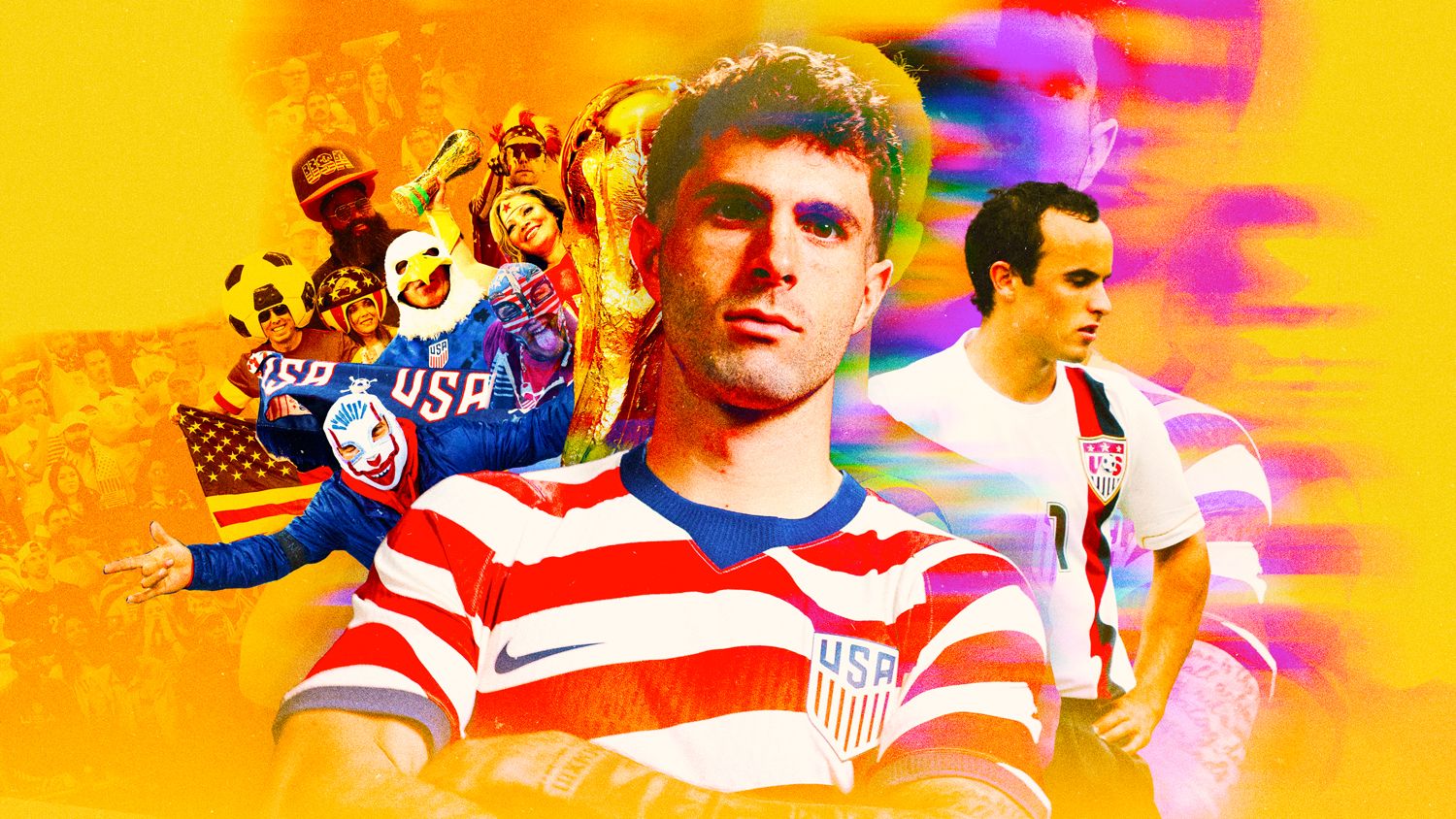
Perhaps the player who can most relate to what Pulisic is going through is former U.S. international Landon Donovan. Pulisic has long since passed Donovan in terms of club achievements, but at international level, Donovan still has the longer résumé, and was easily the team's most recognizable player during his heyday as a U.S. international during the 2000s.
Donovan was a young upstart when the U.S. reached the World Cup quarterfinals in 2002, but in 2006, when he was the clear face of the team, he crumbled under the weight of expectations. He made amends in 2010, scoring three goals, including an iconic game winner against Algeria that put the U.S. into the round of 16.
"I loved [the pressure], and then I failed miserably in 2006," Donovan, who now hosts the "Unfiltered Soccer" podcast with former U.S. teammate Tim Howard, said to ESPN. "And that was a really hard feeling because you realize that along with all the attention and accolades, there's criticism if you don't do well."
For Donovan, it was all a matter of channeling the pressure in a constructive way.
"You realize as you get older -- and in 2010, I realized this very clearly -- pressure is all perception, right? So it's all what you believe or don't believe. It's all in your mind," he said. "So if you feel it, that's your issue. And so I chose to channel it in a, 'Yeah, I want to be the man. I want the ball. I want to take the penalty kick. I want to score the goal.' And I think if you handle it that way, then you're not going to really see that pressure. And I think Christian can do that."
Every player is different, especially when it comes to handling the mental side of the game. Bruce Arena, USMNT manager from 1998-2006 and 2016-17, coached both players. He sees similarities between the two as players, but differences in personality.
"Christian's more reserved than Landon," Arena, who now manages the San Jose Earthquakes, told ESPN. "Landon always sees the big picture, and I think his interests are all over the place. I think Christian's a little bit more reserved, probably a little bit more focused as a football player. I don't think he's allowing too many distractions to get in his way. So they're both different, but there's no reason to believe that Christian won't be successful."
As high as the expectations are for Pulisic, he'll need his teammates to step up in a way that he can pull them along rather than be forced to carry them. The goalkeeping will need to be solid. Ditto for a backline that in recent friendlies looked rickety.
The U.S. attack will need to complement Pulisic as well. In previous cycles, the approach of many opponents was to simply foul Pulisic whenever he got on the run and dare other players to beat them. Against the top teams in the world, that tactic has often worked.
"Part of the challenge with the national team over the last five years or so is that he had to do everything," Donovan said of Pulisic. "If we were going to score or have a big moment, it really had to be him."
At the 2022 World Cup, while Pulisic led the team with nine chances created in four matches, his 11 fouls suffered were more than double the second-highest mark of Tyler Adams, with five.
This time around, the U.S. has three in-form strikers on the roster in AS Monaco's Folarin Balogun, PSV Eindhoven's Ricardo Pepi and Coventry City's Haji Wright. Balogun, in particular, has been playing at a high level, excelling in both Ligue 1 and the Champions League.
"It's going to allow Pulisic to not have so much pressure to produce on the score sheet all the time and just be a really menacing player to play against," Donovan said about the play of the American forwards. "And I think that's when he's at his best."
It's why Pulisic calls this U.S. side the most "well rounded" that he has played on. There are other talented playmakers on the team as well, such as McKennie and Bayer Leverkusen's Malik Tillman, but Balogun is the key, with his combination of mobility, hold-up play, passing and finishing giving the U.S. the kind of threat it has rarely had. Balogun has scored against Europe's best, including three goals this season against two-time defending Champions League holders Paris Saint-Germain.
It's a development that has provided Pulisic with no small measure of comfort.
"It feels like every week, [we're] just seeing [Balogun] score goals. And at the end of the day, if your striker's doing that, I think you're in a good spot and he's doing a great job," Pulisic said. "I think he's also someone who went through some ups and downs and then just comes out the other side, and just with hard work and dedication and his resilience has also been extremely impressive."
Pulisic has also experienced some peaks and valleys of his own throughout his career. His time at Chelsea was marred by persistent injuries and was looked at as something short of successful despite the Champions League triumph. Last summer, he was criticized for skipping the Gold Cup, which morphed into a frosty, public exchange with U.S. manager Mauricio Pochettino.
Pulisic later insisted that the coverage of his situation was overblown and that he and Pochettino have "a good relationship." When Pulisic started the season on fire for AC Milan, it seemed to validate his decision to get some rest.
But this calendar year hasn't been as kind. He didn't find the back of the net for club at any point in 2026, and only scored his first goal for country this year on Sunday. He went through a similar spell prior to the 2022 World Cup, where he had one goal and one assist for Chelsea across 14 appearances totaling 505 minutes, and ended up performing well in Qatar.
The current situation feels different, however. Some of what is ailing Pulisic is down to personnel at Milan, where there is no Balogun-like forward to shoulder some of the attacking burden, yet he's still expected to be the primary attacking weapon. But Pulisic hasn't looked himself either. One critique from Italian outlet Gazzetta dello Sport, following a 2-0 loss to Sassuolo on May 3, said he looked "tormented," that "Pulisic has become unrecognizable."
That said, club form need not carry over to the national team. A different environment with different players can go far to shedding difficulties with a club. Pulisic himself proved that less than four years ago, and backed that up on Sunday with a goal and an assist in a friendly against Senegal.
"Everyone feels pressure, no matter what," he said. "I feel really privileged to be in this position and play for the U.S. team and [at a] U.S. World Cup. I try to enjoy it."
Nothing will make people forget Pulisic's club struggles like a successful tournament. As Donovan's goal in 2010 against Algeria -- and even Pulisic's against Iran -- showed, iconic moments leave an indelible mark on people's collective memories and erase moments of difficulty.
Pulisic is intent on creating even more of those memories. If he succeeds, his star will shine all the brighter, with the entire country watching.
Source: https://www.espn.com/soccer/story/_/id/48939119/christian-pulisic-legacy-defining-moment-2026-fifa-world-cup-landon-donovan-knows-whats-stake