Tim VickeryJun 20, 2026, 03:18 AM ET
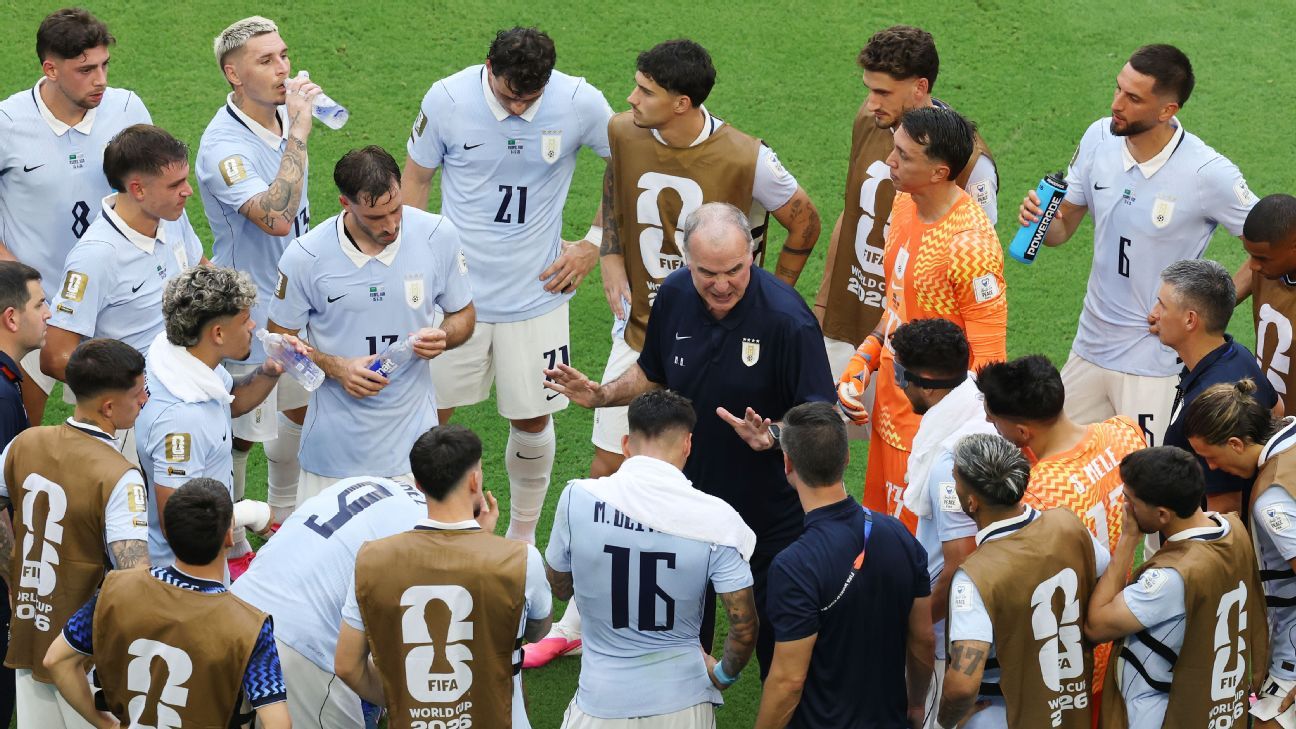
Did Marcelo Bielsa's Uruguay finally get its groove back in that second half against Saudi Arabia?
After a thoroughly undistinguished start, they fell behind five minutes before halftime, and spent the next 40 minutes staring straight at disaster. With an exuberant Cape Verde and Spain still to come, a humiliating early exit was a real possibility.
That chance still exists, of course, but at least Uruguay came away from the 1-1 draw against Saudi Arabia aware that they should have won and that they had created more than enough opportunities to seal victory.
And it has been a while since they have done that against serious opposition. Bielsa's halftime reorganization paid off. And if his side have got their groove back in the United States, then there is something fitting in that -- because it was there that they lost it two years ago.
It seems a long time ago now, but Bielsa made an excellent start in charge of the Uruguay national team. It always looked like an interesting fit. The squad needed a generational change as several of the group that got eliminated in the group stages at Qatar 2022 had gone to South Africa 2010 (and one, 40-year-old goalkeeper Fernando Muslera, has since been recalled).
Available to the new coach were a core of dynamic young players who seemed well equipped to play the Bielsa way -- with his hard-running high press, strangling the opposition in their half of the field, creating two-against-one situations down the flanks. For a while, Uruguay were South America's in-form team; they beat Argentina in Buenos Aires, beat Brazil with a level of domination that few could recall and started the 2024 Copa América in the United States like a train.
But during the course of that competition, the wheels came off. Luis Suárez retired from the national team, making a point to blast the dreadful atmosphere that the coach was creating. No one from the dressing room came forward to disagree.
Bielsa himself has added weight to these accusations, describing himself as a "toxic" person who is difficult to be around. It could be that his brand of aloof eccentricity is not to the taste of the contemporary young player, who is looking for greater communication.
For whatever reason, that Copa América proved to be a turning point and Uruguay's form afterwards was consistently disappointing. Going into the tournament, they were comfortably the top scorers in South America's World Cup qualification campaign. And then they failed to score in eight of the last 12 rounds. Worse, they were not even creating chances, and for a Bielsa side set up to take the initiative and dominate the opposition, this was almost unthinkable.
There was no improvement in the subsequent friendlies. Things even got worse, with a humiliating 5-1 defeat to the United States in November, where Bielsa had to watch his ideas put into practice far more effectively by Mauricio Pochettino, someone on whom he exerted a great influence. Incidentally, the USMNT's easy 4-1 win over Paraguay stands as a tribute to Bielsa's principles -- while the man himself has been stumbling around in the dark.
After 18 World Cup qualifiers, a Copa América and friendlies in October, November and March, Bielsa appeared to go all the way back to the drawing board. His side had no pre-World Cup friendlies. Instead, he worked on the training ground, unveiling a rethought, rebooted lineup for the Saudi Arabia game.
Back in his time in charge of his native Argentina, Bielsa was frequently criticized for not selecting both of his in-form center forwards, Gabriel Batistuta and Hernán Crespo. He was adamant, as in his system there was only room for one striker of this type, who would feed on crosses coming in from wingers on either flank.
This, too, was his model for Uruguay. But now, taking the field in Miami were both Darwin Núñez and Federico Viñas. And with midfielder Manuel Ugarte often slotting in between the center backs, much of the attacking width would be supplied by the wing backs, Guillermo Varela down the right and Matías Viña on the left.
Viña could link up with Maxi Araújo, while Varela's partner was Real Madrid's Federico Valverde, the team's outstanding player, who would now have a corridor down the right to drive forward.
Whatever the thinking behind the new formation, in practice, it proved a massive disappointment. The twin strikers would need crosses, but there were none. With a recent injury record and badly out of form, Viñas was a strange choice to be handed an attacking role down the left.
And Valverde on the right struggled to make any impact on the game. The strikers tried to survive on scraps, with Núñez barely making an impact. After the game, Bielsa was scathing about his team's first-half performance.
And so, after the interval, in place of the reboot came the old boot. Off came Viñas and Núñez and Uruguay reverted to Bielsa's traditional 4-3-3, with Araujo back on the left wing, Agustín Canobbio coming on to work the right flank, Valverde now centralized and free to roam.
And if they did not come across as a replica of the in-form pre-Copa América Uruguay, at least they were moving in the right direction, looking like a genuine Bielsa side, squeezing the play, dominating the game and coming away justifiably disappointed that they had not won the game.
They are back in the Miami sauna next Sunday to face Cape Verde. The African side have a decision to take: will they look to defend with the same dedication they displayed against Spain, secure a draw and seek to get into the last 32 with a win over Saudi Arabia?
If so, then holding Uruguay at bay will present a different challenge. Instead of Spain's patient passing, they will now face a Uruguay who appear to have remembered how to put their opponent under frenetic pressure.
Bielsa -- probably to the relief of some of his players -- is stepping down after this tournament. At the age of 70, there may not be too many major coaching jobs ahead of him. For the moment, though, he is in charge of a national team with massive tradition and heavyweight expectations. There were times against Saudi Arabia when it looked as if Bielsa might only be two games away from the end.
That remains a risk, but at least now morale is higher as Uruguay go in search of a win over Cape Verde that could add a game or two onto Bielsa's top-class career.
Source: https://www.espn.com/soccer/story/_/id/49107794/did-marcelo-bielsa-uruguay-stop-their-world-cup-unraveling