Wednesday's deadly earthquakes are the first major crisis confronting Rodriguez. But the disaster has stirred up anger over government mismanagement.
Caracas, Venezuela – On the side of a busy road, waiting for a bus heading towards Caracas, Mairet Perez flicks through her phone, pointing at colleagues, friends and family from her home state of La Guaira.
“Gone,” she says matter-of-factly, biting her lip, before moving on to other photos showing heaps of shattered concrete.
Beneath the slabs are some of their bodies, she explains. Dozens of people are missing — or dead.
The death toll following the twin earthquakes that hit Venezuela on Wednesday evening is creeping towards 1,500, with about 50,000 people registered missing on a crowdsourcing website.
On the long journey from the Colombian border, arms packed with supplies for those affected, Perez gets a call — more devastating news. Her daughter’s father, his wife and their nine-year-old son have been found. They didn’t make it.
“Everyone in La Guaira is searching and digging out people with their bare hands,” Perez says. “And the government? What have they done? Nothing!”
She adds there are still areas where the government has not even accessed yet.
While the initial mood in Venezuela after the earthquake was one of panic and anguish, frustration and anger are now mounting over the government's response.
For interim President Delcy Rodriguez, the disaster marks the biggest challenge of her presidency so far. As the death toll rises and rescue efforts continue, she faces growing pressure to show her government can coordinate an effective response.
In the hours after the earthquakes hit, Rodriguez called a state of emergency, offered her condolences to those who had lost loved ones, and appealed for international assistance.
But what came next was what many observers describe as a slow and uneven emergency response.
“The government response is anything from totally non-existent to, at best, completely inadequate,” said Phil Gunson, a senior analyst and Venezuela expert at the International Crisis Group, a nonprofit think tank.
He explained that, over the past decade, Venezuela’s economic crisis — rooted in mismanagement, corruption and sanctions — has severely weakened the country’s emergency response systems, along with public services for health, water and electricity.
"Now they lack budgets, personnel, equipment, leadership and planning," Gunson said.
International aid and rescue teams have filled the gap. More than 20 teams have now arrived, including from El Salvador, Spain, Qatar and the United States.
But Gunson said it’s not enough to give the Rodriguez government legitimacy during the crisis.
"Even with US assistance, the government is incapable of demonstrating efficiency in dealing with the catastrophe," he said.
On social media, some users have criticised what they describe as delays or obstruction in the deployment of rescue teams and humanitarian aid.
A team of Colombian firefighters, for instance, was reportedly detained for several hours at Venezuela's main airport, outside Caracas, before being permitted to enter the country.
The Rodriguez administration, meanwhile, has sought to limit access to La Guaira and other hard-hit areas, preventing entry for those without government authorisation.
But in the coastal state of Falcon, local residents broke through a security cordon with spades, frustrated by what they said was a lack of official assistance.
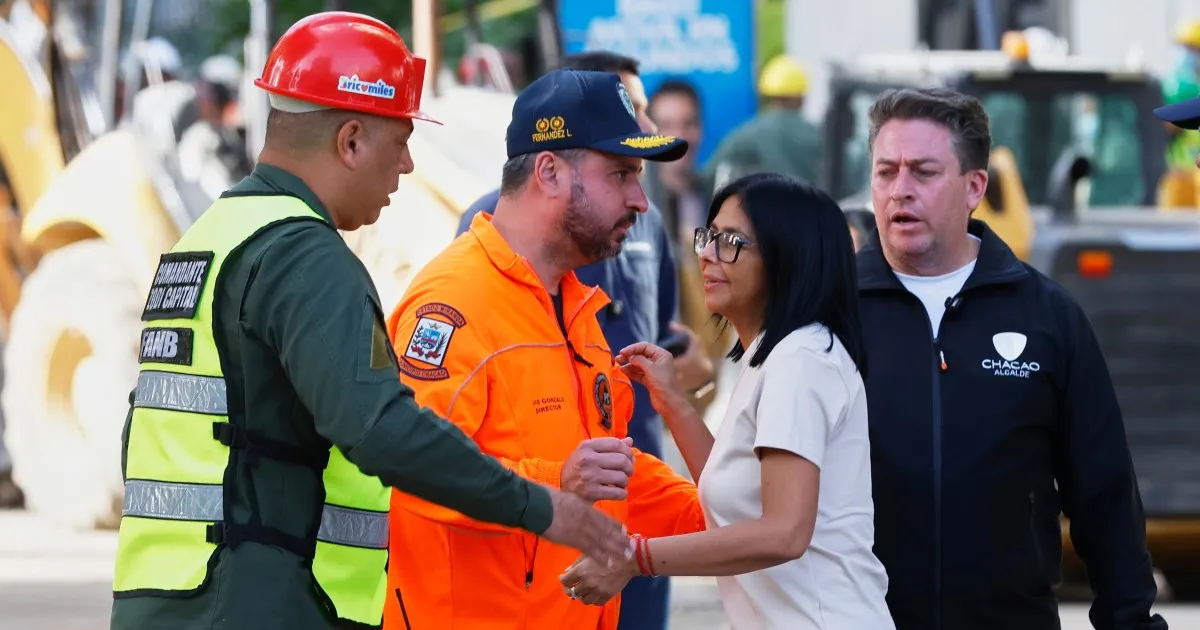
In the Caracas neighbourhood of Chacao on Friday, President Rodriguez was met with boos as she met with residents affected by the disaster.
An employee for a nongovernmental organisation, who asked not to be named, has been assisting with donations after the earthquakes. He told Al Jazeera he expects public anger to sour even further.
"Companies, universities, high schools, gyms, even delivery services — most sectors of society have tried in their own way to do something," he said.
He stressed there was one notable exception: the military.
The military's relative absence, the employee said, was a stark contrast to its heavy presence after the contested 2024 presidential election, when protests filled the streets.
"People still remember dozens or even hundreds of military personnel attacking protesters, and endless buses bringing people to the PSUV's ruling party rallies," he explained, using an acronym for the United Socialist Party of Venezuela.
“But that level of mobilisation is absent in the light of this tragedy.”
In the 2024 election, then-President Nicolas Maduro claimed he had won a third term, though published vote tallies contradicted his government's assertions.
Maduro, however, was abducted and imprisoned as part of a US military operation on January 3. He remains in custody on drug trafficking charges.
While some restrictions on civic space have eased following Maduro's capture, activists say the fear of surveillance and retaliation still hangs over nongovernmental organisations and civil society groups in the country, particularly those critical of the state.
In 2024, after all, Venezuela passed a law barring such groups from operation without the government's authorisation.
The law forced many organisations to shut down or operate in secret, hampering their ability to respond to Wednesday's earthquakes.
Where the military has perhaps been most visible during the crisis has been on the periphery of the restricted zones affected by the disaster.
Soldiers have been deployed to regulate access. Those wanting to enter have to register in Caracas. Journalists are allowed into the area only if they are escorted in government buses.
But Venezuelans like Perez, anxious about loved ones, just want to get home.
As she reaches the west-central city of Barinas, Perez huddles at a bus stop with a group of other passengers, many of them waiting for connections and voicing frustrations at the government’s handling of the crisis.
"It’s absurd. They have been so slow like always," Perez says, explaining her community hasn’t had enough spades, helmets or information about what is happening.
Despite the criticism, President Rodriguez has sought to project an image of control and organisation during the crisis.
After the ousting of Maduro, Rodriguez — his former second-in-command — was placed at the helm of the Venezuelan government with the support of US President Donald Trump.
But as one of the most prominent faces of the United Socialist Party of Venezuela, she remains deeply polarising.
"She is very unpopular outside of the ruling party. She is seen as part of the problem, since she was number two under Maduro," said Javier Corrales, a political scientist at Amherst College.
"Even within the ruling party, some leaders, though not all, see her as a traitor to the cause because she aligned herself with the United States."
If her cooperation with the US turns out well, Corrales believes Rodriguez might regain some popularity. But for many, she will always be seen as an "accomplice" in the damage the Maduro government has done to Venezuela.
"People will know that the nation was impacted by this natural disaster not just because of the magnitude of the earthquakes, but by the poor conditions on the ground — which people will attribute to the ruling party," Corrales said.
Wednesday's earthquakes were not the first to strike Venezuela. Situated on the border between two tectonic plates, the South American country has weathered multiple seismic disasters over the last century.
After a 6.6-magnitude earthquake struck Caracas in 1967, building regulations were updated to ensure structures would not collapse.
"The standards became seismic-resistant, with stricter requirements, and buildings were designed to be more flexible rather than rigid so they can move and withstand earthquakes," said civil engineer Jose Norberto Baussan, who is also an expert on engineering standards and maintenance in Venezuela.
He believes the standards have generally been followed, although other factors can affect how buildings perform during earthquakes, including unstable ground conditions, differences in topography and proximity to the sea.
"But regarding construction rules and periodic inspections, I think we have a major weakness. The authorities responsible for reviewing and inspecting construction projects are, well, not the most effective," he said, adding that height restrictions for buildings also need to be improved.
Natural disasters have long shaped the public's opinion of government. And it is so far unclear how Wednesday's earthquakes might affect Rodriguez, who has been president for only six months.
"There will be an inevitable political impact of this earthquake, but the precise way it plays out is hard to predict," said Gunson, the Venezuela analyst. "In other parts of the world, natural disasters have either worsened existing crises or forced their resolution."
He added that — under Rodriguez's PSUV predecessors, Hugo Chavez and Maduro — rebuilding in the wake of natural disasters had been plagued by corruption and poor planning.
As a result, some of those structures fell short of construction standards. That was likely a factor in the number of collapsed buildings on Wednesday.
"There are people who spent years in shelters after losing their houses to floods and landslides and who have once again lost everything," Gunson said.
He pointed to "the poor quality of the public housing that the Chavez and Maduro governments rushed to construct in a bid to garner public support — but bypassing municipal regulations and using shoddy construction methods".
The backlash to Venezuela's government could ultimately have electoral repercussions.
For the last quarter century, Venezuela has been governed by a socialist president, whether Rodriguez, Maduro or Chavez.
But since Wednesday's earthquake, opposition leader Maria Corina Machado has sought to return to Venezuela, after being smuggled abroad in December to receive the Nobel Peace Prize.
Trump administration officials have reportedly dismissed Machado's efforts as a "political stunt". Machado is a likely candidate for president in a future election.
But Gunson believes the push to schedule a vote will be overshadowed by the present tragedy and its towering human toll.
“The likelihood is that talk of political transition will be shelved for now, or at least that any transition timetable, already extremely uncertain, will be pushed back,” Gunson explained.
But others argue it’s possible that Rodriguez could use the crisis to bolster her position. Millions of dollars of aid are due to flow into Venezuela — and that money could work in her favour.
"The Venezuelan government may end up doing what it has always done with windfalls — divert a good portion of those prior windfalls to co-opt key groups of both elites and potential voters," Corrales said.
"That is, it could do a combination of cronyism and clientelism. This approach could boost the government's electoral competitiveness."
Source: https://www.aljazeera.com/features/longform/2026/6/29/venezuelas-earthquakes-pose-first-major-test-for-president-delcy-rodriguez?traffic_source=rss