Jeff CarlisleJun 28, 2026, 03:10 AM ET
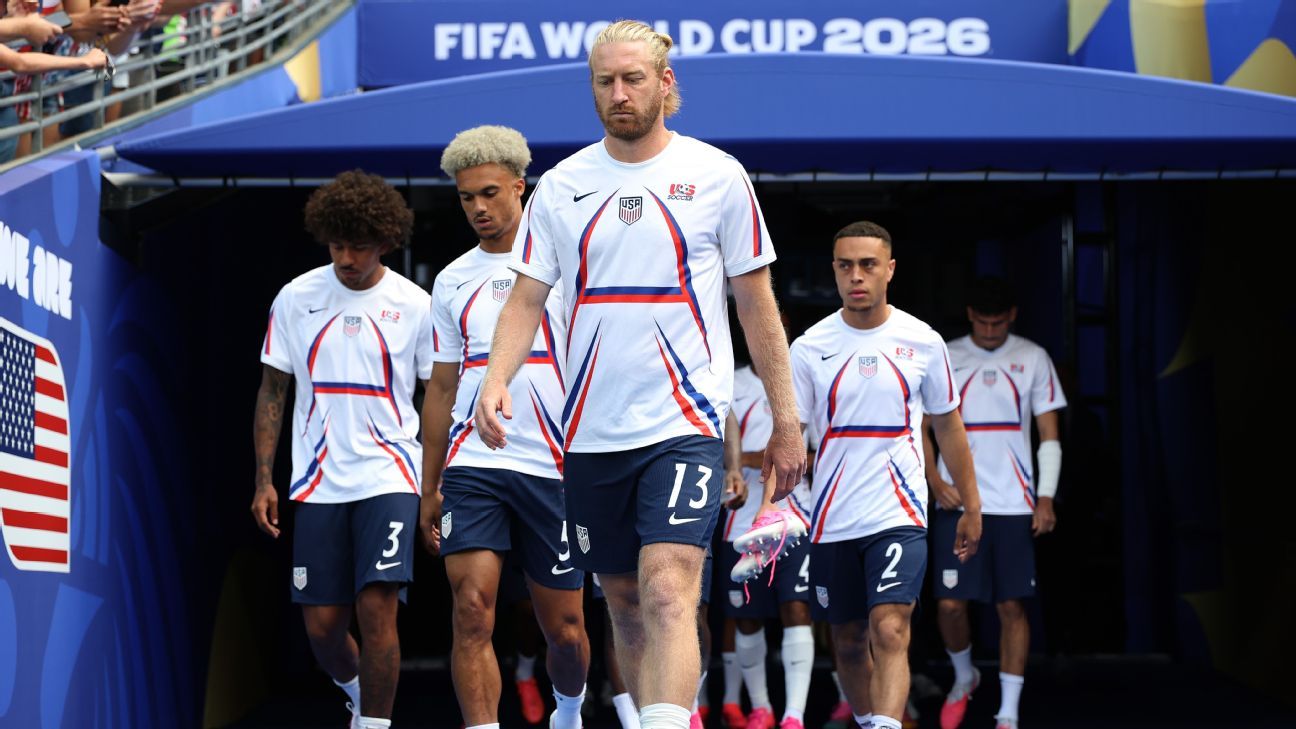
IRVINE, Calif. -- If an alien were dropped into the middle of a gathering of U.S. men's national team players and said, "Take me to your leader," said species would be met with quizzical looks. Sure, some might point to U.S. captain Tim Ream, but a quick look at the roster reveals it is rife with leaders of different types and temperaments.
There's midfielder Weston McKennie, a lively character who is quick with a joke in a bid to keep the mood light. There are the likes of midfielder Tyler Adams and defender Chris Richards, more vocal leaders who aren't afraid to bark at teammates. And then there is Ream, 38, the wizened sage, constantly reading the room to dole out advice or an encouraging word to a teammate who might be struggling. That is by no means the total list of players with leadership qualities, either.
"There are so many guys that are in this changing room that have the ability to lead and have things and moments where they can speak up," Ream told ESPN in an exclusive interview from the team's training base.
All of this makes for a flatter, less hierarchical leadership structure than there has been in the past. Gone is the "Leadership Council" from the last cycle in which then-manager Gregg Berhalter relied on a few players to bounce ideas off of. To be clear, there isn't one right or wrong way to designate leaders, or rely on the advice of a few key players. But in the past, Ream has spoken of how the current approach makes for a broader pipeline of communication, which he feels lessens the odds of a crisis emerging because players feel heard.
It's why when Ream was named captain of the World Cup squad back on May 30, one of the first things he did was reach out to the other leaders on the team with a simple message: Just because he was captain, didn't mean he was the only leader. He couldn't lead the team by himself.
"There's just too much going on," Ream said about his desire to lean on other leaders. "The dynamics are always moving, so I want those guys to speak up. I want them to voice their opinions. I want them to be the guy that I can go to, that other guys can go to. They don't have to come to me.
"So it was just a, 'Hey, like nothing really changes. I want everybody to speak up. I want guys to feel comfortable. Just because I've been named captain, doesn't mean that that anything changes. You know that.' And that was the big thing for me; I need them to help me be the eyes and ears and make things flow the way they always do."
It helps that the likes of Adams, McKennie and Richards have all served as captains in the past. Their longtime standing with the USMNT means they have a platform to speak, whether they are captain or not.
"I think with the chemistry that we have throughout the group, I think the captaincy thing is honestly anybody could wear it," McKennie told reporters prior to the team's friendly against Senegal. "I think a lot of guys here, as long as you guys have the common goal and have the common vision of what you guys want to do, I think the captaincy band is honestly just a symbol of who the referee talks to."
Most of the time, this is true. With Ream on the bench, McKennie wore the armband in the defeat against Türkiye. But anyone who tuned into the prematch news conference for the game between Iran and the U.S. at the 2022 World Cup will recall that sometimes captains are thrust into roles that they didn't know they had signed up for.
On that day, Adams and Berhalter were peppered with questions from Iranian reporters about, among other things, an offending social media post by the USSF that removed symbols from Iran's flag, discrimination in the U.S., the negative effects of inflation in the U.S., and whether they are aware that U.S. citizens are allowed to travel to Iran but not vice versa. Adams was also chided by an Iranian reporter for mispronouncing "Iran."
Showing the skills of a seasoned diplomat, Adams apologized for the mispronunciation, defusing the tension.
"I'm happy I don't have to hopefully answer any questions about it now. Let's just say that," Adams told ESPN as he partnered with Nike on a mini-pitch rededication in Poughkeepsie, New York, right near his hometown of Wappingers Falls. "But I think that for me, I answer everything pretty openly and honestly, I'm a pretty direct person. People know that with me, it's pretty black and white. I wasn't really phased by the situation. Again, I just rely on the experiences that I've been through in order to answer openly and honestly."
That approach applies to his interactions with the team as well.
"Whether I'm wearing the armband or not, I yell at people. I get on people. That's my nature, that's how I am, that's how I lead," he said. "So yeah, I think it's important to have a guy that people can rely on in any circumstance to go to and make sure that they convey that message."
While the U.S. has multiple players that can fill the role of captain, it is now Ream's responsibility, one to which he attaches a certain reverence. He insists it's not something he uses to put himself on a pedestal. Rather, he views the role as a bridge between the players and the USMNT's various departments, be it the coaching staff, the medical team, or the training staff.
For Ream, being named U.S. captain was "very unexpected," because it wasn't something he was thinking about, even as he had been named captain for matches earlier in Pochettino's tenure. His previous experience as captain at Premier League side Fulham made speaking his mind about issues second nature. That said, when the announcement was made by Pochettino, the rock-solid veneer of the usually stoic Ream cracked a bit. Pochettino's words were certainly heartfelt.
"I am so grateful that [Ream] is with us and because [he] is a great captain, not only on the field ... maybe more important off the field," Pochettino said in announcing Ream's captaincy. "And I think he has the experience, he has the capacity to be the leader that we want, the positive leader acting and reflecting on the field, off the field."
Ream's 16 years as a professional soccer player have given him a veritable Ph.D. in human behavior. He's seen the entire spectrum of selfishness and selflessness, and it has given him a finely tuned sense of what to say and when to say it. Or when not to.
"Look at body language. Look at eyes. Listen to the tone in other people's voices when they're speaking; positive, negative. You know, it goes both ways," he said. "Sometimes you can add onto the positive language and sometimes you can feel the kind of negative energy and you know, you just kind of stop it or try to flip the script and give a little bit of a more positive tone, positive language positive eye contact, body language, that kind of thing."
He added, "'How' is also a thing because you don't want to come across as arrogant or all-knowing. You have to have different tones with different people."
When watching teams come out of the tunnel for warmups or the kickoff, there's the usual shouting and pumping people up. There's almost a primal release that needs to take place. That isn't Ream's preferred venue for communicating. Instead, he opts for when people aren't watching to do his leading.
"I don't need everybody to see the one-on-one conversations or the small group discussions that that we're having," he said.
There's no hiding on the field, however. In the heat and intensity of the moment, there's no point in waiting for the perfect time to say something. Oftentimes that moment is now. But again, for Ream, there is an assessment of the situation that takes place that influences how and what is said.
"If I see a little bit of deer in the headlights look on the field, it's, 'OK. Now I know I need to say something.' If I see a steely focus, there's nothing to be said. Guys are locking in."
Locking in aptly describes the USMNT so far. As the U.S. heads into the round of 32 against Bosnia-Herzegovina, you can bet that Pochettino and his staff will be constantly taking the pulse of the team to make sure they are operating at their peak.
The team's leaders will be doing the same.
Source: https://www.espn.com/soccer/story/_/id/49196528/usmnt-squad-full-leaders-world-cup-knockouts-not-just-captain-ream