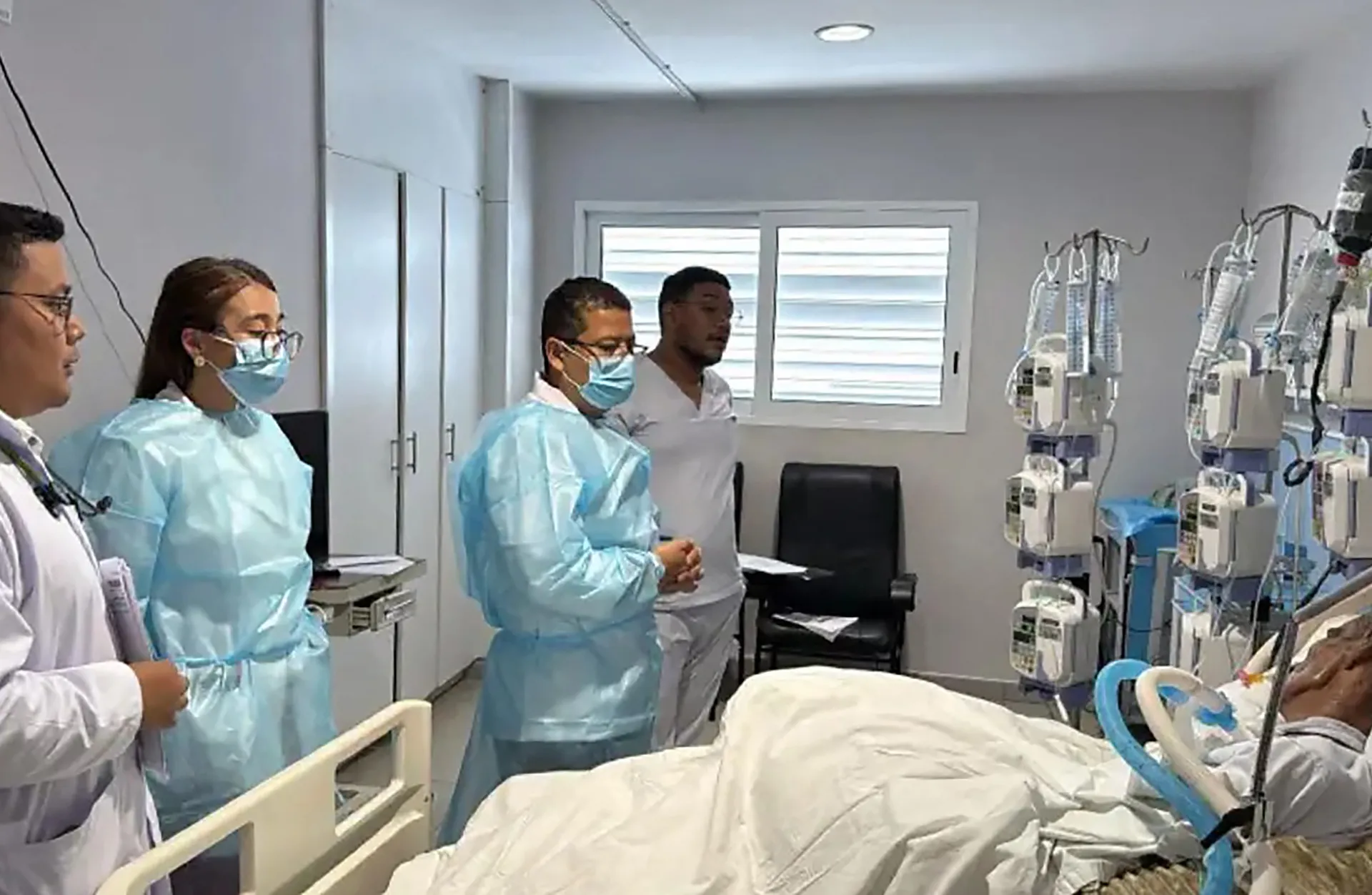
The death of Indigenous leader Brooklyn Rivera has prompted calls from UN experts for an independent investigation.
The administration of United States President Donald Trump has increased its sanctions on Nicaraguan officials following the death of Indigenous leader Brooklyn Rivera while in government custody.
In a statement on Monday, US Secretary of State Marco Rubio described the circumstances of Rivera’s death as “horrific”.
list 1 of 3Nicaragua frees dozens of prisoners amid pressure from Trump administration
list 2 of 3Nicaragua’s president says Trump ‘mentally deranged’ over war on Iran
list 3 of 3Nicaragua confirms death in custody of Indigenous leader Brooklyn Rivera
He also underscored that the government of Daniel Ortega and Rosario Murillo — spouses who share Nicaragua’s presidency — had held Rivera as a “political prisoner”, as part of their campaign to quash dissent.
“Today the Trump Administration took decisive steps to impose additional visa restrictions on more than 100 dictatorship officials and their family members,” Rubio said.
“With this new set of restrictions, the US government has now taken steps to impose visa restrictions on over 2,350 Nicaraguan officials and their family members for their complicit role in Rosario Murillo and Daniel Ortega’s dictatorship.”
The Murillo-Ortega government has long faced criticism for its treatment of perceived dissidents, who have faced imprisonment, forced exile and the removal of their citizenship.
Successive US administrations have criticised Nicaragua for its human rights record. But that scrutiny has increased in the wake of Rivera’s death last week.
Rivera, 73, had been held in government custody since September 2023, with little to no contact with the outside world.
His sudden death last week came shortly after the Nicaraguan government released photos of him bedridden and intubated in a medical facility.
Those photos prompted outcry from the international community, as well as Rivera’s family, who demanded access to the imprisoned activist, as well as proof of his welfare.
On May 27, his daughter Tininiska Rivera issued a statement denouncing the “undignified, inhumane and degrading conditions” in which her father was held.
“On the day my father was taken, September 29, 2023, he left his home in optimal health,” Tininiska wrote. “The regime cannot now claim to blame pre-existing conditions for the physical deterioration of a man who has remained in state custody for three years.”
Several days later, on May 31, the Nicaraguan government announced Rivera’s death, citing organ failure.
That news only heightened the outrage. In its aftermath, a group of United Nations experts described Rivera’s death as part of a “broader pattern of violations against Indigenous and Afro-descendant peoples” in Nicaragua.
It called for an independent autopsy to determine the cause of Rivera’s death, as well as the return of the activist’s remains to his family.
“Failure to conduct an independent investigation and return the remains reinforces the strong presumption of State responsibility for Brooklyn Rivera’s death in state custody,” one of the experts, Jan-Michael Simon, said in a statement.
The UN group noted that 124 Indigenous leaders in Nicaragua had been subject to arbitrary detention between 2018 and 2024, Rivera among them.
Rivera was a representative for the Miskito, an Afro-Indigenous people who live along the Caribbean coast of Nicaragua and Honduras.
For much of his career as a politician and activist, Rivera clashed with Ortega’s Sandinista movement. Starting in the late 1970s, he fought the first Sandinista government as part of the Misurasata armed group, prompting him to go into exile.
Later, the political movement Rivera co-founded, Yamata, would strike a brief detente with Ortega after the left-wing leader returned to the presidency in 2007.
But relations frayed once more, particularly amid tensions over access to resource-rich Indigenous land.
In 2023, during the months prior to his detention, Rivera travelled to Geneva to address a UN forum, where he was critical of the Ortega government. He was subsequently banned from re-entering Nicaragua, but he smuggled himself in, opting to live in hiding.
Authorities then arrested him on terrorism-related charges. He was held in custody until his death.
Ortega has long faced criticism that his government was actively silencing dissent, but that campaign intensified in 2018, after widespread anti-government protests.
Hundreds of people were arrested during that protest movement, and at least 355 people died. Since then, the government has moved to restrict the activities of nonprofits, church groups and media outlets, forcing many to shutter.
In a 2025 report, the nonprofit Human Rights Watch estimated that nearly 5,600 non-governmental organisations have been forced to close their doors since 2018, limiting oversight of government activities.
Approximately 1,500 were terminated on a single day in August 2024, after their legal status was abruptly cancelled.
In 2023, the Ortega government also undertook the mass expulsion of political prisoners, sending activists, politicians and religious figures abroad, then stripping them of their property and their citizenship.
Critics note that such an expulsion rendered the political prisoners vulnerable and stateless, reliant on foreign governments and family abroad for support. The effort was also seen as an attempt to deport those who might pose a threat to Ortega’s leadership.
Ortega’s actions to stifle dissent have been coupled with an effort to consolidate power.
Nicaragua’s Sandinista-stacked National Assembly has approved reforms that would extend presidential terms to six years, allow the appointment of unlimited vice presidents and allow greater army involvement in police matters.
Ortega also elevated his wife, Murillo, from vice president to co-president. In the case of Ortega’s death, the reforms would allow Murillo to succeed him without the need to call for new elections.
Since returning to office for a second term in 2025, Trump has taken an active interest in Latin American politics, including by weighing in on the region’s elections.
He has repeatedly backed right-wing candidates to replace left-wing leaders and has threatened to withhold US financial support, depending on election outcomes.
In Venezuela, Trump also authorised a military operation on January 3 to remove then-President Nicolas Maduro, longtime adversary — a move widely denounced as a violation of international law. He has since threatened Cuba with military action as well.
Nicaragua has not faced as much scrutiny from Trump, though Rubio has repeatedly mentioned it in the same context as Cuba and Venezuela. The secretary of state has also labelled the Ortega-Murillo government as an “enemy of humanity”.
In Monday’s statement, Rubio reasserted US support for human rights activists in Nicaragua.
“The United States stands with the Nicaraguan people who, like Rivera, aspire to see a free Nicaragua,” he wrote.
Source: https://www.aljazeera.com/news/2026/6/8/us-imposes-restrictions-on-100-nicaraguan-officials-after-activists-death?traffic_source=rss