Evacuated from Gaza for life-saving medical care, Palestinians stripped of their documents are confined inside a Baghdad medical centre.
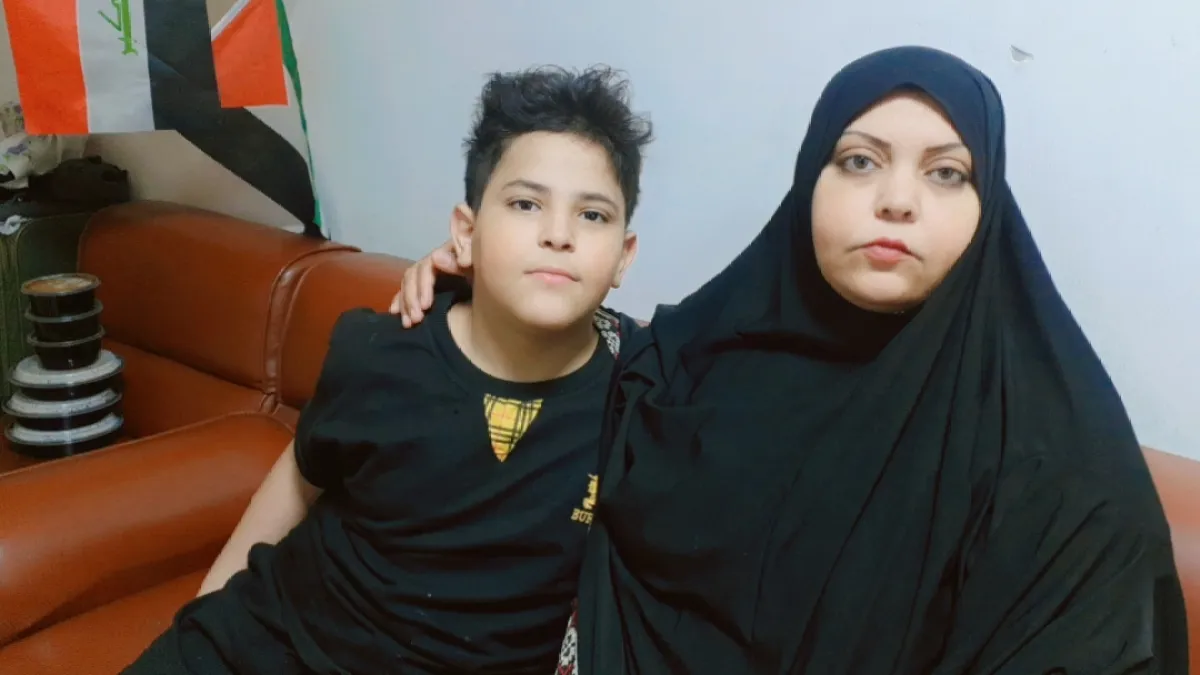
More than two years ago, Gaza resident Hanin Muhammad accompanied by her 39-year-old sister Sabreen, a kidney transplant recipient, was flown to the Iraqi capital Baghdad for medical treatment. But Muhammad has since been confined to the Private Nursing Home Hospital inside Baghdad’s Medical City complex, thousands of miles away from her home in Gaza, as her travel documents have been confiscated by Iraqi authorities.
“My six children are in Gaza, and I am entering my third year without seeing them,” 40-year-old Muhammad told Al Jazeera.
list 1 of 4Burn-like rashes and hunger: Gaza’s children face skin disease crisis
list 2 of 4For third year in a row, Israel blocks Hajj pilgrimage for Gaza Muslims
list 3 of 4Palestine weekly wrap: Ben-Gvir’s abuse of flotilla detainees causes outcry
list 4 of 4Gaza parents brave dental dilemma: Costly treatment or food on the table?
Her family home in Rafah was destroyed by Israeli forces, forcing her children to be displaced into makeshift tents located between Rafah and Khan Younis.
“I check on them through other people because they lack internet connection. I am begging anyone to intervene so we can get back to Egypt, register, and see our children,” she said. Currently, Palestinians can go in and out of Gaza only using the Rafah crossing, which opens into Egypt.
Muhammad, who travelled to Iraq as a medical companion to her sister, is part of a forgotten cohort of 46 Palestinians evacuated to Iraq, comprising 21 patients and 25 family escorts.
According to health authorities tracking the group, the clinical breakdown of the patients highlights the severity of their conditions, which include five oncology patients, four suffering from blood disorders, one cardiac patient, one kidney disease patient, and 10 patients wounded in the ongoing genocidal war that has killed nearly 73,000 Palestinians and wounded more than 172,000.
The group was flown to Baghdad in March 2024 on a military aircraft in coordination with the Iraqi and Egyptian governments, with a symbolic presence from the Palestinian Embassy in Cairo.
These rare evacuations highlight a much broader medical crisis back home. According to Gaza’s Health Ministry, more than 20,000 patients and wounded people are currently waiting to travel abroad for medical treatment.
Zaher al-Waheidi, head of the ministry’s Information Unit, reported that 1,200 children in Gaza now suffer from spinal cord injuries and paralysis directly resulting from Israeli attacks, while some 4,000 children require urgent treatment abroad.
Despite the overwhelming need, official data provided by al-Waheidi shows that only 154 children have been allowed to leave Gaza since the Rafah crossing, the enclave’s only gateway to the outside world, partially reopened in February amid heavy Israeli restrictions.
The crisis is equally dire for newborns: in 2025, more than 4,000 women had premature deliveries, and at least 4,800 babies were born with low birth weights – double the pre-war figure. Last year alone, 457 infants died in their first week of life.
For the handful who made it out, like the group in Iraq, the promised sanctuary quickly devolved into a cage defined by confiscated documents, restricted movements, and systemic neglect.
Upon their arrival from Egypt’s Heliopolis Hospital, the promised short-term recovery windows evaporated. Evacuees state that their primary identification and travel documents were immediately seized.
“When we left Egypt for Iraq, the Iraqi authorities took our identification papers from the Egyptians, and we haven’t seen them since,” Muhammad told Al Jazeera.
“When we asked for them, they told us they were held by Iraqi Intelligence and the Ministry of Foreign Affairs. We demand them back, but no one answers us.”
The Palestinian Embassy in Baghdad issued new passports for those lacking them, but according to Muhammad, these documents remain unstamped by the Iraqi government and are functionally useless. She noted that without the official stamps, they cannot travel anywhere.
This administrative vacuum has completely frozen the lives of the companions. Noor Ibrahim, a pseudonym for a young woman who arrived as an escort for her cancer-stricken aunt, is stranded along with four of her aunt’s children.
“I have been engaged for four years, and my fiancé and family are in Gaza,” Ibrahim told Al Jazeera. “We left on the promise that it would be a temporary six-month treatment trip, but now, two years have passed.”
She expressed deep frustration as she is stuck inside the medical complex, emphasising that she just wants to return to Egypt, from where she can travel to Gaza to complete her marriage and start her life.
The stress of the confinement has also severely exacerbated underlying health conditions. Ibrahim noted that while her aunt received the necessary cancer treatment, she has developed various other undisclosed health complications in Iraq, and her psychological state is exhausted from leaving her husband and family behind in war-ravaged Gaza.
For the Palestinians living inside Baghdad’s Medical City complex, daily life has become a grind of material deprivation and psychological distress. The evacuees are completely cut off from any monetary stipends, leaving them entirely dependent on the hospital for basic shelter and local citizens for additional charity.
Samah Abdul Moati, 65, who battles leukaemia, liver cancer, and an arm injury, is accompanied by her injured 43-year-old son and her daughter-in-law. She painted a grim picture of their daily life.
“The hospital brings food every day, but no one can eat it because it is unfit for consumption,” Abdul Moati told Al Jazeera. “We are surviving on the grace of local well-wishers who don’t fail us. But we don’t care about the treatment any more – we just want to return to our children.”
Abdul Moati’s situation is compounded by unfathomable grief: two of her sons were killed in the war, two others have platinum implants from injuries, her husband is fighting cancer in a Gaza intensive care unit with no one to care for him, and her daughters and orphaned grandchildren are living in tents for displaced people.
“The hardest feeling is that I am trapped between the hospital walls while my heart is outside with my family and my people,” Abdul Moati said. “My husband is in the intensive care unit alone, and my children and grandchildren are in tents under the cold and fear.”
Compounding their alienation, evacuees who have tried to protest or publicise their predicament faced swift administrative blowback. When they demanded their right to travel five months ago and spoke to the media, hospital management retaliated by locking down the ward and banning them from even visiting the hospital garden.
Muhammad revealed that they were only allowed out after journalists wrote about their situation, adding that officials continuously throw them from one department to another without providing any straightforward answers.
The spokesperson for the Iraqi Ministry of Health, Saif Albadr, did not answer repeated calls from Al Jazeera.
While the head of public relations at the Health Ministry, Ruba Falah Hassan, told Al Jazeera that the case is “political.”
“Frankly, this is a political issue, not health-related.. I’m not authorised to talk about it,” she stated.
The newly appointed Iraqi government spokesperson, Haidar Al-Aboudi, told Al Jazeera that he “will look into the matter”.
For the Palestinians stranded in the Medical City, they maintain that they lack the financial means to buy commercial airline tickets even if their papers are returned, meaning they desperately need a coordinated effort by a charity or government body to facilitate their travel back to Egypt.
“I am not asking for a luxury or an exception,” Abdul Moati pleaded in her final remarks.
“I am asking for a simple human right: that my family does not remain divided between life and death. Open a safe path, facilitate our family reunification, and let me return to my family before it is too late.”
Source: https://www.aljazeera.com/features/2026/6/2/trapped-gaza-patients-flown-to-iraq-stuck-in-administrative-limbo?traffic_source=rss
World
‘Trapped’: Gaza patients flown to Iraq stuck in administrative limbo
Article Top Ad Zone
Article Middle Ad Zone
Article Bottom Ad Zone
Original Source: www.aljazeera.com
Get World alerts on Telegram
Follow World in your language and open the full stories on PulseForge.
Share
Comments
Comment system is currently disabled.