Russian president claims Ukraine, which has ramped up attacks on Russia’s energy sector, proposed the limits.
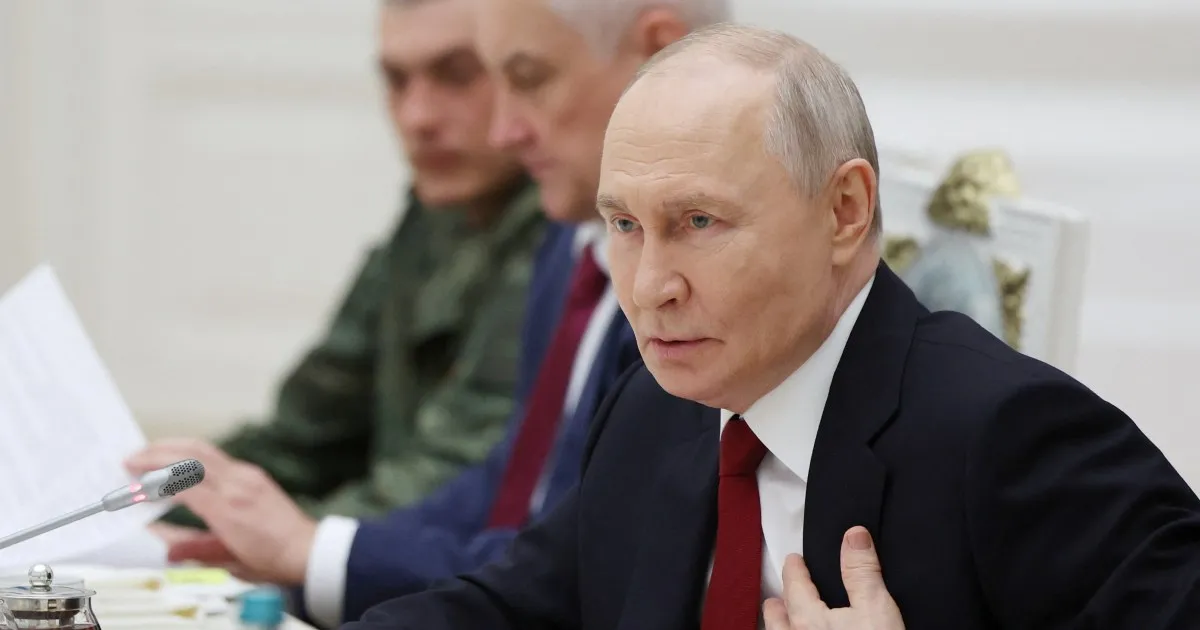
Russian President Vladimir Putin says Moscow will continue its more than four-year-long war on Ukraine, rejecting Kyiv’s proposals to limit the use of long-range missiles and stop hostilities.
In an interview with Russia’s state television service on Sunday, Putin said Ukraine had proposed a mutual halt to long-range attacks as a step towards peace. But the Russian president suggested this proposal was made because Kyiv’s forces were under pressure along the 1,250km (775-mile) front line.
list 1 of 3France seizes fifth Russian ‘shadow fleet’ tanker linked to Ukraine war
list 2 of 3Ukraine decimates Russian logistics, bringing chaos to Crimea
list 3 of 3Why is Crimea critical to the Russia–Ukraine war?
“It is clear why this proposal is being made because our counterstrikes deep into Ukrainian territory are much stronger, have greater impact and are, frankly, more destructive,” Putin said.
“Given their catastrophic shortage of personnel, the Ukrainian armed forces apparently believe this could be their salvation. But saving the Kyiv regime is not part of our plans,” he added.
Ukrainian officials have not yet commented publicly on Putin’s remarks — including on the Russian leader’s claims that Kyiv sent a proposal to curb the use of long-range missiles.
Putin acknowledged that Russia has had to increase its air defence capacity to counter intensified Ukrainian drone attacks that have targeted Russia’s oil industry in recent months.
What’s behind Putin’s rejection of Kyiv’s reported proposal, and what does this mean for peace talks?
Putin made his comments as Ukraine continued to intensify its attacks on Russia.
On Sunday, President Volodymyr Zelenskyy said the Ukrainian military had hit the Slavyansk and Yaroslavl oil refineries in Russia overnight with long-range drones, about 300km and 700km (190 and 435 miles) from the front line, respectively.
A fire broke out at the oil refinery in Slavyansk-na-Kubani in Russia’s Krasnodar region, Governor Veniamin Kondratyev reported on Telegram, and several houses were damaged by debris. He said one person was killed in the region just east of Ukraine’s Russian-occupied Crimean Peninsula.
“We continue our operations that weaken Russia’s ability to wage this war,” Zelenskyy wrote on X on Sunday, adding that each attack “means fewer resources serving Russia’s war machine”.
Ukraine’s attacks on Russian refineries are the latest in a campaign against Russian energy sites that has gathered pace in recent weeks.
Last week, Ukraine used long-range drones to hit two oil facilities in Kerch in Crimea and Port Kavkaz in Krasnodar. Both are used to bring fuel to the Russian front lines. It also struck electricity plants, prompting the suspension of fuel sales in Crimea.
On Sunday, Yaroslavl Governor Mikhail Yevrayev also reported on Telegram that the region northeast of Moscow had been under attack from Ukrainian drones and said exits from its capital, also named Yaroslavl, had temporarily been closed.
Meanwhile, in the Belgorod region, which sits on Ukraine’s northeastern border, another person was killed in the Shebekinsky district during 64 Ukrainian drone attacks in 24 hours, Russia’s TASS news agency reported.
Russia shot down “a total of 117 enemy drones of various types”, the governor of the neighbouring Kursk region, Alexander Khinshtein, said. “Drones dropped explosive devices on our territory seven times.”
Russian attacks on Ukraine killed at least four people on Sunday, local officials said. Two of the dead were in Zaporizhzhia, a city in the southeast. The other two deaths were in Kharkiv in northeastern Ukraine.
Putin announced his rejection as Moscow is reportedly reeling from the impact of Ukrainian drone attacks on its energy sector. However, Putin downplayed them on Sunday.
“All the strikes, wherever they hit our infrastructure, absolutely do not affect the situation on the front, on the line of combat contact,” Putin said.
“They are attempting to disrupt energy supplies and impact the tourism season – intentions they have openly communicated to us through various channels,” he added.
He said Russia’s task at hand is “to quickly and significantly ramp up production of those air defence systems that are most needed”.
In fact, Russia has a significantly greater capacity for long-range attacks, Ian Lesser, distinguished fellow at the German Marshall Fund of the United States, told Al Jazeera. Therefore, it is not surprising that Putin would want to preserve this edge and avoid any compromise on this front, at least for the time being, he said.
“Moscow will surely see its own long-range strike capability as a deterrent, perhaps all the more significant for him [Putin] as Ukraine expands its own ability to attack targets in Russia at longer range,” Lesser added.
Ukrainian officials have yet to comment on the prospect of limiting long-range strikes, but in early June, Zelenskyy wrote an open letter to Putin and proposed a meeting to discuss ending Moscow’s war on Kyiv.
In his letter, Zelenskyy told Putin that he had spent nearly half of his 26 years in power in Russia “waging war against Ukraine” and said even Russians are now growing increasingly tired of Ukrainian missiles and drone attacks, inflation and fuel shortages.
He noted that with the US focused on its war on Iran, “it would be wrong to simply wait until the war in Europe returns to the centre of its attention” and suggested a path to peace.
“Ukraine proposes ending this war through direct engagement between us – and you. I am proposing a meeting. … If you do not personally come to the conclusion that it is time to end this war, Ukraine will continue fighting for its existence,” he added.
Putin said he had rejected the proposal.
Yes. In September 2024, Putin warned that if Western nations allowed Ukraine to use their long-range weapons to strike inside Russia then it would signal NATO was also “at war” with his country.
“This would in a significant way change the very nature of the conflict. It would mean that NATO countries, the US, European countries are at war with Russia,” Putin told Russian state TV.
In November 2024, however, Kyiv was given the green light from the US and NATO to start firing long-range missiles that are being provided by countries like the United Kingdom, France and the US at Russian territory.
The move came as Moscow intensified its attacks on Kyiv and after the deployment of North Korean troops in Russia’s Kursk region, which was invaded by Ukrainian forces in August 2024. They captured a large amount of territory before being forced back across the border in 2025.
Despite Kyiv using long-range missiles, Russia has not declared war against NATO.
Since US President Donald Trump began his second term in January 2025, he promised to end Russia’s war in Ukraine.
He has met both Putin and Zelenskyy in separate meetings to discuss ending the war, but so far, these efforts have not borne fruit.
In May, the leaders of the UK, France, Germany and Poland met Zelenskyy in Kyiv in a show of unity a day after Putin hosted his allies at a Victory Day parade in Red Square that celebrated the victory over Nazi Germany in World War II.
Putin has strongly objected to European leaders’ involvement in truce talks.
“How can the EU or individual EU countries serve as mediators when they are directly assisting the country with which we are in an armed conflict?” he asked journalists in St Petersburg this month.
Truce talks have largely stalled due to Russia’s insistence on retaining territory it has seized in Ukraine. Ukraine has stated that it is not prepared to cede any territory.
In recent days, Putin has given mixed messages about when – or with whom – he might be prepared to resume talks.
On Tuesday, Putin said Moscow is ready to renew talks. However, he stated that these would be on the basis of what was proposed at negotiations held in Istanbul in 2022, including Russia’s demand that Ukraine surrender the eastern region of Donbas, which is currently largely under Russian occupation.
On Sunday, Putin said Moscow was expecting a resumption of Washington-led diplomatic efforts to end the war. He said US envoys Steve Witkoff and Jared Kushner were also expected to visit Moscow once the “hot phase” of the US-Israel war on Iran was resolved.
However, he also acknowledged that his meeting with Trump in Alaska in August yielded no agreement to end the war and suggested that in upcoming peace efforts, Russia’s ally Belarus could assist.
Lesser said Putin’s rejection of limiting the use of long-range missiles is a further indication of his unwillingness to engage in serious negotiations to end or limit the war, at least under current conditions.
“Russia does not want to signal weakness in relation to Ukraine but also in the context of relations with NATO,” he said.
Source: https://www.aljazeera.com/news/2026/6/29/russia-ukraine-war-why-has-putin-rejected-limits-on-long-range-strikes?traffic_source=rss