Taybeh Junction, occupied West Bank - The barbed wire placed in front of the entrance of the Mleihat compound makes it cumbersome for women, children, the elderly and visitors to enter.
But Muhammad Mleihat, 57, says the wire is mostly meant to slow the settlers down long enough to be seen. "They have cutters," he said, gesturing at the fence line. "They come and cut it and push through."
Mleihat is no stranger to displacement. His family were among those expelled in the 1948 Nakba, or "catastrophe" - when 750,000 Palestinians were ethnically cleansed from their homeland during the formation of Israel.
Two years ago, he and his children were driven out by settler violence from Mughayyir al-Deir, a herding community in the hills to the east. They came to this land, a kilometre or so (about 0.6 miles) northwest of the Taybeh Junction, where he says he holds a tabu - an official land deed - in his own name.
But over the past three years, with all of the Palestinian Bedouin villages east and south of the junction now violently emptied, the settlers' confrontation zone has now reached this stretch along Route 449 - into areas officially under shared Israeli security and Palestinian civil control. Until recently, these regions, designated Area B by the Oslo Process, were seen as beyond the settlers' reach. With the lands the Bedouins left behind now emptied, the settlers have followed.
"The settlers came after us - the same settlers from Mughayyir al-Deir,” explained Mleihat.
Locals say the most aggressive settlers in the area are part of a network linked to Neria Ben Pazi - a settler sanctioned by the European Union, the United Kingdom, Australia, and Japan, among others - who spearheaded much of the forcible displacement of Palestinians from areas east of Ramallah, including allegedly supporting displacement efforts in Mughayyir al-Deir. Local monitors estimate Ben Pazi now has established outposts across the West Bank “in the double digits”.
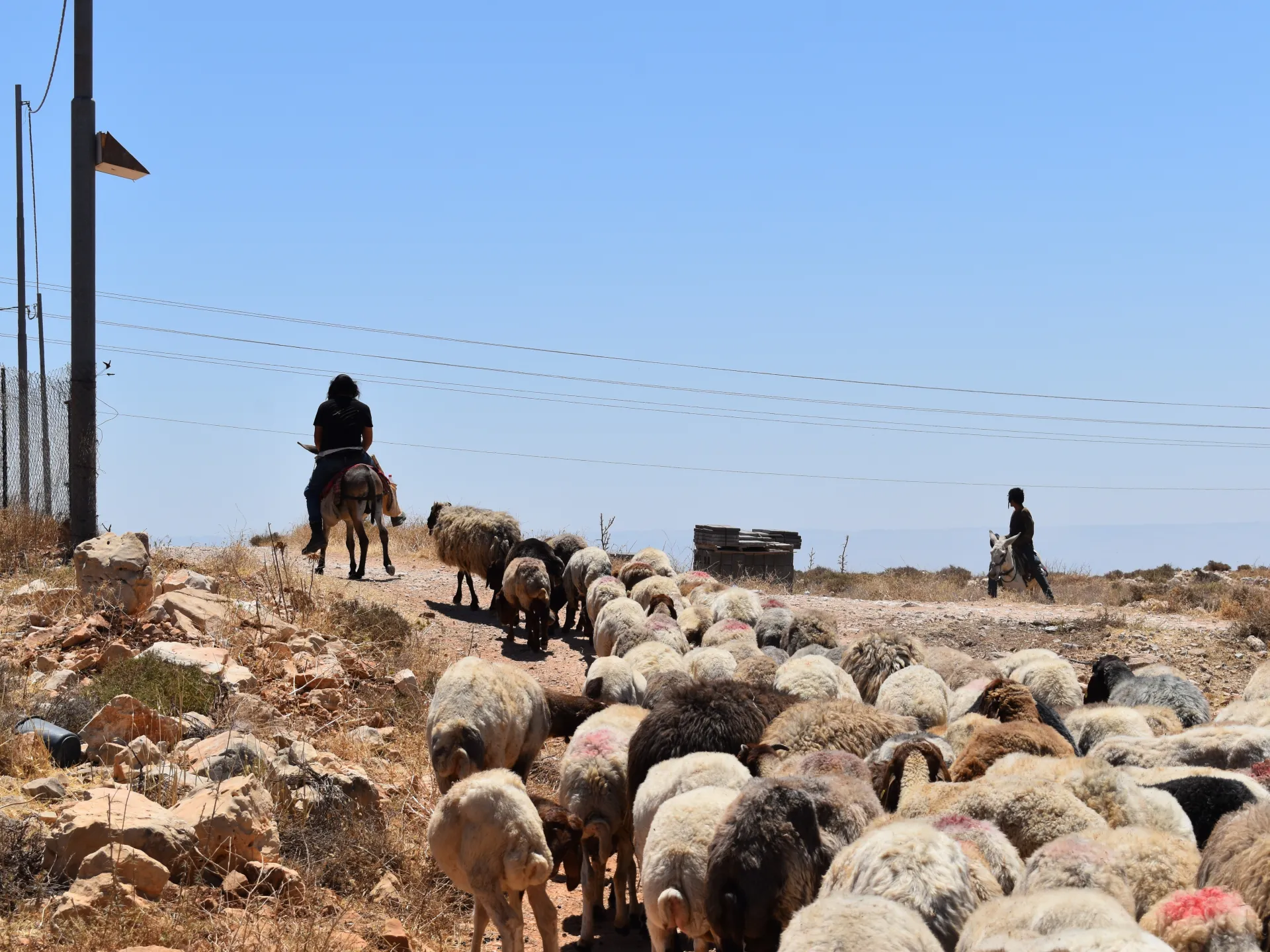
According to the accounts of the families in the area, the settlers arrive at night on donkeys and all-terrain vehicles, which are given to settlers in illegal outposts through state funding. They cut fences, drive their flocks onto cultivated land, wreck fodder and hay, and sever water hoses and electrical wires.
Hilltop youth - the name given to some of the most ideologically zealous of the settlers - carry wooden or metal sticks during their daily incursions, at times hitting and kicking residents. During the day, they make rounds, bringing their herds through the Palestinian families’ properties, with their flocks consistently feeding on the olive groves beside the Mleihat compound.
Just above the Mleihat compound, a building and a small plot lie half-abandoned by its Palestinian owner. In recent days, settlers cut the fence and brought in 20 camels to keep and graze on the land, which is situated at the centre of this cluster of Bedouin homes located along the southern side of Route 449. The camels, according to an Israeli activist who has documented the area for years and provides protective presence to the communities, were brought in on loan from settlers from an illegal outpost down in the Jordan Valley. Effectively, herds were shifted across the West Bank to reinforce the newest settler push.
"They emptied Ein Samiya, al-Mu'arrajat, Mughayyir al-Deir, Mikhmas, Ras al-Ein al-Auja," remarked Mleihat.
"They want to finish off this one, too, then move on again.”
Mleihat’s account tracks closely with the findings of a report released this week by Amnesty International, which concluded that Israel is pursuing the annexation of a large part of the occupied West Bank through what it called a deliberate, state-backed campaign of ethnic cleansing against Palestinian Bedouin and herding communities - amounting to the war crime of unlawful transfer and the crime against humanity of forcible transfer.
Citing United Nations figures, the report counts some 5,910 Palestinians forced from 117 communities between January 2023 and April 2026, at least 45 of them depopulated entirely. The Ramallah and el-Bireh governorate, which includes the land where Mleihat now lives, accounted for the largest share of the displaced.
Amnesty's report focuses on Area C, the roughly 60 percent of the West Bank under full Israeli control, where the state possesses the administrative machinery of removal - including demolition orders, "firing zone" declarations, and the designation of unregistered land as state land.
On Mleihat's plot - which is in Area B, privately registered, and held with an official deed - those levers are largely unavailable. The army cannot easily demolish a legally built home on titled land, and the Civil Administration cannot lawfully evict its owner.
What is left, then, is extra-legal force.
"The only way for the state to kick them out is illegally," said Yotam, an Israeli activist who has done protective presence with Palestinian communities in the area for several years. "And for that, they use these settler gangs."
It is for this reason, activists and locals say, that some of the most violent outposts to emerge recently - including in places like Tayasir, Beit Imrin, Jilijliya, Ein al-Duyuk, al-Mughayyir, Jaloud, and Madama - are in fact located in Areas B and A (which is under complete Palestinian administrative control), where land deeds and Palestinian civil authority were once thought to offer protection.
There are two settler outposts in the area of Taybeh Junction. The newest, locals said, was established by Ben Pazi, not on the families' private land but on a small sliver of state land at a nearby water-access point - a foothold the state does nothing to stop, even as the displacement it generates radiates outward into the surrounding private plots of Area B.
Yotam said he has seen, hanging in the local police station, a photograph of Ben Pazi's herds grazing on the now-emptied lands of Wadi as-Seeq, apparently given to the station as a gift.
Meanwhile, Ben Pazi’s newest outpost has taken on some of the aggressively violent tactics found in his other outposts that erased so many Palestinian communities before, carried out largely by a group of teenage settlers tasked with both herding the settler flocks and harassing locals.
On June 1, the Israeli military signed a yearlong closed military zone order covering the area immediately around the junction, restricting civilian access to the site. While the order technically applies to the settlers, in practice, residents and activists say, it has been enforced only against the solidarity activists who offer protective presence to the family residing in the closed area. The settlers remain in the recently established illegal outpost alongside a permanent military post on the hill. Such one-sided enforcement has been used elsewhere, before Bedouin communities were subsequently violently displaced.
Nayef Khalaife, the father of the last family on the northern side of the road, sees no contradiction in any of it. "When the army comes, it doesn't talk to the settlers. It comes, stands by him, and leaves," he said. "There's no law. There's no law for the settlers. We are outside the law's protection."
Al Jazeera has contacted the Israeli military and security authorities for comment on the allegations made by Palestinian locals and activists in this article, but has yet to receive a response.
Khalaife and his small family live in a modest home overlooking a plain where the only flocks still grazing belong to the settlers. Day after day, the settlers invade their land and attempt to break into their home.
Both Khalaife and Mleihat have sold their flocks, which for decades had been their livelihood. "Because of the settlers, we sold them - there are no pastures," said Mleihat. "They sealed it, and they're the ones living in it." His income now, he said, is "nothing - only from God".
Families across the local cluster have either sold their flocks or keep what remains hidden away, out of the settlers' reach. In the process, the traditional Bedouin herding way of life is being systematically extinguished - as is the case across the West Bank these days.
Water has been another tool of dispossession. Khalaife's family used to truck water from a source about a kilometre away, but this week, "the settlers came and shut it off", he said. Amid the daily incursions and harassment, Khalaife described acts of theft large and small - even a settler pocketing a teacup from the yard one day, or lifting a jacket from the laundry line another. He no longer fears them, he insists. "If death comes, let it," he said gravely while his wife, son and daughters sat beside him inside their home.
Together, the family walked outside. Standing in the yard in front of their home, Khalaife, his wife Shoma, and their son and daughters looked down at the plain below. Khalaife's daughter, Ikhlas, pointed to the settler outpost about 150 metres (about 500 feet) away, facing the family home. Then, she brought up photos on her phone.
In the photographs, taken a few years ago, several homes dot the plain. "In 2020, there were five families living here," she said, scrolling. "There were many neighbours close by - we were happy with them. But by 2024, they were gone completely; no trace of them left, except this tree."
Since the settlers took the plain, nearly all of the neighbours' homes have been demolished, with only scattered debris remaining. "The house [the settlers are] living in now was a Palestinian house," she explained. "They came at them, made them leave, and they settled in it themselves."
"We're sad because they left us, and we stayed on our own.”
A gentle breeze broke the otherwise eerie silence of the emptied plain. Ikhlas pointed to a wrecked structure with materials strewn on the ground. "Look how they smashed it, but the tree the family planted beside it stayed.
“The tree - it's a witness that they were here."
Source: https://www.aljazeera.com/features/longform/2026/6/11/property-deeds-no-protection-for-palestinians-as-settler-violence-spreads?traffic_source=rss