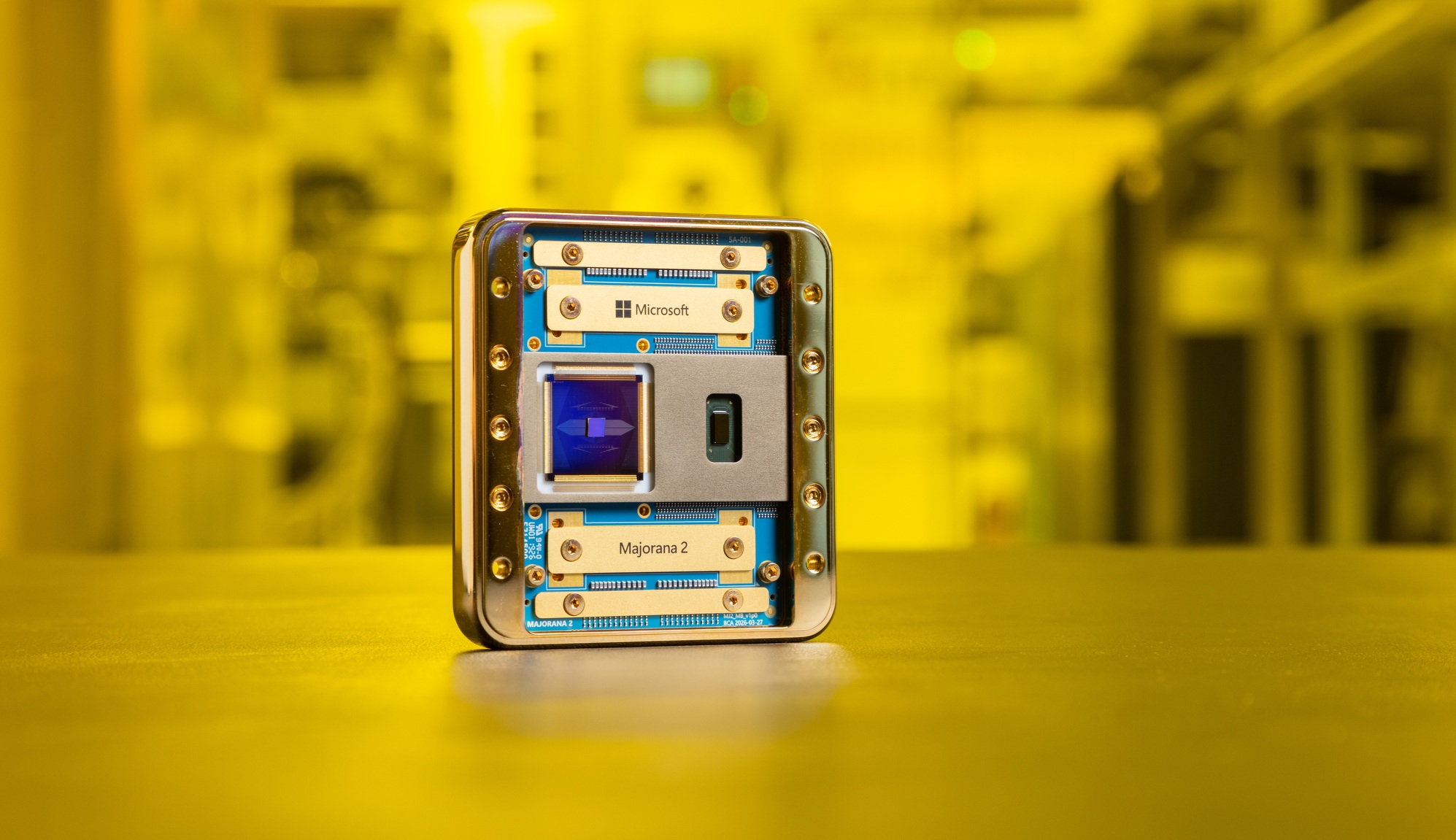
Microsoft’s Majorana 2 quantum chip arrived this week with numbers that are genuinely difficult to contextualise: qubits 1,000 times more reliable than the first generation, a mean qubit lifetime of 20 seconds against an industry norm measured in microseconds, and a revised roadmap targeting a commercially scalable quantum computer by 2029. Behind those numbers is Microsoft Discovery agentic AI, and that platform is arguably the more consequential part of this announcement. To put that in plain terms: most quantum chips today can hold their fragile computational state for a fraction of a second before losing it. Majorana 2 holds it for up to a minute. Microsoft’s own analogy is a phone battery that, instead of dying in a day, lasts nearly three years on a single charge. Majorana 2 was developed with the help of Microsoft Discovery, the company’s agentic AI platform for scientific R&D, which also reached general availability this week. The timing is deliberate. The quantum chip is Microsoft’s proof that the platform works. What Microsoft Discovery agentic AI actually did here The common read on this story is that AI designed the chip. The reality is more specific, and arguably more interesting. The decision to switch the superconducting material from aluminium to lead, which Microsoft says is the single change most responsible for the reliability improvement, came out of years of conventional materials research, not an AI recommendation. What Microsoft Discovery’s agents did was everything around that: managing fabrication workflows, automating measurements that previously took weeks each, breaking down nearly two decades of siloed research data, and surfacing correlations that no single researcher could hold in their head across that volume and variety of information. “As you run AI agents on this data, they’re able to essentially resynthesize and make correlations that we as humans cannot see because no single individual has that much vision across that much data,” said Zulfi Alam, corporate vice president for quantum at Microsoft. That framing matters because it shifts the story from “AI built the chip” to something more accurate: agentic AI compressed the experimental cycle. What would have required extensive trial-and-error to find the right atomic-level recipe for the chip’s crystalline structure could, through AI-driven simulation, be narrowed to a single targeted experiment. “In the new world order, through simulations, you can see where the highly probable target is. And then with that knowledge, you ideally only have to experiment once,” Alam said. The measurement problem, solved One of the more concrete wins the team describes involves qubit measurement; the process of detecting quantum states by determining whether there’s an even or odd number of billions of electrons on a semiconductor wire. When done manually, this takes weeks. Microsoft tried to automate it a few years ago using earlier machine learning and couldn’t. With agentic AI built on Microsoft Discovery, they created a specialised agent that now runs the process automatically and continuously, building three-dimensional maps of qubit conditions at a pace no individual researcher could replicate. “Using agentic AI to automate the measurements was a game changer,” Alam said. The agent handles parallel voltage adjustments across hundreds of parameters simultaneously, something human researchers, thinking linearly and structurally, cannot do. Chetan Nayak, Microsoft technical fellow leading the quantum programme, said the shift has been thoroughgoing: “Agentic AI has permeated almost everything we do, it’s just become kind of a very natural part of our workflow.” Microsoft Discovery goes general The platform that underpinned all of this is now available to enterprise customers. Microsoft Discovery combines specialised AI agents for scientific research, a Discovery Engine for research and reasoning workflows, and enterprise-level security and governance. A free Microsoft Discovery app, usable locally with a GitHub Copilot account, is also in early preview, lowering the barrier for individual researchers who want to run the same kind of agentic workflows. The commercial pitch is clear: the same capability stack that the quantum team used to compress its development timeline is now available to any organisation running intensive R&D. Microsoft has already seen uptake in life sciences, chemicals and materials, energy and manufacturing. Syensqo, for instance, is using it to develop next-generation fluids for semiconductor manufacturing. The 2029 claim, in context Microsoft’s revised quantum timeline deserves a note of editorial distance. The company has moved its target from 2033 to 2029 based on Majorana 2’s progress, which is a significant acceleration, but quantum roadmaps have a history of optimistic compression. The 1,000x reliability figure refers specifically to improvements over Majorana 1’s qubits, not a direct benchmark against competing approaches from IBM or Google, which use fundamentally different architectures. Nayak’s own framing is honest about the incremental nature of this: “Where are we relative to last year? We’re 1,000 times better.” That’s a meaningful year-on-year milestone. Whether it holds at the pace required to reach utility-scale quantum computing by 2029 is the question no one, including Microsoft, can yet answer. See also: UK and Germany plan to commercialise quantum supercomputing Want to learn more about AI and big data from industry leaders? Check out AI & Big Data Expo taking place in Amsterdam, California, and London. The comprehensive event is part of TechEx and is co-located with other leading technology events including the Cyber Security & Cloud Expo. Click here for more information. AI News is powered by TechForge Media. Explore other upcoming enterprise technology events and webinars here. The post Microsoft’s Majorana 2 quantum chip is also a case study for agentic AI in R&D appeared first on AI News.
Source: https://www.artificialintelligence-news.com/news/microsoft-discovery-agentic-ai-majorana-2/
AI
Microsoft’s Majorana 2 quantum chip is also a case study for agentic AI in R&D
Article Top Ad Zone
Article Middle Ad Zone
Article Bottom Ad Zone
Original Source: www.artificialintelligence-news.com
Get AI alerts on Telegram
Follow AI in your language and open the full stories on PulseForge.
Share
Comments
Comment system is currently disabled.