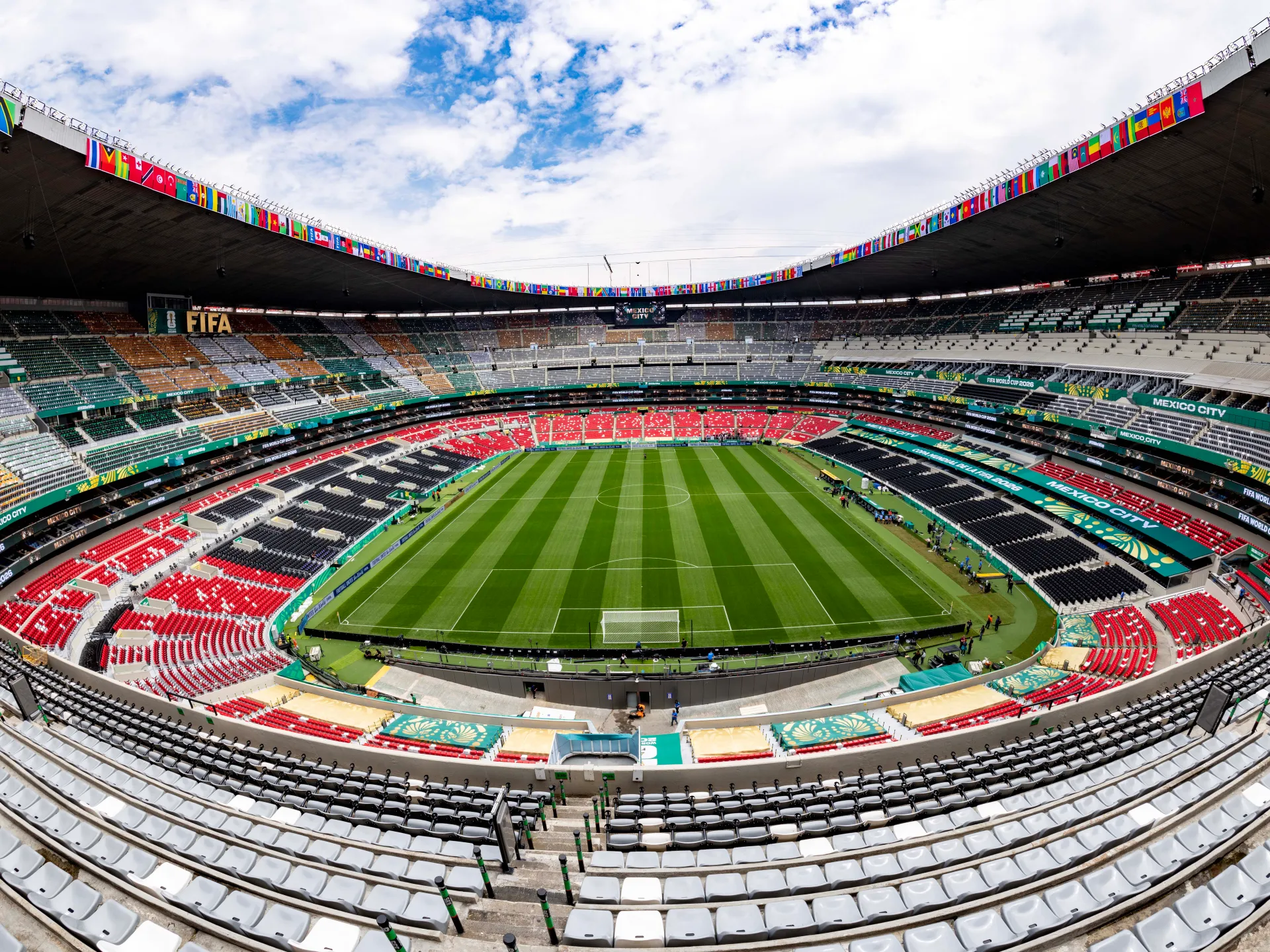
Mexico City’s iconic Estadio Azteca will become the first venue to host matches at three separate World Cups.
You can follow the action on Al Jazeera’s dedicated World Cup 2026 page with all the latest news, match build-up and live text commentary, and keep up to date with group standings, real-time match results and schedules.
“There’s just something very special about the Azteca,” said Pele. “You need to be inside it, to feel it to understand. It’s unique.”
list 1 of 4Pressure on cohosts Mexico as South Africa await in World Cup 2026 opener
list 2 of 4World Cup guide: All to know about groups, match schedule and kickoff times
list 3 of 4World Cup: Rating the chances of top European teams at the tournament
list 4 of 4What time are World Cup 2026 matches in my time zone?
The Brazilian legend enjoyed one of the finest moments of his career in Estadio Azteca, as he lifted his third World Cup in the towering stadium in Mexico’s sprawling capital.
This year, a new generation of players will realise just how special the stadium is, as it becomes the first arena to host World Cup matches in three separate tournaments.
From Brazil’s remarkable World Cup victory in 1970, to Diego Maradona’s “Hand of God” goal in 1986, this arena has provided the backdrop to some of the biggest moments in football history.
Now, after nearly two years of renovations, the 83,000-seat stadium is ready for kickoff in the largest World Cup in history.
Here’s all you need to know about Mexico City’s legendary stadium.
Construction on the “Colossus of Santa Ursula” began in 1961 and was completed five years later, with more than 107,000 fans attending the inaugural match between Mexico’s Club America and Italy’s Torino.
The venue was then used for a number of games during the football tournament at the 1968 Mexico City Olympic Games, including the final, which saw Hungary defeat Bulgaria 4-1.
Two years later, it was the showpiece stadium at the 1970 World Cup, as Mexico became the first country outside of Europe and South America to host the tournament.
Estadio Azteca hosted 10 matches during the event, including the opener, in which Mexico played out a goalless draw with the Soviet Union.
It was also the venue for a match which is widely regarded as one of the finest of all time, as Italy overcame West Germany 4-3 after extra time in an incredible semifinal encounter.
Italy went on to lose 4-1 to Brazil in the final, with Pele parading the World Cup trophy around the Azteca pitch.
Stories of World Cup 1970 at Estadio Azteca would provide enough material to fill any stadium museum, but this magnificent arena was not done yet.
Sixteen years after Pele lifted the Jules Rimet Trophy in Mexico, the World Cup was back in the North American nation, with the country’s largest stadium once again at the centre of the action.
The tournament opener was one of nine matches played at the venue – 1-1 draw between Bulgaria and Italy. But it was the quarterfinal between Argentina and England which provided the most famous moments in the Azteca’s illustrious history.
Argentina’s Diego Maradona was at the centre of it all, as he broke English hearts with two iconic moments.
On 55 minutes, with the game goalless, Maradona jumped to contest a high ball with England goalkeeper Peter Shilton. The Argentinian used his left hand to punch the ball into the net, much to the fury of The Three Lions players and staff. The referee did not spot the foul and allowed the goal to stand.
Minutes later, Maradona showed what he could do with his feet, as he dribbled past numerous players to score one of the finest individual goals of all time.
Argentina went on to reach the final as Maradona and company defeated West Germany 3-2 to lift the World Cup in Mexico City.
Mexico will play two of their three group games at Estadio Azteca and could also play some knockout fixtures at the stadium, including a potential clash with England in the Round of 16.
If the prospect of more than 80,000 Mexican fans is not intimidating enough, then opposition players will also have to deal with altitude and poor air quality in Mexico’s sprawling capital.
The Estadio Azteca, which is the largest stadium in Latin America, sits some 2,200 metres (7,200 feet) above sea level, with the high altitude set to provide a real test for teams that travel to Mexico City for their matches.
“You would expect a faster onset of fatigue, higher heart rates at any given running intensity, and a reduced capacity to sustain the high-intensity efforts that define modern international football,” Sam Shepherd, head of sports science at sports nutrition company Precision Fuel & Hydration, told The Associated Press news agency.
To mitigate the physiological toll of thin air, sport scientists generally recommend two contrasting approaches: an extended acclimatisation period of at least two weeks, or the “fly-in, fly-out” method – arriving as close to kickoff as possible before acute symptoms set in.
After a nearly two-year facelift, Estadio Azteca reopened in March for a showpiece friendly between Mexico and Portugal.
The redevelopment work included new seating, upgraded locker rooms, improved lighting and a rebuilt pedestrian bridge linking to transport networks in the local Huipulco neighbourhood. The project was plagued by delays from the outset, and workers were still completing the finishing touches with just 48 hours left before the stadium officially reopened.
Despite the last-minute rush, Estadio Azteca hosted the friendly match on March 28 as the two teams played to a goalless draw.
The historic venue will now host five matches during the World Cup, with the opening ceremony also taking place there.
Source: https://www.aljazeera.com/sports/2026/6/11/the-world-cups-most-storied-stadium-prepares-for-another-chapter?traffic_source=rss