The suspended Palestinian league is squeezing a generation of footballers, with little certainty for the future.
Sheikh Jarrah, Occupied East Jerusalem — It’s nearly three years since Mahdi Hijazi last played a professional game of football, with the war on Gaza thrusting the domestic Palestinian league into limbo.
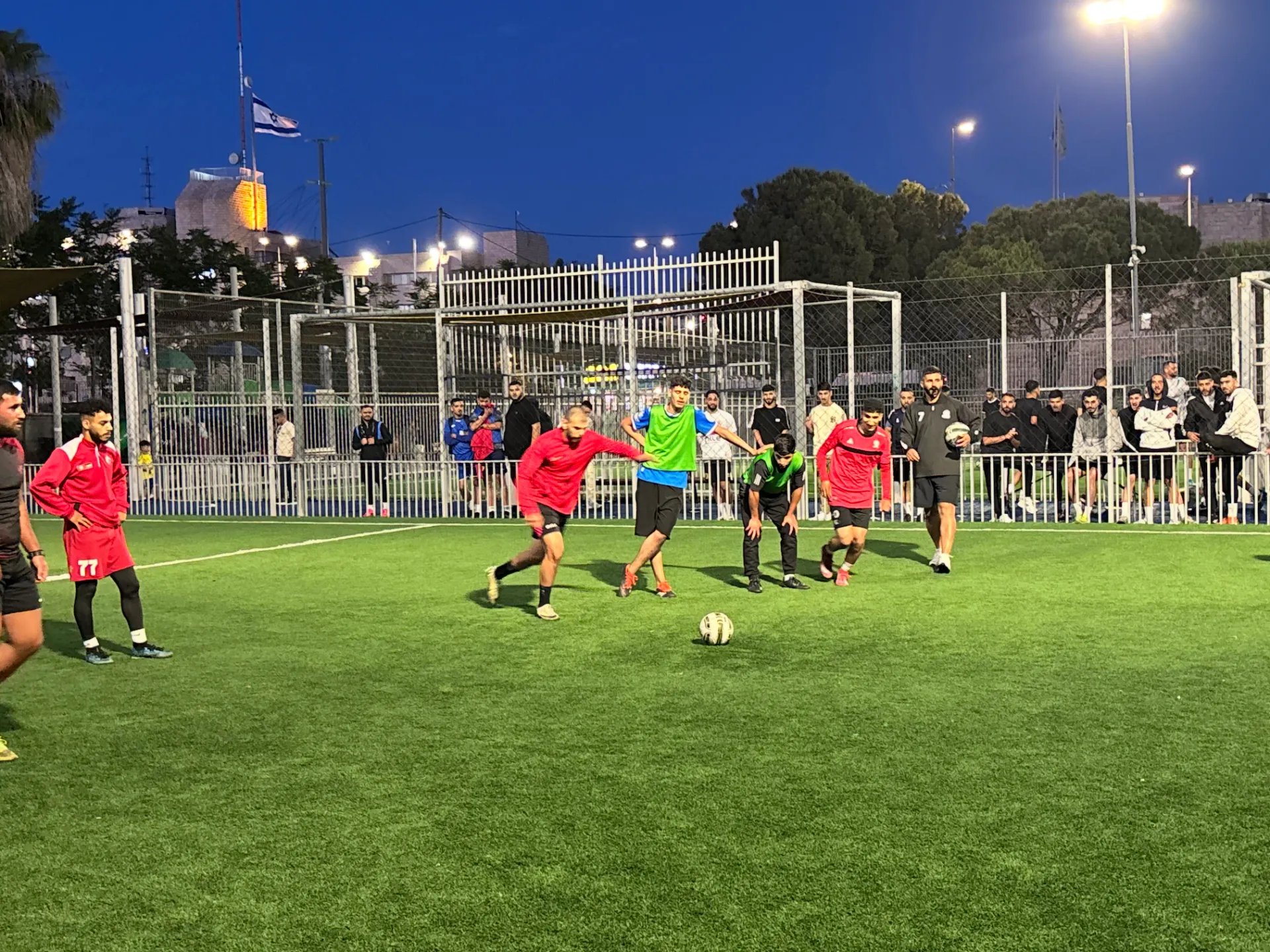
The 23-year-old now spends his days on the sidelines of a series of football pitches adjacent to the Israeli police headquarters in Sheikh Jarrah in occupied East Jerusalem. The area has faced rounds of evictions of Palestinian families by Israeli authorities over the years, to be replaced by Israeli settlers.
Hijazi, who played for the Palestinian national team and travelled abroad with Hilal Al-Quds, Jerusalem’s most decorated club, can be seen handing out refreshments to the players, desperate to hang on to the game he loves in any way possible.
“Football is in our blood. Winning, losing – football is beautiful, it’s life… we breathe football,” he told Al Jazeera. “For three years, there’s been no sporting activity at all. Things are hard, you keep yourself in shape through workouts at the gym… Our only concern right now is to get back to football.”
Hilal Al-Quds has been a part of Hijazi’s life since birth. His grandfather founded the club, and he came up through its ranks as a youth to compete for the first team, playing games across Asia.
But the Hamas-led attacks on southern Israel on October 7, 2023 – and the subsequent genocide in Gaza – has changed everything.
Nobody knows when the Palestine Professional League – suspended since the war on Gaza began – will return, putting the future of Palestinian football in peril.
Palestinian football squads were typically stitched together from players across the West Bank and East Jerusalem, but an Israeli military offensive in the occupied territory has made travel there exceedingly difficult. Officials say that a surge in settler attacks and the closure of West Bank roads by the Israeli military, which were used to shuttle Palestinian footballers from one match to another, has made the domestic game impossible to play anyway.
For Palestinian players, the suspension of the Palestine Professional League has been catastrophic. Khaled Abu Dalu, 36, a former national team player, has run a leading youth academy in Jerusalem for the past decade, with many of its players going on to compete at professional level.
A footballer in the professional league might previously earn the equivalent of $2,000 to $3,000 a month, while national team players could make as much as $7,000.
“Some of my former players who were stars, all of that, are now out of work, taking some lowly job. There’s nothing that does justice to his career,” coach Abu Dalu said.
Hijazi said the suspension of the professional domestic league has seen many players in the prime of their careers quit football and work any job they can find.
“The money was good, [but] today, it’s gone. A lot of friends have gone into construction – one became a barber, one a mechanic, one’s in a supermarket, one works in a bakery,” said Hijazi. “As footballers, at the end of the month, we knew a salary was coming, [but] now, there are people who are married, who have kids, who have no income.”
Hijazi himself has found a new living buying and selling cars, but there are other challenges the players and support staff face beyond the suspension of the league. West Bank players who have neither the relative mobility a Jerusalem ID brings, nor a permit to work inside Israel, have suffered most.
Mustafa Owais, 35, a former professional player before the war, described the tragic story of one former teammate from Bethlehem, with much of the governorate under the direct control of Israel.
“His only job was football [but] after the war, he started working two days a week in the West Bank — the whole week he makes 100 ($34.24) or 200 shekels ($68.47), and he’s married, has kids, a family,” Owais told Al -Jazeera.
Another former teammate who once earned $5,000 a month playing football now scrapes by on $500, he said.
Some players, desperate for opportunities to play football and support their families, have even made the uneasy decision to join clubs in the Israeli Premier League.
“At the end of the day, a person wants to do the thing he loves, regardless of our political views… so, he heads to the Israeli league, until the Palestinian league comes back,” reasoned coach Abu Dalu.
Abdul Fatah Arar, a veteran coach who has won multiple Palestinian league titles and managed the Palestinian powerhouse Taraji Wadi Al-Nes, a club based near Bethlehem, lists the number of domestic players who over the years have sought opportunities abroad.
He estimates that 70 to 80 players have gone to play in Libya, about 10 in Egypt, half a dozen in Jordan, and a handful more to Qatar, Kuwait, Malaysia and Indonesia. Those countries classify Palestinians as local players rather than foreign, making them cheaper to sign. “Other players, of course, don’t have the chance, so they disappear,” he said.
Hijazi said that even if players find an overseas team to play with, the transition is not always easy.
“A player who’s been idle a long time going abroad now – it’s different. He needs to get back to the league first, get back the passion on the pitch, and only then think about going abroad,” he said.
One of Hijazi’s former teammates at Hilal Al-Quds made the difficult move to Libya after his first child was born shortly after October 7, 2023. After a long time out of work, he eventually joined a club in Libya, but finding it too dangerous to leave his house in Tripoli at night, he returned to Palestine.
The women’s national team did manage to regroup and provide Palestinian players with hope of competing at international level.
In April 2025, a largely homegrown Palestinian squad beat Jordan in the final of the West Asian Football Federation (WAFF) Women’s Championship final, lifting the title for the first time.
Laila Atamneh, 18, from the East Jerusalem neighbourhood of Beit Hanina and a member of the Women’s Under-20 National Team, said players would remind themselves who they were playing for: “There are people in Gaza rooting for you. It gave us a spirit that wasn’t there before.”
“The war might have been a curse in so many ways, but I feel like it brought out the best version of the national team,” she said.
Still, the Palestinian clubs she played for in the past have disappeared due to the crisis and she doesn’t know any other women her age who still play in Jerusalem.
“When you see no goal in what you’re doing, it’s not easy to keep going. Where would I go with my talent next? They can’t see a further step,” she explained. “It all comes back to training, without it, you go nowhere.”
The longer the West Bank Premier League remains suspended, the more the damage compounds — particularly for younger players who should be beginning to replace the current crop of professionals.
“A generation is lost every year,” said Khalil Hamed, a former player who is now a coach at Abu Dalu’s football academy. “A generation that should be emerging is disappearing. Take the ones who are 18 today: two years ago, they should already be in the first team, the team’s star, today, they’ve given up.”
Abdul Fatah Arar, who has helped develop the West Bank Premier League since its inception in 2008, said none of the young players he was coaching in 2023 are still playing football.
“They got older. Some of them disappeared — I don’t know even if they are working in Israel. Three years, four years — in football, that is a generation,” said Arar. “It is a period from World Cup to World Cup.”
After the summer break concludes, Arar hopes a scaled-down version of the league can emerge. Mustafa Owais says that if football does return, then players could be paid as little as 500 ($171.18) shekels per month, and possibly no salary at all. However, the clubs are broke since Palestinian Authority funds are frozen by Israel, and the local business donors who once bankrolled teams have dried up.
Any revival would likely be a return to the fledgling conditions of 2008. “Sport has gone back 20 years – Three years set us back 20 years,” he said.
Arar has a more optimistic outlook for the future of Palestinian football. He says that the youth academies that have sprung up in villages and towns across the West Bank – run by former players and national team veterans – could be the seeds for a future resurgence.
“We can’t say the three years destroyed our project, no. As Palestinians we don’t give up,” he said. “We started from zero and reached a high point.”
As the Friday morning training session at the Sheikh Jarrah mini-pitches winds down, Owais, Hamed, and a couple other former professionals watched a group of boys – none older than 12 – run drills during Abu Dalu’s academy.
Coach Abu Dalu believes the first group has ten genuinely talented players, but he worries that the longer the leagues remain in stasis, the fewer chances the kids will have to play professional football.
“By 18, if no opportunity comes, he’ll end up like us — either he becomes a coach, or he walks away.” he said. “If they went to Europe, they’d play at any club. God willing, they find better chances than the ones we’ve seen ourselves.”
Source: https://www.aljazeera.com/features/2026/6/14/losing-three-years-set-us-back-20-palestinian-footballs-future-in-peril?traffic_source=rss