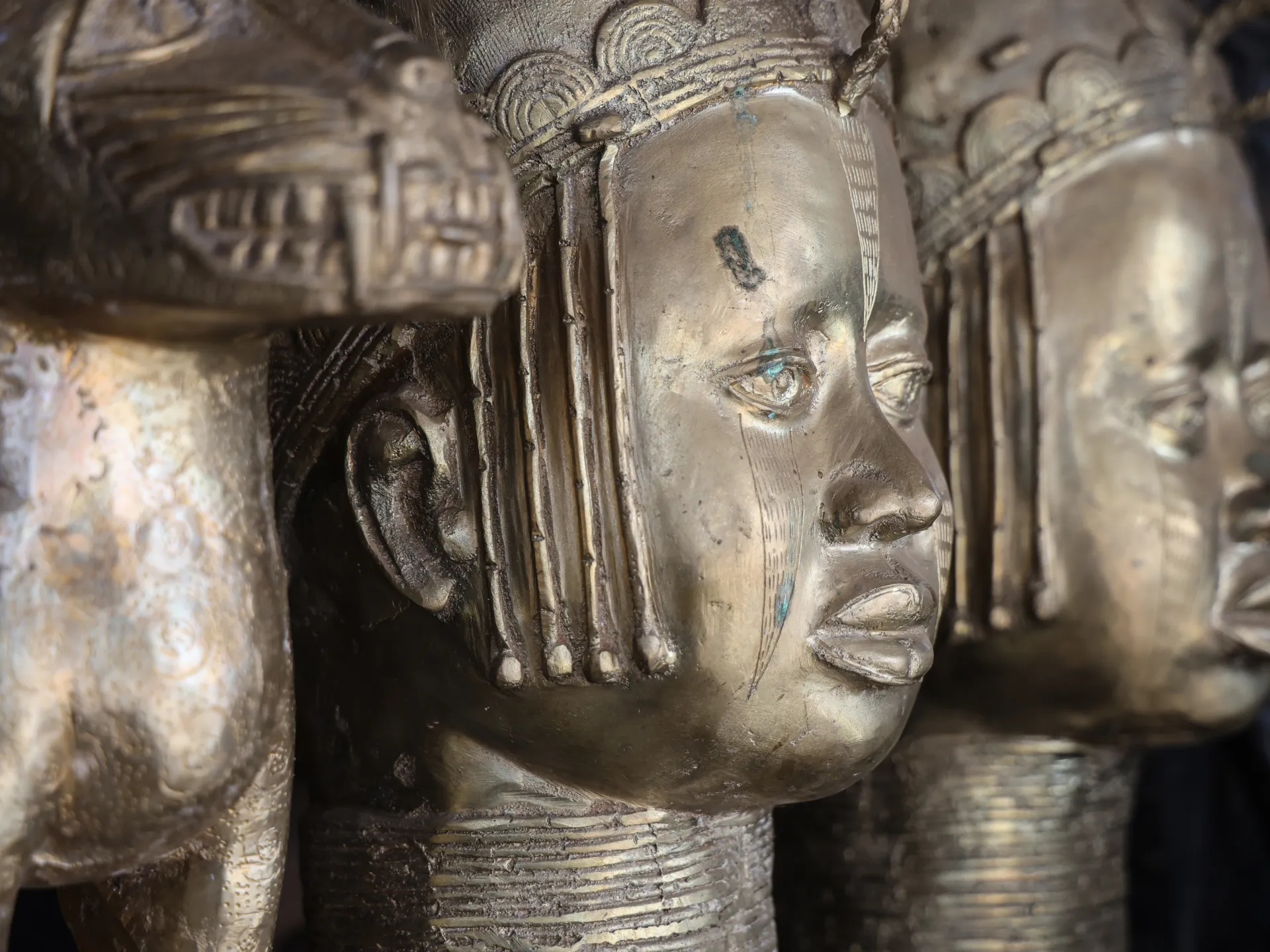
Behind the global restitution story, master artisans are fighting to keep a centuries-old craft alive.
Benin City, Nigeria — In the back yard of a neighbourhood drinking bar, the clang of metal carries from a small bronze foundry. Swirling smoke rises from smouldering charcoal. A small crucible, half-full with molten bronze, sits atop orange-brown embers.
Two workmen pour the liquid bronze into clay moulds buried in the sand using long metal tongs. “We are moulding the statue of a man, organ by organ,” says one of the workmen, nicknamed Double Chief. “When all the organs are cast, we will join them together to form the full stature of the man.”
They perfect the facial features of a replica model. Slowly, with a metal blade, he brings the image to life, starting with the eyeballs. Then, he glazes over the nose, ears and lips.
A crate of beer sits in a corner in the workshop, brought over from the bar. Between work, the men exchange jokes and tease one another, pausing only briefly before returning to the hot metal. Around them, bottles, their contents sipped to the last drop, and scattered tools bear witness to long days in the forge.
The scene reflects a craft deeply woven into everyday life on Igun Street, in the southern Nigerian city of Benin, the historic home of the Benin bronze-casting tradition. The men working in foundries like this one are heirs to that tradition.
The Benin Bronzes are a broad term used for the carved ivory, wooden works, metal sculptures and plaques looted by British troops during the Punitive Expedition in 1897.
Scholars estimate that more than 5,000 artefacts were stolen, some of which were gifted to Queen Victoria, others sold in auctions, held in private galleries or donated to museums across Europe and elsewhere.
The call to return the art, which began in the 1930s, intensified in the recent decade, inspired by growing pressure, repatriation activism and the relentless effort of the Benin Dialogue Group, a multilateral stakeholders' group.
As momentum built at the peak of the homecoming of these arts, Igun Street unexpectedly found itself in the global spotlight. Diplomats, state officials, museum curators and researchers began arriving in numbers local artisans say they had never witnessed before.
This noon, Double Chief's voice brims with pride as he points to a recently completed sculpture resting on a wooden bench. The bronze figure, a man in a suit and tie, had received its final polish only that morning after months of work.
Yet for many bronze casters, the attention has done little to solve underlying concerns.
"We are struggling to keep the industry alive," says Oriakhi Osazee, who sits on a wooden stool at the entrance of a store in Igun. A sculptor whose mediums are clay, fibre, brass and bronze, Osazee has been in the craft for more than 35 years. He speaks with depth and conviction, drawing from vivid dates and past events to reinforce his ideas.
Efforts to recruit apprentices have stalled, he says. Young people, on whom the future of the craft depends, are increasingly leaving in search of what he calls "quick money" in other professions, cities and countries.
When their ancestors began, he recalls, their craft extended beyond bronze casting. There were, among the Iguns, men who had a gift in ivory carving. Long before the global ban on ivory trade was made official, that layer of art, without heirs and hope of continuity, had died.
For Agbonmwenre Alex, the subject of heirship within the craft is a matter of personal pain.
Alex, who was taking a tour of his workshop, began learning the craft at the age of eight under the guidance of his father. He started with errands and light tasks before progressing to kneading clay pottery. Over time, he learned every stage of the casting process, from preparing moulds to the final polishing of finished works.
Today, he is the only one of his father's seven sons who remains in the profession. But uncertainty now hangs over the next generation.
"I would like my sons to take after me," Alex says. "Unfortunately, I started exposing them to this craft so late. They literally see this work as outdated, archaic, and dying. The zeal, the love for the job, is dead."
I would like my sons to take after me. They see this work as outdates, archaic, and dying. The zeal, the love for the job, is dead. by AGNONMWENRE ALEX, BRONZE CRAFTSMAN
I would like my sons to take after me. They see this work as outdates, archaic, and dying. The zeal, the love for the job, is dead.
His first son chose to study law. His second is pursuing a degree in healthcare. Despite repeated efforts to pique their interest, including offering workshop space, raw materials and financial support to start a business of their own, neither accepted.
"The number of youths is declining drastically. It [the craft] is at risk of going into extinction. Apprentices are so scarce,” says Osazee. “We used to have a lot of apprentices in the past."
As fears about the future of bronze casting grew in Igun, the artefacts that made the street famous were beginning to return home.
One of the unsung heroes behind that process is Bankole Sodipo, a professor of law at Babcock University in southwest Nigeria. On the eve of the pandemic, while on a sabbatical in the United Kingdom, Sodipo learned that the University of Aberdeen was eager to return artefacts in its custody.
He helped create the conditions to ease and accelerate the return process, mediating among stakeholders and helping navigate the legal and diplomatic questions surrounding repatriation.
The news of his progress soon reached the University of Cambridge, where discussions about returning Benin artefacts had stalled. Sodipo became involved in efforts to bridge differences among stakeholders whose competing views threatened to derail the process.
In October 2021, both returns were completed. Among the repatriated works were an Ọba's head from Aberdeen and a bronze cockerel from Cambridge.
“It was a signal to the world," says Sodipo. “I was highly elated. I was very excited to have been approached for this and to have cracked it.”
In 2022, Nigeria and Germany signed an agreement covering the return of 1,130 stolen Benin Bronzes. The Netherlands returned 119 artefacts in June 2025. More recently, Cambridge transferred legal ownership of 116 looted Benin artefacts to Nigerian authorities.
With these returns rose the question of custody. Who is the rightful custodian of the arts? Where should they be housed? And, above all, what would be the name and identity of the museum?
The questions stirred much controversy and public debate. Former governor Godwin Obaseki supported plans to house returned objects in a new museum, while Ọba (King) Ewuare II, the royal king of the Benin Kingdom, argued that the artefacts had originally been taken from the royal palace during the reign of Ọba Ovonramwen, from whom he descended.
The oba warned against what he described as "attempts to divert the destination or the right of custody of the artefacts", insisting that the works belonged to the royal palace from which they were taken during the 1897 invasion.
The dispute became one of the defining debates of the restitution era. It also complicated plans for displaying returned works. The original proposal to house repatriated artefacts in the now-completed Museum of West African Art (MOWAA) stalled.
Although then-President Muhammadu Buhari signed a 2023 decree recognising the oba as the custodian of the returned artefacts, tensions resurfaced during a preview event for the museum in late 2025. The police calmed the chaos and helped evacuate ambassadors, donors and other guests. Wase Aguele-Konu, head of communications & media relations, says the museum currently holds no Benin Bronzes in its collections.
For several Igun bronze casters, including the outspoken Ogbevoen Osaboro, resolving the custody debate is a question of history and heritage. Growing up, Osaboro learned - through oral histories - that ancient bronzes were cast at the command of the oba for the purposes of the royal court.
Many historians trace the tradition to the beginning of the 15th century. And until recently, says Osazee, bronze works were not primarily commercial objects. They recorded major events, preserved history, and reflected spiritual and political life in the kingdom.
“The jobs were done to preserve our culture and tell the stories of major events in the kingdom. Those days, there were no photographs,” Osazee, adorned in patterned ankara fabric, told Al Jazeera. “Some of those ancient arts were kept in the shrines and worshipped. People prayed to them.”
Several artisans and historians say the spread of Christianity and Islam caused some communities to increasingly associate traditional objects with fetishism, witchcraft or idolatry. Even Sodipo, widely travelled and scholarly, was not immune to those fears.
When he was first approached to help with the restitution process, he worried about spiritual harm. He wondered whether the artefacts, long associated with royal and religious traditions, carried unknown powers. "I prayed. I had to be bold," he told Al Jazeera. "Given that we took other forms of faith, some people see this as idolatry."
The meaning of the bronzes has also evolved. Ancient works celebrated warriors, deities, kings, totemic animals, and royal figures such as Queen Idia, an influential 16th-century queen mother who became the first ever Benin woman recorded to have waged a war in order to secure the reign of her son, Oba Esigie.
Ancient craftsmen enjoyed longer delivery timelines, said Osaboro. Some spent years on a single piece, with a focus on details, aesthetics and polish. Artisans today are jostling to mass-produce within short commercial deadlines.
At noon, Osaboro sits on a plastic armchair in the shade of his storefront. Lively and loud, he buttresses each point with sweeping hand gestures. Halfway through the conversation, he opens a flask of steaming rice and begins to eat.
Plaques and beads dangle from hooks overhead. Sculptures of gods and mortals, kings and queens, line wooden shelves in metallic shades of brown and gold. Customers drift between the displays, learning the inspiration behind each design and haggling prices.
For a city whose identity is so closely tied to bronze, Benin has surprisingly few public monuments cast in the metal. That absence long frustrated bronze casters such as Ogbevoen Osaboro and Oriakhi Osazee, who believed the city's streets should do more to reflect the artistic tradition that made Benin famous around the world.
Three years ago, that wish was partly fulfilled. When Oba Ewuare II decided to immortalise his queen mother in bronze, Osaboro joined a team of some of Igun’s most accomplished sculptors to deliver what he describes as one of the defining works of his 43-year career.
Unveiled in 2023, the monument is a 22-foot-tall statue of Queen Mother Ikuoyemwen (Iyoba N’ Uselu). During the event, priestesses chanted ancient ceremonial songs while dancers, adorned in beads and traditional regalia, performed before a crowd of dignitaries. The oba, scissors at hand, cut the ribbon to loud cheers.
The statue, which stands at Five Junction in Benin City, was the product of months of work spread across creative studios and multiple foundries. Projects like this, artisans say, affirm the enduring power of their craft to preserve history despite existing drudgeries.
Oral histories remain one of the primary ways Igun's heritage is passed from one generation to the next. But oral traditions can be fragmented, inconsistent, or vulnerable to loss over time.
That concern lies at the heart of Digital Benin, a nonprofit project building one of the most extensive digital records of Benin's dispersed cultural heritage.
Using teams of researchers, curators, anthropologists, historians, analysts, and investigators, the project tracks documents and digitises records connected to looted artefacts held in museums around the world.
“We are tracking and documenting the objects, so when people push for restitution, they have all the data to discover how many objects are held by various institutions,” Obobaifo Eiloghosa, a researcher with the project, told Al Jazeera.
Eiloghosa and her team sorted more than 12,000 catalogue cards by hand and manually transcribed at least 5,000. The exercise revealed several wrong labels, names, spellings, and historical accounts on museum display cards.
“The entire effort is to move beyond seeing this as mere museum objects. We want to make people see that these objects had meaning to the people and place where they were looted from.”
Beyond restitution, the project is building a digital library of oral histories, local names and pronunciations recorded from elderly residents, who still possess the language, accents and cultural memory associated with the works.
For Eiloghosa, the archive reveals something larger than the movement of artefacts across continents. “It only shows we are not savages or barbarians as they [some Western historians] try to depict us,” she said. "We are a civilisation that had so much intelligence and innovative minds.”
For all the attention paid to the Benin Bronzes, few outsiders understand how they are made.
Agbonmwenre Alex does. While tinkering with a sculpture of an oba, the artisan talks through a process he has spent decades mastering. He learned it as a child under the watchful eye of his father, who subjected him to a demanding apprenticeship.
“It was very tough for me," Alex told Al Jazeera. The process begins with clay. First, the sculptor kneads the clay until it reaches the right texture. A replica of the intended object is then shaped and left to dry.
Once the form is complete, Alex coats it with honey wax, bringing patterns, contours and fine details to life. A second layer of clay is applied over the wax model, reinforced with wires, and left to dry again.
Behind his shop, an open courtyard hosts his oven. There, the clay mould is baked until the wax melts away, leaving behind a hollow cavity. Molten bronze is poured into the space, taking on the exact shape and detail of the original sculpture.
When the metal cools, the mould is broken apart, and the final stage begins. The bronze is carefully polished and refined until it acquires the glimmering finish for which Benin's craftsmen are renowned.
The technique has been passed down through generations of Igun families. Though tools and materials have evolved over time, artisans say the underlying principles remain largely unchanged.
It is a process measured in patience rather than speed - one reason many older craftsmen worry about its future in a world increasingly drawn to quicker rewards.
The physical landscape of Igun reflects the mixed fortunes of the craft itself.
At first glance, the street appears prosperous, lined with bronze stores displaying gleaming sculptures and plaques. But deeper inside, the picture changes. Many former workshops have given way to motorcycle-parts traders, bars and other businesses.
Al Jazeera counted fewer than 40 active art stores and barely two dozen foundries, many of which had not operated for weeks.
Adjacent to Osaboro’s shop, two men work in a foundry. His son Osaboro Etinosa greets them warmly before inspecting the edges of an ada, a curved ceremonial sword, which is both a weapon and a sacred emblem of the Kingdom of Benin. The two bare-chested men were using both the hand-held and die-filer machines to draw out the sheen and smooth rough, dark edges.
Away from the workshop, he admires the sculpted bust commissioned by a customer as an award plaque for a music artist. Etinosa grew up amid the same pressures that pulled many young people away from the trade. Among his peers, bronze casting was often despised as old-fashioned. The aspiration for many was to migrate to Europe, make money in a short span, and return with visible signs of success - cars, houses and fashionable clothes.
Etinosa chose a different path. Full of energy and easy laughter, he showed up today in a white senator outfit - a tailored two-piece dress popular in West Africa - and black leather sandals. His father first introduced him to the craft by asking him to make simple items such as pendants, bracelets and necklaces.
He sold them to classmates and was allowed to keep his earnings. The money went towards childhood treats - biscuits, ice cream and other small pleasures. But the experience left a lasting impression.
“I love art. I didn’t want the craft to die.” From that moment, he immersed himself in an apprenticeship tradition that has shaped generations of bronze casters.
The system remains central to Igun’s identity. Apprentices are expected to learn not only technical skills but also adhere to ethics such as hard work, patience, passion and drive to learn.
Yet the model is evolving. Long apprenticeships that once lasted between five and seven years are becoming less common. The seven-year terms include five years of learning and two years of unpaid service to the master. In return, says Alex, the master rents a shop for the learner, furnishes it with tools and donates a couple of finished bronzes to him.
Technology has also lowered some barriers. Etinosa says he was fortunate to enter the trade at a time when electric fans had begun replacing the manual bellows once used to feed foundry fires.
The changes extend beyond the workshop. In an effort to keep the tradition alive, the Guild of Benin Bronze Casters—known locally as the Igun Erọonwwon—has relaxed rules that once restricted entry almost exclusively to hereditary practitioners.
Until about two decades ago, teaching outsiders was considered taboo.
"Apart from our biological son and bloodline, we could teach the craft to any non-family member," Alex recalled. "Anyone who violated it thus broke the oath of secrecy. There was a curse on it."
Today, non-family members can join the guild through a formal initiation process involving fees, rituals and oaths administered by guild leaders.
For many artisans, the change reflects a difficult reality: traditions that refuse to adapt may not survive.
Igun is changing. New trading plazas rise beside squatting bungalows. Tiled roofs overlook rusted zinc sheets. Smoothly plastered concrete walls stand alongside old clay structures. Across the street, the quiet concentration of art stores competes with music drifting from nearby bars.
Etinosa and Omoruyi Otasowie, both in their 30s and among the guild’s youngest members, see themselves as custodians of both tradition and change. Otasowie’s path into bronze casting was anything but planned.
One day, his father invited him for a chat. “I am travelling. I leave this business in your care. If it dies, it’s on you," his father told him before migrating to Europe. That was how he inherited the family shop, with no interest and experience except reluctantly serving as an occasional translator between his father and foreign buyers. The other connection: the memories of watching his uncles and grandfather working in their forge.
Today, he believes survival depends on adaptation.
Instead of hawking the bronzes to markets across major cities and countries within Africa as their fathers did, Etinosa and Otasowie are turning to Facebook, WhatsApp, TikTok, and websites to reach new customers around the world.
They are building digital galleries while teaching older guild members how to market their work on the internet. These digital stores are ways of pushing their brands to the borderless global internet market of millions of art lovers. "The markets have changed," says Otasowie.
Diversification has become part of his strategy, too. Otasowie’s store now stocks plaques, paintings, fibre, beads and wooden carvings alongside the bronze works. “All is a means to survive. Diversified art to survive,” he said.
The changes extend beyond marketing. Modern moulds have shortened production times. Iron pots have replaced some of the fragile clay vessels once used in metal casting.
"There are a lot of changes that are making the work easier. In the past, the stress was too much," Otasowie said. "I have a lot of ideas that I will inject into this work to make it easier.”
The raw materials used in Benin bronze works have evolved over centuries. From manillas, a metal ring used as money in 16th-century West Africa, to old spoons and today’s mix of copper, tin and other metals. The cost of raw materials is surging, artisans say, as a result of inflation. A kilogramme of brass, sold for 500 naira (0.36) five years ago, now trades for close to 8,000 ($5.83), slowing profits and patronage.
"If you are not a lover of art, you cannot be a part of the bronze casters. If you want to be in it just for the business's sake, you will enjoy it," he said. "To survive this craft, you have to think beyond the money. Art is not all about money."
Against these odds, both men have become success stories in their own unique ways. Etinosa began with less than a dollar but has gradually grown his assets to nearly $1,000. Otasowie turned what he describes as the scanty shelf of his father’s shop into a rich gallery of art collections while building a growing online presence.
Yet, both insist that the greatest rewards of the craft cannot be measured in money. It’s the patience, discipline, creative thinking, and self-mastery that the craft has developed in them. The Igun bronze casters are reformers of mind, character, worldview and vision, they say. When Otasowie signed up as a craftsman, for example, he was a man of short patience. Today, in his words and manners, he exudes calmness.
Sitting on the balcony beside his workshop, he reflects on what decades of bronze casting have taught him. Motorcycles occasionally rattle through the stillness below.
“Being into this bronze practice shapes your mind. It moulded me into who I should have become. The art speaks through you,” Otasowie says. "I was this kind of person who doesn’t like to slow down. But the flow of the art is helping me internalise patience. Only God knows why he gifted humans art.”
Source: https://www.aljazeera.com/features/longform/2026/7/3/if-it-dies-its-on-you-saving-nigerias-benin-bronze-casting?traffic_source=rss