Tisha ThompsonJun 4, 2026, 08:15 AM ETCloseTisha Thompson is an investigative reporter for ESPN based in Washington, D.C. Her work appears on all platforms, both domestically and internationally.
This summer's World Cup will pose an unprecedented security challenge due to its size and scope, but the nation's law enforcement is "leaning in," Andrew Giuliani, executive director of the White House FIFA World Cup 2026 Task Force, told ESPN in an interview.
"This entire country's police force is leaning in," he said. "It is an unbelievable problem set when I think about what local law enforcement is going to have to go over this 40-day stretch. It is unprecedented.
"We're going to do everything in our power to make sure that nothing goes wrong."
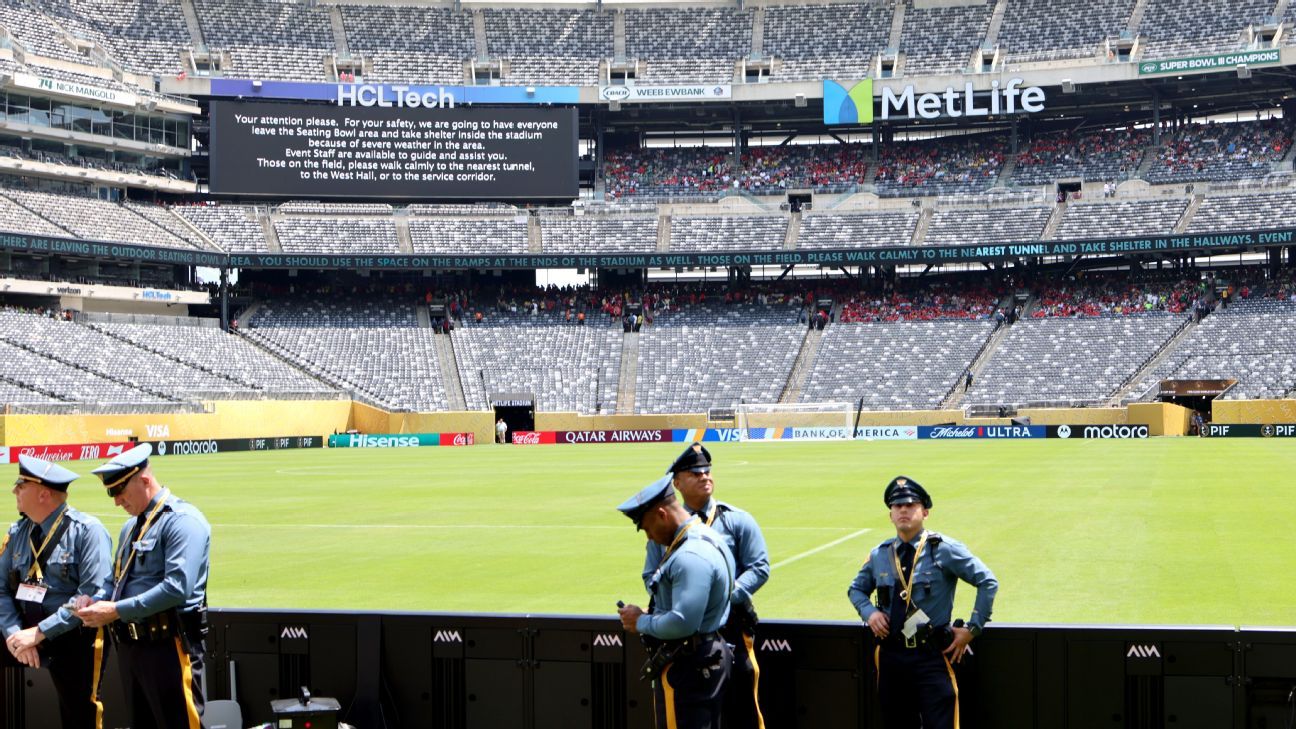
Officials said more than 400 law enforcement agencies are working with the federal government and private security firms to secure the stadiums, fan festivals, base camps and hotels for the record 48 teams who will play 78 matches over 39 days in 11 U.S. cities, with another 26 matches in Canada and Mexico. By contrast, the last World Cup in Qatar saw 32 teams play across a country smaller than Connecticut.
Because the tournament is so sprawling, the federal government does not have the resources to take over as it would for a presidential inauguration or even the Olympics, according to Giuliani. Instead, it is working with local and state law enforcement to coordinate security, including sharing information across the various cities, he said.
"We want to make sure that ... they have coordination necessary to be able to see trends that may be hopping up in Miami that may end up affecting New York or may end up affecting Houston," he said.
Giuliani said that he and other security planners had been "planning with one hand tied behind our back" due to the partial government shutdown of the Department of Homeland Security earlier this year.
"We've seen some gaps, but we've been able to plug some of those holes. We are still plugging a few of those holes," Giuliani said, declining to detail specifics. "But what I can tell you is we've made tremendous progress."
To prepare for the millions of international fans expected, security planners are learning about behaviors unique to the different fanbases that will be visiting their cities. "What may look like a riot to a local police officer, that may actually end up being something that's just standard practice for a soccer fan from that country," Giuliani said.
FIFA provides threat assessments and intelligence about potential threats from each team's home country and shares them with local security planners, according to JP Hayslip, director of security for the Philadelphia Eagles.
"For instance, this particular team uses a lot of fireworks, while some teams don't. Some teams will march, some don't," said Philadelphia police chief inspector John Przepiorka, who oversees the city's Tactical Support Bureau.
Przepiorka said he will dispatch officers who speak the languages of the teams to fan marches and along major fan corridors to assist those who might not speak English. Philadelphia police officers also will be equipped with specialized translation technology embedded in body cameras that will allow them to communicate in more than 50 languages, according to the city's police commissioner, Kevin Bethel.
Security planners are eager to prevent a repeat of the 2024 Copa America final in Miami, when fans without tickets rushed the stadium's gates and caused a crush that resulted in multiple injuries. As a result, FIFA has created a "last mile" security perimeter around stadiums. Many parking lots will be fenced off, and fans will be required to show their tickets before entering the area, according to Hayslip.
"We don't want a person to get to our property who doesn't have a ticket," he said.
Though the stadiums will perhaps be the safest locations on match day, security planners also will need to protect soft targets such as hotels, team base camps, restaurants, fan festivals and block parties.
FBI deputy director Christopher Raia told ESPN that he was most concerned about homegrown extremists like the man who drove a truck into Bourbon Street in New Orleans last year in an ISIS-inspired attack.
"Those are very difficult incidents to not only detect but also stop," he said. "In some way, those big 9/11-style attacks that happened in 2001, those are almost easier to detect nowadays because of the different tools that we have in place. It's these small-scale, soft target attacks from people who get radicalized online via the internet and sit behind their keyboard nine, 10 hours a day."
Bethel said Philadelphia would deploy sanitation vehicles to block certain intersections to prevent such an attack.
Though host cities have received $625 million in federal grants to cover overtime and additional security costs, many teams and fans will stay in smaller cities across the country that have less funding.
"I'm more concerned about these secondary locations," said John Cohen, executive director of the Center for Internet Security, which has been working closely with host jurisdictions. "Those smaller and midsized jurisdictions may not have the human capital or financial resources to dramatically expand their security presence."
Organizers are also contending with the first World Cup in history in which a host country is at war with another participating nation. Giuliani said he had spoken directly with the West Wing so that he could "communicate those dance steps" as the Iranian team enters the U.S. to play group stage games in Los Angeles and Seattle.
One area the federal government has focused on in the lead-up to the World Cup is increasing the country's ability to combat unauthorized drones during sporting events. The DHS awarded host cities more than $250 million to help purchase anti-drone technology, and 60 officers from 30 state and local jurisdictions -- including all U.S. host regions -- have received drone mitigation training at the FBI's Redstone facility in Huntsville, Alabama.
"The thing that keeps us all up at night is an unauthorized drone with a payload that could hurt people," said Devin Kowalski, assistant director of the FBI's Critical Incident Response Group.
Last November, an alleged white supremacist in Nashville told undercover federal agents he planned to attack the region's power grid using a drone equipped with several pounds of C-4 explosives. In March, the FBI warned local law enforcement in California of a potential plot by Iran to launch a surprise retaliatory drone attack. French officials detected more than 400 unauthorized drone incursions during the 2024 Olympics in Paris.
Mike Torphy, assistant section chief of the FBI's Critical Incident Response Group, told ESPN his team would be prepared to intercept unauthorized drones and "make the drone leave the area so that the game is uninterrupted."
Transportation networks remain a perpetual potential target, experts said. Anarchist groups sabotaged the Italian rail network and disrupted travel on the first day of the Milan Cortina Olympics in February. Two years earlier, arsonists attacked France's high-speed rail network hours before the opening ceremony of the Paris Olympics.
Rail systems are "harder to harden and you can still achieve your tactical objectives and not have to circumvent hardened security measures," Cohen said.
Cohen added that U.S. law enforcement has been grappling with a "tremendous amount" of fake bomb threats that originate overseas, some of which use artificial intelligence to call emergency centers. "The goal isn't to blow anything up," he said. "The goal is to simply cause disruption."
The goal is as much to disrupt as it is to embarrass the U.S. on the global stage, said Leon Panetta, former CIA director and defense security during the Obama administration.
"It's the chaos strategy," he said. "Do whatever you need to do to raise hell and make it embarrassing for the Americans to have to say they fumbled the ball and could not basically bring order to that event. And that is their success."
Giuliani told ESPN he was also anticipating cyberattacks on FIFA-related events. "This is absolutely something we're expecting, whether it's ticket hacks, or different things coming up on your QR codes to trying to take over Jumbotrons at stadiums to transportation systems," he said.
On April 7, multiple federal agencies issued a joint advisory about an "urgent and ongoing Iranian-affiliated cybersecurity threat" to critical infrastructure by groups believed to be associated with the Islamic Revolutionary Guard Corps.
Security experts told ESPN they were worried about the federal government's ability to combat these attacks because of recent cuts to federal agencies. The U.S. Cybersecurity and Infrastructure Security Agency is operating at roughly two-thirds of its capacity under previous administrations, according to Nikita Shaw, a cybersecurity expert and senior fellow at the Center for Strategic and International Studies.
"The U.S. was already in a pretty vulnerable state when it comes to cybersecurity," Shaw said. "Now, on top of that, under this administration, there's been a retreat by the U.S. government on cybersecurity."
Giuliani said he was confident that CISA was "more efficient than ever" and "prepared" to combat these anticipated attacks.
The burden of protecting fans will primarily fall on local police departments, which have seen an exodus of officers after the COVID-19 pandemic and George Floyd protests in 2020. "Police departments have more resignations and retirements and less people signing up," said Chuck Wexler, executive director of the Police Executive Research Forum, which works with local police departments preparing for the World Cup. "Departments are stretched thin."
Roosevelt Poplar, a 36-year veteran of the Philadelphia police department and president of the Fraternal Order of Police Lodge 5, said his department has more than 1,000 job vacancies and expected the police force there would be "all hands on deck" on match days. The Philadelphia police department will use a combination of voluntary and mandatory overtime during the tournament, he said.
"We want to make sure our officers are mentally prepared to handle the long 39 days this is going to be," Poplar said.
The Atlanta Police Department will have more than 200 extra officers on duty on match days, according to Atlanta police chief Darin Schierbaum, and officers have been told to expect 12-hour shifts and no vacation during the tournament.
Giuliani said some of the $625 million in federal security funding host cities received would be used to pay overtime. Overtime pay will cost the Los Angeles Sheriff's Department an estimated $2.7 million, with another $5.7 million designated for the Inglewood Police Department and local fire and EMS departments, according to documents obtained by ESPN through a public records request.
Raia acknowledged that 39 days is a long time but said the FBI had enough resources, bodies and funding to meet the challenge. "We have the things that we need in order to keep people fresh, give people time off to recalibrate, rest, make sure they are on top of their game when they go back on shift," he said.
Giuliani told ESPN he had a clear metric for success for the World Cup, both on and off the field.
"If on July 20, ESPN is talking about an amazing game for the World Cup final, maybe the U.S. winning their first World Cup in penalty kicks -- I could be a dreamer -- then we've done our job," he said. "If we're talking about safety and security procedures, then we haven't done our job."
ESPN reporter Michael Rothstein contributed to this report.
Source: https://www.espn.com/soccer/story/_/id/48949556/fifa-world-cup-2026-security-challenge-unprecedented
