Eight years ago, it was Mesut Ozil, whose parents are Turkish. This time, German manager tries to blame Deniz Undav, who has Kurdish and Yazidi heritage.
Germany have failed to progress to the round of 16 in the FIFA World Cup for the third time in a row after losing to Paraguay this week.
And yet again, the four-time world champions have – instead of diagnosing and treating the root causes of their failure – turned to a now familiar response: finding a scapegoat.
Eight years ago, media figures and politicians from the far-right Alternative for Germany (AfD) party honed in on two players – Mesut Ozil and Ilkay Gundogan – and blamed them after the team stumbled at the group stage and failed to defend their 2014 title.
The pair had accepted an invitation to meet Turkish President Recep Tayyip Erdogan during a state visit to the United Kingdom a month before the start of the World Cup in Russia. The pair, who are of Turkish origin, were pilloried for their decision. So vociferous was the criticism that there was speculation they would be dropped from the squad. When the team fell at the group stage, Ozil announced his international retirement aged just 29, citing the criticism in a letter explaining his decision.
“I will no longer stand for being a scapegoat for his incompetence and inability to do his job properly,” Ozil wrote, referring to then-German Football Federation President Reinhard Grindel, who in 2019 resigned amid corruption allegations. Ozil accused Grindel of wanting him “out of the team” after Grindel criticised his meeting with Erdogan. Ozil, however, thanked the German national team coach Joachim Low and director Oliver Bierhoff for standing up for him and backing him.
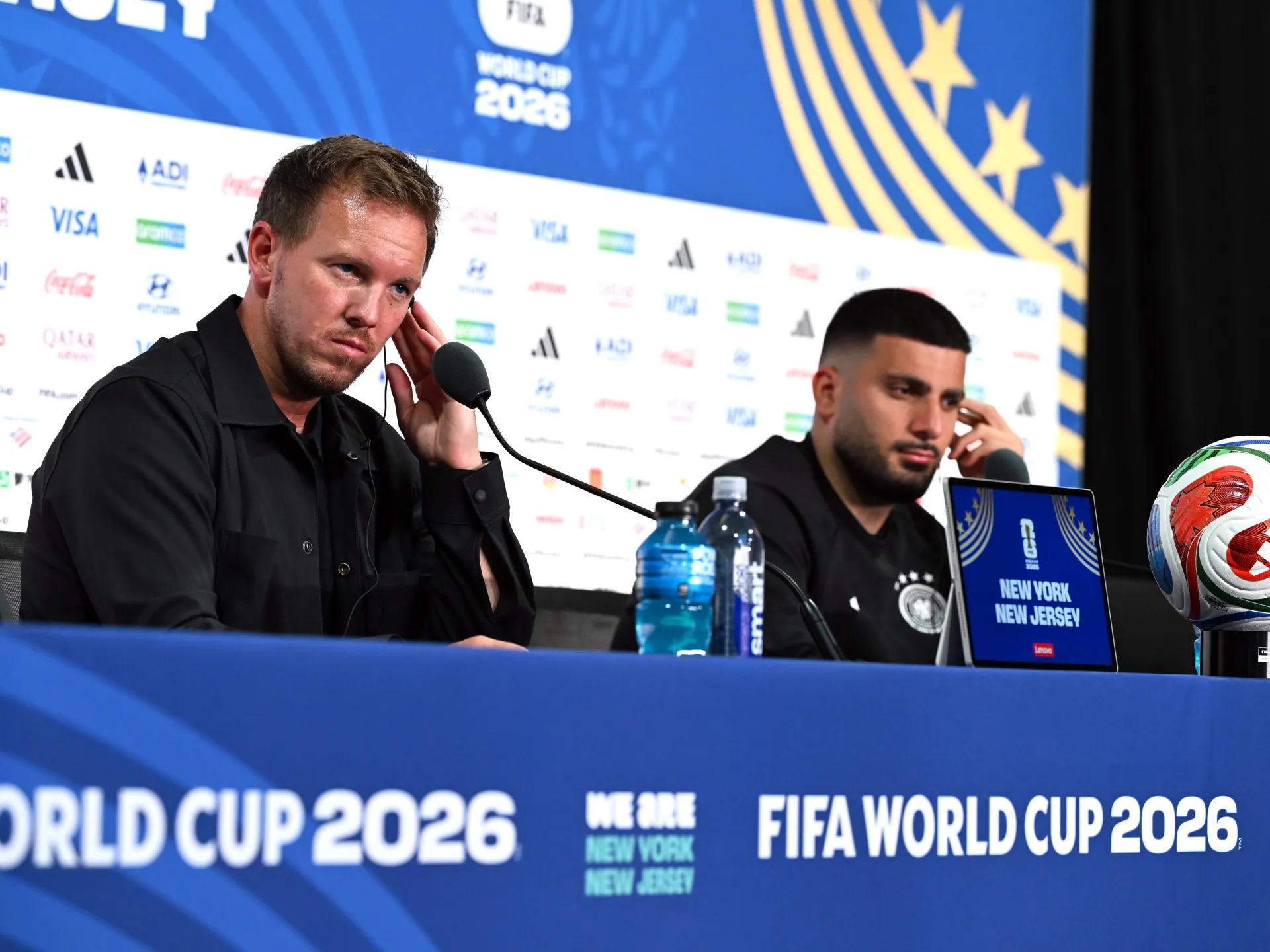
Eight years later, in an interview with Magenta TV after the match against Paraguay, Germany manager Julian Nagelsmann tried to find a similar fall guy. He singled out Deniz Undav, a striker of Kurdish and Yazidi origin, for criticism.
“We have to take the lead in the first minute of the game. We are four alone in front of the goal, and we just have to play the ball sideways, then you put it in an empty goal. Deniz [Undav] somehow puts it to the far post,” Nagelsmann said. “There are just little moments where you have to break the low block with a very simple action.”
To their credit, German fans did not take the bait and focused their ire on Nagelsmann, whose baffling tactical and personnel decisions had been a talking point in the lead-up to the knockout round.
Undav had never been in his manager’s good graces. The latest incident was the continuation of a fractured relationship between the Germany manager and the Stuttgart striker.
In March, Undav scored the winning goal against Ghana in a friendly, but instead of praise, Nagelsmann criticised his fitness and link-up play. The former Bayern Munich boss was widely rebuked and later apologised to the player.
At the beginning of the World Cup it looked like the story would have a happy ending. It took all of seven minutes for Undav to come off the bench and equalise against Ivory Coast in Toronto. He then also nabbed a winner late on. Without Undav’s five goal involvements in the first two World Cup matches, Germany might have finished in third place and faced elimination at the group stage.
His substitution at the hour mark against Paraguay instead closed another dark chapter in the history of the German national team.
It was not always like this. Germany lifted the World Cup in Brazil 12 years ago because those in charge identified problems starting to manifest at the senior team level. At the turn of the century, Germany were no longer producing world class talent and weres reliant on the goalkeeping heroics of Oliver Kahn for tournament success. German teams were also falling behind tactically and struggled to produce world class coaches, which in turn affected youth development.
The German Football Federation (DFB) tackled these problems head on, investing in youth academies throughout the country and emphasising technical ability over size and athleticism. The leadership of Jurgen Klinsmann and Low promoted these ideas at the senior level, giving birth to a new Germany just as dominant but completely different from the team of a generation ago.
Two decades on and Germany now find themselves stuck in their dogmatic ways. At the helm of the national team sits Nagelsmann, who never played the sport professionally and whose granular use of data has earned him the moniker of “Laptop Trainer”.
Nagelsmann might understand the nuances of the game, but his aloof nature, previous run-ins with players, and his chopping and changing have many questioning whether he has a feel for the game.
Part of Germany’s World Cup lore is their success in pressure situations. Before the loss against Paraguay on Monday, Germany had never lost a penalty shootout at the FIFA World Cup. Not only had Germany won all four of their previous shootouts at the World Cup, they had also missed only one penalty kick of 18 attempts in shootouts. Against Paraguay, they missed three times.
In many ways, how the DFB has treated talents like Undav is an indication of why the national football team find themselves in their present crisis.
Undav’s development was not the product of an academy. It was the product of hard work and sacrifice. He has worked as a machine operator in a factory. Even after 104 goal involvements in 163 matches in the German third and fourth tiers, the Bundesliga clubs never came calling. So Undav went to Belgium, continued to score goals and earned a 7-million-euro ($8m) transfer to Premier League side Brighton & Hove Albion.
And even in the national team, he has had to face public pushback from his manager.
Much was made of Undav’s Kurdish heritage and immigrant background earlier in the tournament. The player, who celebrated his first World Cup goal by dancing the Kurdish kurmanji with teammate Antonio Rudiger, was equally German in his blunt assessment after the team’s loss to Ecuador at the group stage on June 26.
“I had the feeling they [Ecuador] wanted it more than us,” he said before imploring his teammates to shift their mentality “We must defend ourselves more. If it gets nasty, then we have to be nasty too.”
But Nagelsmann was critical of his comments. “Ecuador wanted it more than us? That’s nonsense,” he said.
Undav will turn 30 this year. He may not be involved the next time Germany are at a World Cup. But if Germany actually want to proceed further in future World Cups, the DFB would be well served to examine why his talent was overlooked by the academy system it put in place to ensure that a new generation of Undavs make their national team debuts at 17 instead of 27.
Source: https://www.aljazeera.com/news/2026/7/2/german-football-has-a-bigger-problem-than-a-world-cup-loss-scapegoating?traffic_source=rss