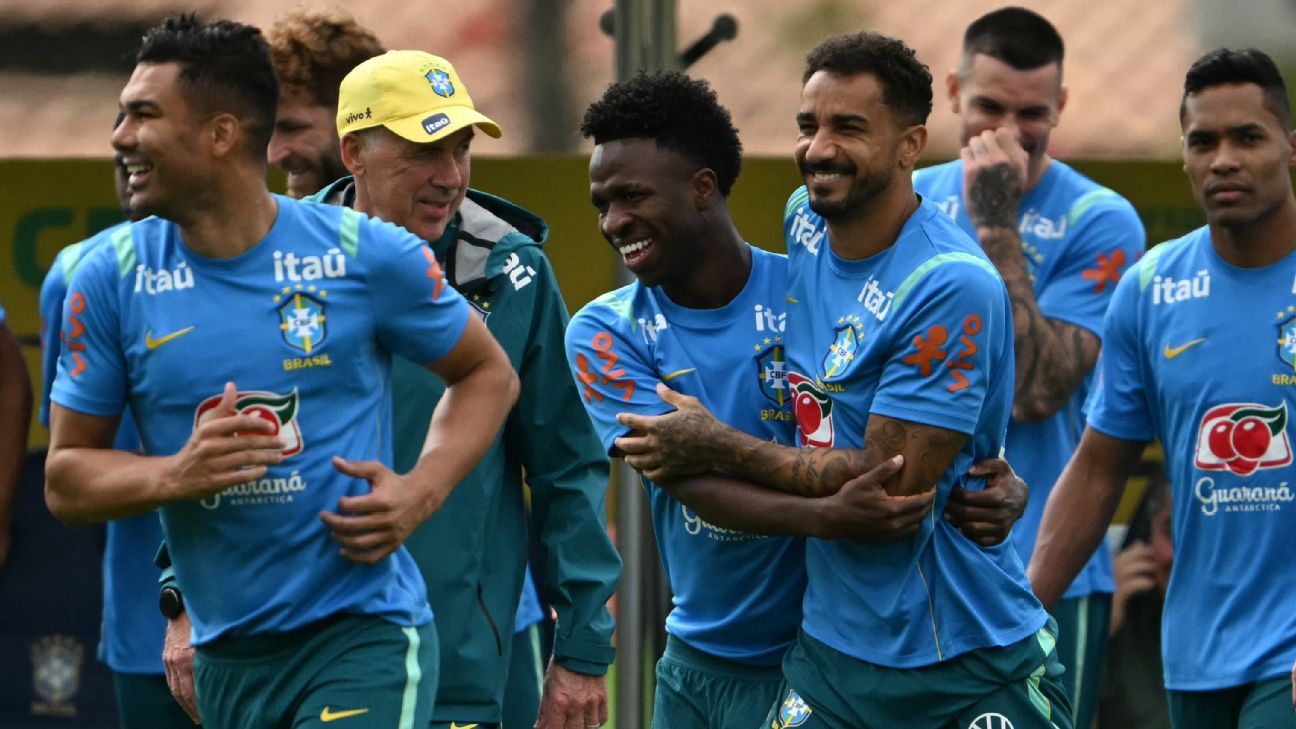
Tim VickeryJun 12, 2026, 04:00 AM ET
Two players in Brazil's squad were not born when the country won the last of its five FIFA World Cup titles in 2002. A generation of adult Brazilians has grown up without seeing the country lift the trophy, and it feels as if a birthright has been taken from them.
Twenty-four years have passed since that last triumph -- coincidentally, the same timespan between win No. 3 in 1970 and No. 4 in 1994 -- but this gap feels more serious.
Soccer in Brazil is never just about what you do. In a fluid game open to so many interpretations, it is also about the way you do it. And the old magic of Brazil was about more than winning -- it was about winning with style, swagger and a joyful demonstration of life's possibilities.
They played such wonderfully expressive soccer that no one lucky enough to see that team can forget it. So the Brazilians went home disappointed, but with their glamor and international prestige intact.
That no longer seems to be the case. Brazil are still heavyweights, of course, and they remain the only team to have won the World Cup five times. But they no longer have a monopoly on flair. People no longer look to them as they once did -- as the spiritual guardians of the beautiful game.
All of this means that the stakes are high this summer. A lot is riding on the 2026 World Cup. Back home, the most important, overriding aim is to win the tournament.
It would be unwise to expect 1970 or 1982 soccer from the current side. For a while, Brazil haven't produced the kind of outstanding central midfielders who make that possible. But they are strong in several key positions, and can count on a frightening array of attacking talent.
The road to winning the World Cup for a sixth time has been long and bumpy, but in all-conquering Italian coach Carlo Ancelotti, they have a wise and experienced pilot. He knows the goal, hence the fact that he agreed to a contract up until the 2030 World Cup. Success is winning the tournament. Failure, he's well aware, is anything and everything else.
But if Brazil were to emerge victorious on July 19, they will have scaled Mt. Everest using a highly unorthodox route. Raising a traditional eyebrow, Ancelotti emanates calm in the middle of a somewhat chaotic preparation period -- and some of the chaos is of his own making.
Much of it, however, precedes him. Brazil wasted years -- almost all of the 18 qualifying games and a Copa América -- under two domestic coaches who appeared utterly out of their depth. Ancelotti then took over with a year to go and, as per usual for a national team coach, there is little time to work. Although, in his typical relaxed manner, the Italian seldom complains.
His plans have been further hampered by injury. Before the squad could be named, he had already lost three players who would surely have been in the starting lineup -- attackers Rodrygo and Estêvão and defender Éder Militão, who would almost certainly have played at right back.
But there have been further problems. The first came in the farewell game against Panama in Rio de Janeiro's Maracanã stadium. Their 6-2 win looks good, but underlying it, though, is a problem.
The first team -- both the players involved and their tactical system -- played a very poor first half. After the break, when 10 substitutions were made, it worked much better. The problem? Ancelotti's favored scheme for Brazil has been with four attackers, with the idea of using Brazil's wingers and also allowing Vinícius Júnior to remain free up front. But it leaves only two in the center of midfield, one of whom is the 34-year-old Casemiro.
Brazil looked very light in that zone of the field, with Panama enjoying more possession and playing around and through Casemiro and Bruno Guimarães. There was a huge improvement in the second half when Brazil played three in the center of the field.
Ancelotti admitted that the results of the game had given him doubts about the formation for the World Cup. And along with the doubts came a concern. His 26-man squad included only five midfielders, and surely he would need more.
Then, in the second and final warmup match -- a 2-1 win over Egypt in Cleveland -- Brazil lost attacking right back Wesley, who pulled up because of a muscle injury. Ancelotti used the situation to reinforce his midfield, calling up soon-to-be Manchester United signing Éderson, but this leaves him without an attacking right back.
In his rejigged side, Wesley is expected to provide width down the right. Now, Ancelotti must choose between Danilo or Roger Ibañez to fill the right back position. There is a sense that Brazil are playing whack-a-mole, solving one problem but creating another.
The team can boast a strong spine, with Alisson in goal, the UEFA Champions League final pair of Marquinhos and Gabriel Magalhães at center back, Casemiro and Guimarães in the middle, and Vinícius and Raphinha as the match-winning talent to be left free up front. But around the edges, there are plenty of uncertainties.
Ancelotti said that he's clear in his own mind about the starting lineup for Saturday's opening game against Morocco. But the local media are fretting over doubts. Who will be the fullbacks? What will happen down the right flank now that Wesley isn't there? Will Lucas Paquetá be the third man in midfield?
Will center forward be Matheus Cunha, who has the virtue of working back and covering the left wing to free Vinícius? Or Igor Thiago, to give the side a reference point? And what about Endrick, who, from being an outsider a few months ago, is now pushing hard for a place? His winning goal against Egypt was the first scored by a central striker in Ancelotti's yearlong reign.
The coach, meanwhile, appears untroubled by such questions. More than starting the World Cup hot, he is much more interested in finishing the competition on a high, which is where we need to talk about Neymar.
Ancelotti led everyone on a merry dance, all the way to the moment that the squad was announced May 18, but it seems likely that he always intended to bring Neymar into the fold. Ancelotti still thinks through the prism of the player he once was, a solid midfielder who saw his role as supporting the talent. Ancelotti has a genuine reverence for the stars -- one of the reasons he has worked so happily with so many of them -- and with Neymar, he glimpsed a possibility.
On one hand, the inclusion of the 34-year-old -- still by far the most expensive signing in soccer history -- makes little sense. His form this year for Santos has hardly been earth-shattering. It is still unclear how much really remains of the player before he suffered a serious knee injury in October 2023.
When the squad was announced, Ancelotti was optimistic that Neymar would improve his physical condition in the next few weeks. It has not happened. A right calf injury means that all he has been doing is recuperating. He is still not ready, and all along, Ancelotti had stressed that he would not take an injured player to the World Cup.
Why, then, is the coach taking this leap of faith? It almost certainly has to do with his experience of USA '94, when he was assistant coach to Italy's Arrigo Sacchi. In the early stage of the competition, Franco Baresi, Italy's magnificent defensive organizer, suffered a knee injury and underwent a minor operation. Maybe people thought he was out of the tournament.
And then, for the final, Baresi led Italy out to face Brazil. His job was to mark Romário, the player of the competition, out of the game. It could not possibly work -- until it did. Baresi got the best of that duel, and Italy held out for a 0-0 draw, but lost on penalties.
Years later, the two coaches, Sacchi and Brazil's Carlos Alberto Parreira, were together at an event. They spoke of Baresi's surprising success and came to the same conclusion. The conditions of that World Cup -- the intense heat of the final, and the cumulative effect of exposure to a month of high temperatures -- meant that it was better to be injured than to be tired.
Ancelotti has drawn his own conclusion. Perhaps, come the end of the tournament, in a totally different function, Neymar can be his Baresi. Against drained opponents, Neymar's lack of full sharpness will matter less, and his undoubted talent might just tip the balance.
With a squad of 26 to choose from, Ancelotti clearly thinks that such a gamble is worthwhile. And so Neymar has an unlikely last opportunity. For him, it is almost certainly a case of win or bust -- and maybe, after a 24-year drought, the same is true of Brazil.
Source: https://www.espn.com/soccer/story/_/id/49021550/24-years-their-last-world-cup-title-win-bust-brazil