A flotilla activist recounts his detention after Israeli forces intercepted a Gaza-bound solidarity mission at sea.
They had just pushed Eleni next to me, forcing her to her knees, her face squeezed against the cold metallic container.
She turned to me and whispered, “How are you?”
“Been better, to be honest,” I thought to myself. That’s all I could think of, as if a mediocre attempt at humour might make the guards looming over us disappear. But I said nothing. I nodded back at her before being dragged around 90 degrees to face someone typing on a computer. The person opposite me was in a face mask, like they all were, a desk-based commando who wanted to know my first and last name, my birthdate, and my passport number.
But I didn’t have my passport. It had been left on our sailboat with the others. We were held at gunpoint by commandos who were unambiguous: No personal items, no shoes, no passports.
We were part of the Global Sumud Flotilla, a fleet of more than 50 sailboats carrying activists in an act of solidarity and providing symbolic humanitarian aid to the people of Gaza.
We set off on Thursday, May 14, from Marmaris, Turkiye, for Gaza in a bid to challenge Israel’s illegal naval blockade. But on the following Monday afternoon, May 18, Israeli naval forces intercepted our vessel, La Sirena, in international waters near Cyprus. Over the next two days, they boarded all of our boats, detaining 428 activists from more than 45 countries. The seven of us on board La Sirena were taken at gunpoint and transferred to the Nahshon, one of the two Israeli military landing crafts converted into floating prisons for the operation.
The name Nahshon is sometimes linked to the Hebrew word for serpent, and it belongs to a figure from the Book of Exodus – the leader who, according to Midrash, initiated the Hebrews’ passage through the Red Sea. So we had become prisoners on a ship named for a man who walked into the sea to free his people – held captive in the name of liberation by those who had turned that legacy into a tool of siege.
The desk-based commando opposite me didn’t seem bothered by the symbolism. He simply wanted to know my passport number. But I couldn’t remember it, and we had to settle on my name and nationality. There was something almost procedural about how I was being processed at that moment. What I didn’t know was that it would be the last moment of that ordeal, more than 50 hours in all, that wasn’t governed by deliberate cruelty.
Soon after, I was thrown into a metal shipping container that the soldiers had repurposed as a processing chamber, or so it seemed at first. But then, a leg, possibly a knee, took me to my own knees. As I fell, a hard blow landed on my left ear, and I heard nothing but buzzing. I was being beaten – and then, seconds later, I was spinning towards a white door on the right, still on my knees, like a human pinball.
I flew through a door and landed in a compound. At first, I must have mirrored the terrified gaze I saw on others’ faces when they exited after me. We were all convinced that we had just entered the next level of whatever this place was.
Immediately, I was greeted with soothing hugs, sips of water and the warm gazes of those who went through the container before me. Together, we spent minutes that turned into hours, listening to the repetitive cacophony of sounds coming from behind the white door.
Kicks and screams were followed by the buzz of Taser guns, more screams, bangs on the metal container, and yet more screams. At the end of each cycle, the white door flew open, revealing a comrade rolling or limping, holding their chest or head or pulling their pants up, always with the same look of terror.
“What level of hell have I just entered?” they seemed to wonder.
The compound we landed in was open to the elements. It was outlined by six containers arranged in a rectangle. Four of them were accessible to us, two on each long side, while the remaining two formed the short ends and were sealed shut. One was reserved for the wounded, one was already filled to the brim, and another was what I understood to be a torture container.
To get out of the cold, we made our way towards the fourth, the one opposite the white door we had all just been spat out of, slowly venturing past the black tape on the floor just past its entrance. We were warned by comrades who came through before us that our captors didn’t want us crossing that line; they wanted us outside and crammed as far away from the white door as possible. But we made it in.
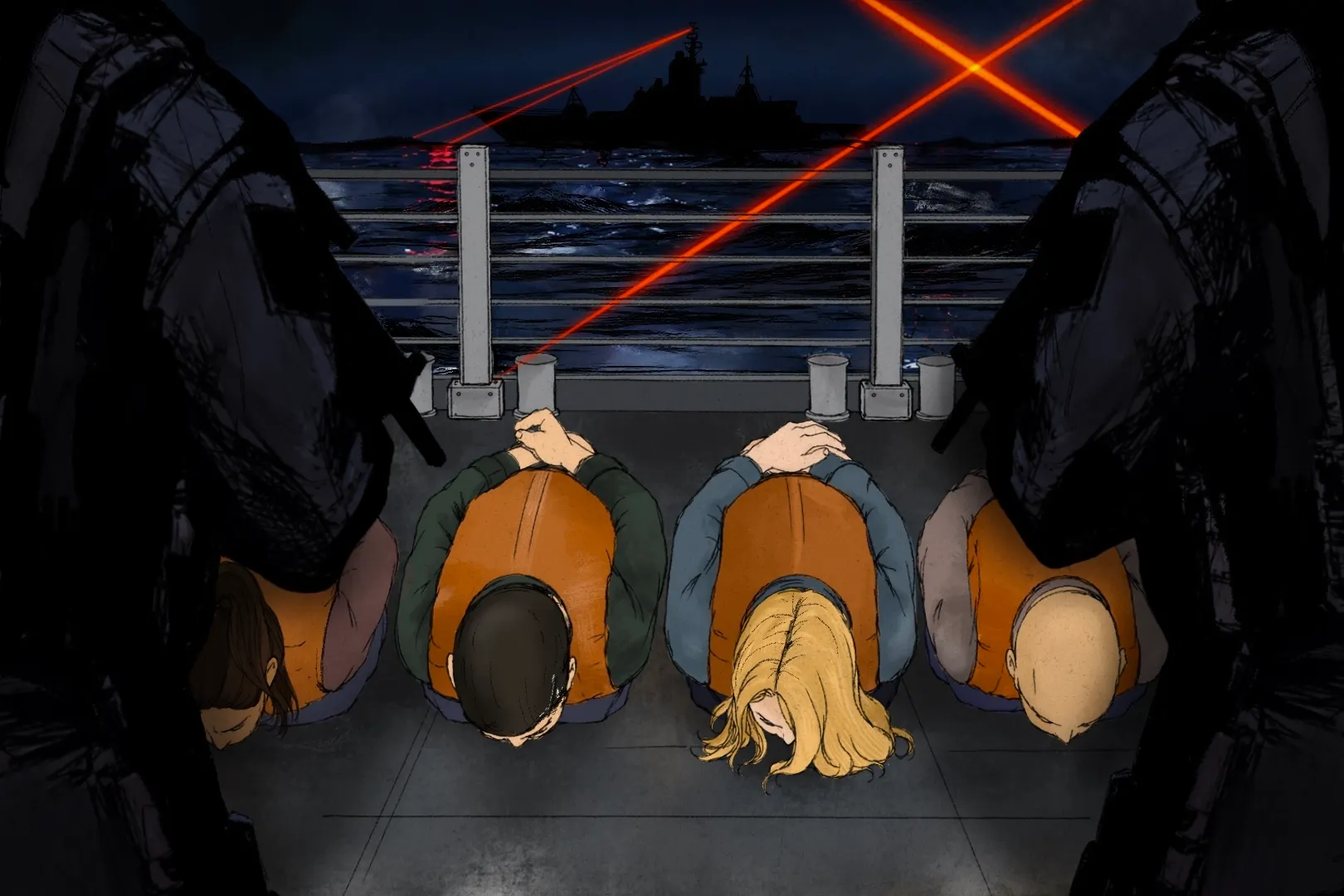
From there, I could see a sticker on the container door. “F*** Hamas,” it read, along with Israeli and US flags. There was a guard at each of the four corners of the deck above, always pointing their guns straight towards us in the compound. Over our entire prison journey, these guards never said a word. A metallic tube protruded beside the guard opposite the torture container, rising and curving into an L that leaned towards us, pointing straight into the compound. All night long, the guards opposite our container would flash strobe lights and point the laser beams of their weapons at comrades unfortunate enough to be crammed next to the container opening.
The bangs and screams as comrades were spat out of the white door continued for hours. Some of us retreated into the container; others remained in the compound. Towards the end of that first day – whatever a “day” or an “end” might mean under these circumstances – some news arrived.
Some of our comrades had caught sight of birds, possibly pigeons. With that, we rationalised that because pigeons were land birds that never strayed too far from shore, it must have meant we were approaching land.
A little later, a female comrade from France walked into our container, triumphant and cautious in equal measure, unable to suppress a grin. It wasn’t just the pigeons – someone had also spotted a couple of guards trying on lifejackets. We were approaching land – that was now clear. She suggested that we start packing our belongings and discreetly get ready without letting our captors know, but most of us didn’t have much with us.
Her message: Don’t get too excited, but allow yourself a sigh and a slight grin.
To terrify us, our captors stormed into the compound several times, each with a loud bang. The door would swing open, and stun grenades were thrown randomly towards us – into an opening, onto bodies; it really didn’t matter. The Israeli naval commandos would form a wall with their shields, and with their guns protruding at us, another stun grenade and then another. We would crouch together at the far corner away from the white door, trying to stay safe and as far away from our captors as possible.
But moments after our French comrade triumphantly announced our imminent departure, the door swung open once again. We heard two bangs from the stun grenades, and our captors formed their usual shield wall. There we were, once again in our small corner, but this time something was different. Our captors stayed around, and they ordered us all into a container for the first time. I could not stop grinning on the inside. I sensed that something had changed. I considered the pigeon, the lifejackets, the cramming. Surely, we were going home, I thought.
Our captors were looking for a volunteer or two to clean up our rubbish. They wanted us to sweep the place clean before we left. Two people put their hands up. The rest of us would have happily helped had we been asked to do so – or had we been given the chance. Why wouldn’t we? We were going home at last.
The two volunteers picked up all the rubbish and stacked it in a corner. We, in turn, were stacked inside our container, where we struggled to breathe. We devised a clever system where we took turns walking in front of the opening of the container. At some point, as we walked around in circles, I missed our captors retreating through their usual white door.
They left behind water and food supplies they considered adequate: Sometimes 12 litres, sometimes 24 for more than 170 of us, and white bread loaves, some still frozen, were occasionally tossed straight onto the wet deck. A few of us were on a hunger strike, which doesn’t feel like a bad choice given what was on offer.
But now, many of us despaired, because these new provisions meant we would be here at least another day. Shoulders dropped. There were no more sighs of relief, and our slight grins disappeared.
But I continued to assume the best, thinking that our captors surely delivered these meagre supplies to give us the impression that our detention would continue. They wanted us to think we were stuck there. I believed it was a game.
Hours went by, and our captors retreated, but surely this was still a facade. Surely these were the last few seconds of torment. Surely they would come back and tell us that another country’s navy was there to pick us up.
But more hours passed, and the light faded. It soon became evident that we would be spending another night here. By now, we had learned to read the sounds. The humming of the Zodiacs being winched back onto the deck was a preamble for what always followed the arrival of more detainees: The screaming, the kicking, the metallic clangs and the buzzing of Tasers from inside the torture container.
The time people spent being tortured appeared to increase as the hours passed, and it seemed that some nationalities and complexions – those who looked Turkish or Arab – were stuck in there longer.
The whole time, we tried figuring out which direction the Nahshon was heading. Our sailboat captains sprang back into action, explaining that the sun in the Northern Hemisphere has an elliptical orbit towards the south, so at noon the shortest of shadows would point to the North. We listened and clung to whatever hope and point of the horizon we could – all while dreading that we would soon see the coast of Israel.
Our captors continued to visit us, always with a bang, and I had grown accustomed to the process of stun grenades and having to cram into a corner. But one time, they entered and started to fire rubber bullets at us, ensuring our complacency dried up with fears that things were getting worse.
There would surely have to be an end to this nightmare. Dozens of us had broken ribs, fractured bones, abrasions, Taser burns. Something would signal that we could soon stop using frozen bread as toilet paper. Stop screaming for sanitary pads. Stop using water bottle rings and labels to create impromptu slings. Stop ripping additional clothing layers to stem the bleeding. By this point, even the dreaded Israeli shore seemed like a better option than this.
Finally, our captors entered the area with their usual series of bangs and asked for a volunteer to interpret. They shouted at us to line up by our numbers and in tens, which we did hastily and nervously, hoping any news was better than no news. But then, a commando with a strong North American accent ordered us all to get on our knees with our heads down. If anyone lifted their head, he threatened to shoot. I began calculating in my mind how many minutes on my knees I would swap for seconds in the torture container.
It felt like we had been on our knees forever. There was a drone overhead, and a nationalist-sounding song was played on the loudspeakers in a maddening loop. I devised another small trick to give myself a sense of control and a sense of time. I began timing the song again and again. One minute, 10 seconds. As we finally approached a port, I asked myself what kind of power or strength had allowed us to endure all of this. We all wondered the same thing.
Our strength had come from our solidarity – a kind gaze or a warm gesture, ripping our clothes to make bandages for others, discreetly using our bodies to support comrades struggling to stay on their knees, and hugging strangers to stay warm during the cold nights in the container.
But it was also the realisation that we had endured only a tiny fraction of what Palestinian prisoners experience. Our 50-odd hours of being captives at sea, plus another full day on land, could not begin to compare to the 80 years of Palestinian suffering – the same suffering we had set off to protest.
We had been inspired by them, and we found our own sumud, steadfastness, in the process. As the song finally stopped and our line started moving, we knew we would be shoved through the torture container once again and out onto the Israeli port of Ashdod. While we had initially dreaded being taken to Israel, by the time we arrived, we were simply desperate to get off the boat.
Still, we all knew that what awaited us there wouldn’t necessarily be any better.
In the hours that followed, we were again beaten repeatedly, forced into stress positions, dragged across the port’s impromptu processing centre, some of us forced to kneel and to crawl. While we were being fingerprinted, photographed and transferred to the prison service inside a large processing tent, I was dragged into a small curtained-off area by two guards. One of them thrust a folding knife towards me. The blade was aimed at my abdomen, but I instinctively moved and it struck my hand instead, causing a 4cm wound and drawing blood.
No medical assistance was offered, despite the visible injury. The incident has since been documented by medical staff in Athens and will form part of ongoing legal proceedings. The attack was entirely unprovoked. The guard then continued to torment me, forcing me to strip naked. After our release, other detainees told me that everyone brought into that curtained-off area was forced to strip, and several said they had been threatened with stabbing by guards.
In Ketziot prison in southern Israel, the torment continued – our injured comrades were never medically attended to. We were dragged around and crammed 30 to a small cell for hours, suffocating from a lack of oxygen. We were offered no food or drinkable water, but the prison boat experience was the most harrowing part of the detainment.
We had been placed in a black box without any rights, in an act of piracy by a state that seems determined to create new rules of the sea, just like its ever-expanding settlements in the West Bank and its encroachment upon Gaza create new facts on the ground there.
We have lived to tell the Israeli prison boat story, and to warn others that unless we take action, we will not be its last passengers. What we endured for 72 hours at sea and on land, Israel has been perfecting by detaining and dispossessing Palestinians for decades.
Standing by our Palestinian brothers and sisters has now become both an act of solidarity and a means of resisting Israel’s ever-expanding reach – into territory that was never theirs, into international waters and onto the bodies of those who came to bear witness.
Editor’s note: The Israeli Army was approached for comment regarding the allegations contained in this article. At the time of publication, no response had been received.
Source: https://www.aljazeera.com/features/2026/6/7/fifty-two-hours-on-an-israeli-prison-ship?traffic_source=rss