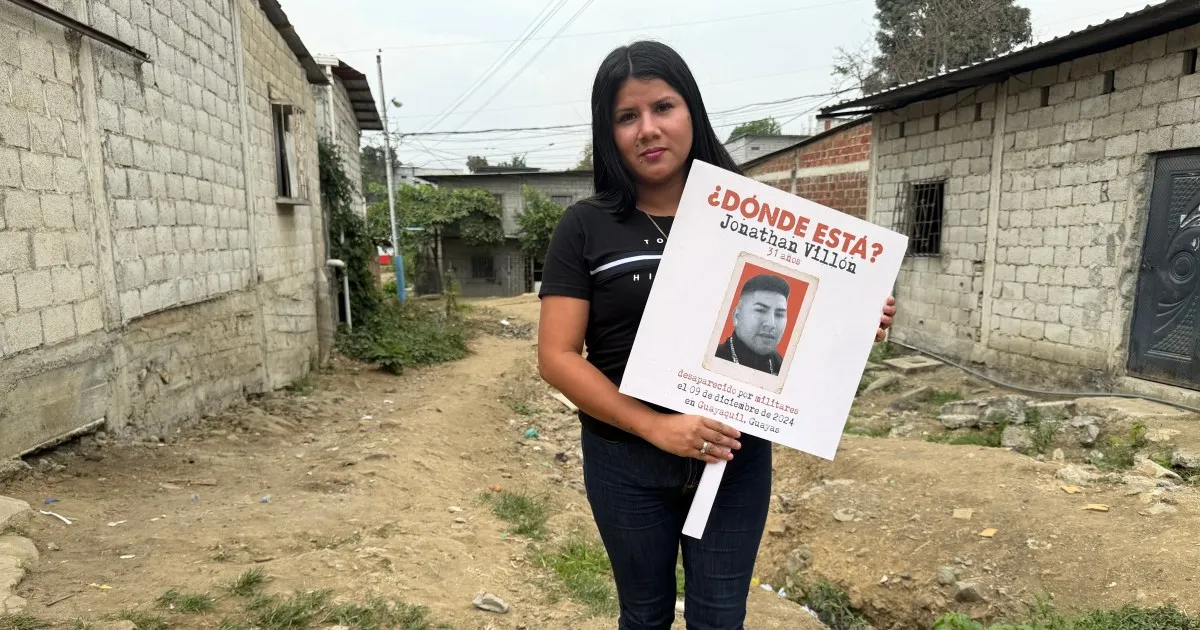
Fifty-one people have reportedly disappeared during Ecuadorian military operations since early 2024. Can their loved ones find out what happened?
Not long ago, Ecuador was one of the safest countries in Latin America. Now, it is one of the deadliest.
Violent drug cartels have arrived from around the world — from Mexico to the Balkans — to secure cocaine trafficking routes to the coast.
Homicide rates have skyrocketed. President Daniel Noboa has pinned his hopes of lowering the violence on heavy police and military deployments across the country.
In doing so, his government has been plagued with allegations of human rights abuses, including enforced disappearances.
In a new episode of Fault Lines, Al Jazeera investigates the claim that 51 people have been forcibly disappeared during military operations since early 2024.
“For 2024 and 2025, we have 34 preliminary investigations that are currently under way, and 51 victims,” Leonardo Alarcon, the acting attorney general, told Al Jazeera in an exclusive interview.
"The cases are progressing, but the investigations have to be objective and conducted rigorously in order to present the judge with the necessary and compelling evidence to prove the case.”
While it might be true that the cases are progressing, families of the missing argue they are moving at a snail's pace.
Since early December, Fault Lines has spent time with families who are pushing for accountability and pleading with the government to learn what happened to their loved ones.
In some cases, they have spent years without receiving any direct response.
“It gets harder every time my nephew asks when his father will come home and I don’t have any answers,” said Rosario Villon, whose brother, Jonathan Villon, has been missing for almost a year and a half.
The 31-year-old father of three was last seen on December 9, 2024, when he left to pick up groceries in his hometown of Guayaquil.
Addressing a vigil for Jonathan last December, Rosario explained the toll his disappearance has taken on her family.
“Seeing my mother cry for her son, not knowing what to do next to bring him home — it isn’t easy," she said.
Fault Lines has reviewed footage of the day Jonathan was detained. Security cameras show soldiers patrolling Jonathan's neighbourhood, Nueva Prosperina.
A neighbour's mobile phone video also captures the moments after Jonathan was forced into the truck's bed, under a wooden bench. The truck then drives off, and he has not been seen since.
The family recorded the licence plate numbers of the municipal vehicle the soldiers were using, but the military has refused to respond to requests about Jonathan's case.
“We have the evidence, we have videos, we have the licence plates of the truck, and they won't give us a concrete and exact answer. What happened to my husband?” asked Jonathan’s partner, Yadira Bohorquez.
Lawyers representing the family say the military simply declared that it had no operations in that area on that date, despite the video evidence.
“The case of Jonathan Villon is completely paralysed by the refusal of the Ministry of Defence to cooperate in handing over information that the Prosecutor's Office has already requested,” said Fernando Bastias, a lawyer with CDH Guayaquil, a human rights nonprofit representing the family.
Only one case has so far garnered national attention, leading to soldiers being held accountable.
The victims are known as "The Malvinas 4”, named after a neighbourhood in southern Guayaquil called Las Malvinas.
Just one day before Jonathan was detained, four Afro-Ecuadorian boys, aged 11 to 15, were walking home from playing football in the neighbourhood.
At first, when the boys were reported missing, the military claimed it had played no role in the disappearance.
But surveillance footage later showed Air Force officers forcing them into the bed of a truck.
“They have been lying from the start," Luis Arroyo, the father of two of the boys, said of the soldiers involved in the case.
"At first, they never hit them. They never tortured them. They left them safe and sound. But after the investigations, then they changed their tune."
The remains of the four boys, including Arroyo's sons, Ismael and Josue, were ultimately found burned in a remote area, called Taura.
Five of the soldiers accused of participating in the boys' disappearance cooperated with prosecutors. They admitted to beating the boys and leaving them naked, far outside the city.
At the conclusion of the trial in December 2025, they received a sentence of 30 months. The 11 soldiers who did not cooperate received more than 30 years in prison.
“This is huge, not only in Ecuador but in Latin America. It is not normal for the military to get convicted for enforced disappearances,” said Camila Ruiz Segovia, a campaigner with the human rights group Amnesty International.
“It might deter the military from committing further violations, and that's why it's important to keep pushing for the other cases.”
Fault Lines reached out to the Ecuadorian military and the office of President Noboa about the allegations of forced disappearances but did not receive a response.
Meanwhile, families like the Villons continue to push for the truth about their loved ones' whereabouts. But without the cooperation of the military, they remain in a state of limbo.
“I pray to God a lot to touch the hearts of those soldiers, and that they tell us what happened to our family members,” said Bohorquez, Jonathan's partner.
“I hope that we are victorious in this battle and that all of our family members, all of them, are alive.”
Source: https://www.aljazeera.com/news/longform/2026/6/4/ecuadors-disappeared-inside-one-familys-search-for-answers?traffic_source=rss
