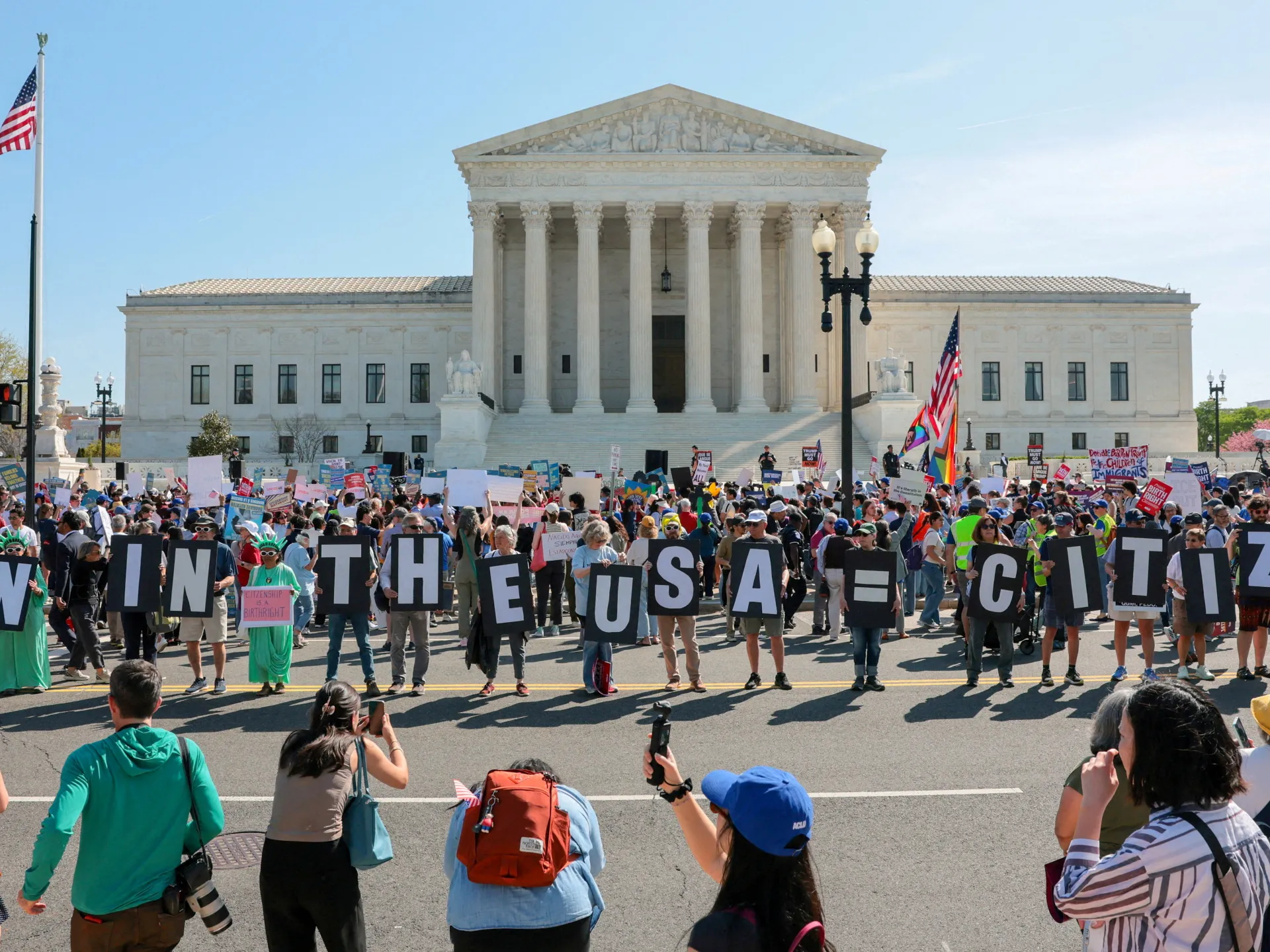
Birthright citizenship survived, but the fight over who is fully recognised as American is far from over.
Last week, days before the nation’s 250-year anniversary, the United States Supreme Court reaffirmed the constitutional right to citizenship to nearly everyone born in the US. Anticipation of this decision had long been building, and you could almost hear a collective sigh of relief when the announcement arrived. The president cannot cancel the Constitution by executive order. The US will remain, at least in this one very specific way, an open and welcoming society.
Immigration advocates across the country celebrated. The ruling was a rebuke to the president’s supercharged anti-immigration agenda. It felt like a bullet had just been taken out of a loaded gun.
To the administration and its supporters, the Court’s 6-3 judgement was seen as a betrayal. Trump responded with barely concealed racist snark, writing on Truth Social that he “would like to congratulate President Xi, and the Great Country of China, on their massive Birthright Citizenship WIN!” White House adviser Stephen Miller, the chief architect of Trump’s anti-immigrant agenda (and his unofficial secretary of histrionics), described the court’s decision as “our national self-obliteration”.
Well, Stephen. It’s been a good run! In truth, political prophets predicting the demise of the republic due to some misbegotten aspect of the immigration system are as constant as the North Star. We’d do well to remember this fact while the nation commemorates its 250th birthday. We’ve survived everything from the anti-Catholic Know Nothing party (so named because the movement began as a secret society, and members were advised to say they “know nothing” about their own group to outsiders) to the racial terrorism of the Ku Klux Klan (still with us, but a shadow of its former self).
Reading through the Supreme Court’s birthright citizenship decision is instructive, if only because the justices rehearse the ways that different marginalised groups have had their citizenship contested over the years. These include Chinese Americans such as Wong Kim Ark. Wong was born in San Francisco to Chinese parents in the 1870s, but officials denied him citizenship, claiming he owed allegiance to the Emperor of China and not the US. He sued and won, and his 1898 Supreme Court case solidified the legal foundation of the Fourteenth Amendment, which establishes birthright citizenship.
Also mentioned in the decision is the 1857 Supreme Court ruling that Black people, enslaved or free, could not be citizens of the US. In that case, the infamous Dred Scott v Sandford, the US was violating its own principle of granting citizenship by jus soli (born on the land). The Fourteenth Amendment, passed after the Civil War, corrected that error, the majority wrote. And it should always be remembered that the Indian Citizenship Act, which extended citizenship to the Indigenous peoples of this country, was passed into law only in 1924. Each of these groups, of course, has also had to battle constant voter suppression efforts simply to exercise their full citizenship.
Based on this significant Supreme Court decision, it may seem like a tolerant and generous America is being affirmed from the bench. This, sadly, is a hasty and unwarranted conclusion. What the Court’s other rulings on immigration this term make abundantly clear is that, while birthright citizenship has been affirmed, the Court is allowing the government to withhold the promises of liberty and guarantees of freedom from others who have reached our shores and live in our communities.
The Court gutted Temporary Protected Status (TPS), a programme begun in 1990 to provide lawful temporary residence and work authorisation to people from specified countries fleeing war and other forms of instability. This decision will directly impact hundreds of thousands of Haitians and thousands of Syrians who live and work in the US. And not just them. Some lawmakers are already warning that the sudden departure of Haitians, who constitute a large segment of the healthcare workforce, will have profoundly negative consequences for healthcare in this country. Other nationals in the country on TPS, including Lebanese, Salvadorans, Sudanese, and Ukrainians, are at future risk of losing their right to stay and work.
It doesn’t stop there. The Court also ruled that the government may turn away asylum seekers at ports of entry along the southern border, a policy formalised during the first Trump administration. This rule now has the force of law behind it, and the consequences will be devastating. In a blistering dissent, Justice Sotomayor explained that “the Court today blesses the Executive Branch’s decision to slam the door shut on all who are fleeing persecution, despite the detailed inspection and asylum system that Congress enacted and commands.”
Meanwhile, we have an administration seeking to denaturalise American citizens at a rate unprecedented in the post-Civil Rights Era. And the First Amendment right to freedom of expression is challenged, not defended, by our chief executive, as the government seeks to deport human rights advocates, such as the Palestinian activist Mahmoud Khalil, for their speech.
Islamophobia has been mobilised into the most cynical kind of political service with the rise of the so-called “Sharia-free Caucus”, a congressional caucus of some 60 Republican representatives from 25 states that have united to fight the phantom threat of something they call “Sharia law”. (In Islam, Sharia is a guide to ethical behaviour and not a legal code.) The Sharia-free Caucus has decided that “Sharia law” is taking over “our Constitution, our freedoms, and the Christian foundations of our nation”. Preposterous, for sure, but let’s be clear. The anti-Catholic Know-Nothing Party of the past has been resuscitated and modernised into the anti-Muslim Sharia-free Caucus of today.
On the 250th anniversary of the founding of the US, we would do well to understand that the country is neither a set of stated principles nor a settled ideology. Rather, the US is an entity in constant motion, its meaning and values contested every day. For the length of our history, that contest has mostly been about a privileged few keeping out the deserving many in both the definition and rewards of what it means to be American. The same fight will continue, perhaps for another 250 years. But what should be clear, especially today, is that the promise of this country gets closer to being fulfilled when it hews to its expressed principles of liberty and justice for all, and every time it extends those rights to more rather than fewer people.
The views expressed in this article are the author’s own and do not necessarily reflect Al Jazeera’s editorial policy.
Source: https://www.aljazeera.com/opinions/2026/7/4/at-250-america-is-still-deciding-who-belongs?traffic_source=rss