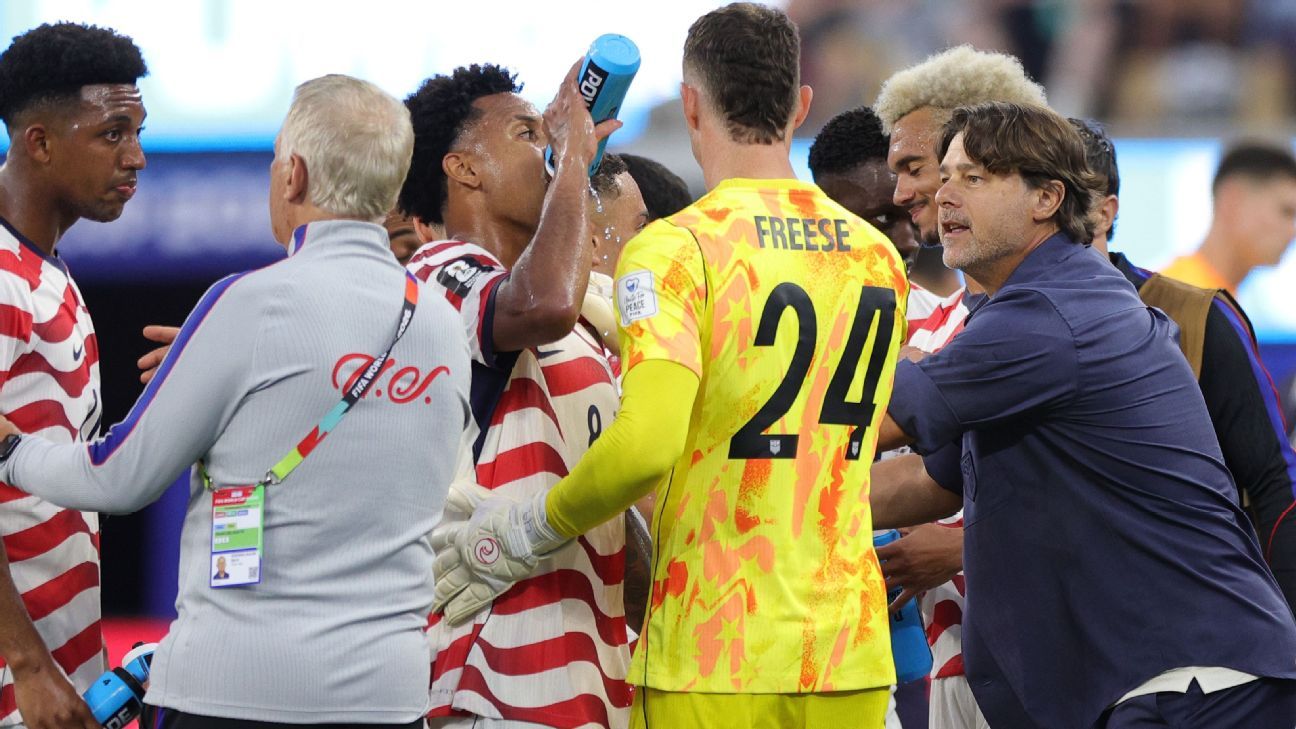
For this World Cup, FIFA has introduced mandatory hydration breaks -- around the 22nd minute mark of the first half and 67th minute of the second -- to counter the weather conditions across Mexico, Canada and the United States this summer.
But while the breaks are essential for player welfare when it's hot, they are happening regardless of the temperature, leading to plenty of criticism about the impact on the game. Furthermore, the breaks have essentially split the game into four quarters similar to the NBA or NFL -- which is handy given that the majority of sports fans from the home nations consume their sports in that manner -- while it also allows FIFA to cash in on some lucrative advertising revenue for three minutes midway through each half.
Like them or loathe them, our reporters looked at a number of different ways that the hydration breaks are making an impact on this World Cup.
Jump to: A commercial cash injection? | A momentum killer?
The World Cup hydration breaks were first announced by FIFA last December, with the severe heat experienced by teams and players in the U.S. during last summer's FIFA Club World Cup prompting the game's governing body to introduce a formal structure for drinks breaks.
FIFA wanted a "streamlined and simplified" version of the more ad-hoc hydration breaks at previous tournaments and, despite this World Cup being played in some stadiums with air conditioning and roofs, a decision was made to introduce three-minute stoppages each half in every game
"For every game, no matter where the games are played, no matter if there's a roof, or temperature-wise, there will be a three-minute hydration break," Manolo Zubiria, Chief Tournament Officer of the World Cup, said last December. "It will be three minutes from whistle to whistle in both halves. Obviously, if there's an injury [stoppage] at the moment of the 20th or 21st minute and it's ongoing, this will be addressed on the spot with the referee."
"I don't like it; I only like it when the conditions are extreme," USMNT boss Mauricio Pochettino said. "But when the conditions are good, it is unnecessary."
Spain drew 0-0 with Cape Verde on Monday night, but boss Luis de la Fuente spoke about the temperatures before the game. "I look at it in terms of the health of the players," he said. "In extreme conditions it's the right thing, having a break to freshen up. It's true that tomorrow with the temperatures there'll be [inside the stadium], maybe it isn't necessary. But we've all seen the temperatures in Chattanooga [Spain's training base], the humidity. Those breaks let you get your energy back."
There is sound medical science behind the need for hydration breaks, however.
According to FIFPRO, the global player's union, three games at last year's Club World Cup should have been suspended or postponed due to the extreme heat due to those fixtures exceeding the threshold of 28 degrees Celsius (82.4 degrees Fahrenheit) on the Wet Bulb Globe Temperature gauge (WBGT) -- a measure of heat stress in direct sunlight, accounting for air temperature, humidity, wind speed, sun angle, and cloud cover.
So far this summer, no World Cup game has been impacted by such excessive heat and FIFA amended the fixture list following the Club World Cup to cater for more games under cover and fixtures being played at times more likely to be accompanied by less punishing conditions.
But it's still hot, so there is support for the hydration breaks.
"The new rule should be viewed primarily as a medical safety measure," Prof. Mehmet Karabulut, M.D., Medicana Health Group, said. "Today, the game of football is much faster and requires immense physical effort; players traverse vast distances on the field and often engage in high-intensity efforts.
"Under such conditions, it's easy to lose a lot of fluids through sweat, making it difficult to regulate body temperature, especially in warm and humid weather. An organized break to consume fluids and cool down will enable players to return to the field in optimal condition and prevent possible health risks before fatigue sets in.
"These breaks are not a complete player-safety policy on their own. Kick-off times, recovery periods, cooling areas, emergency medical protocols and acclimatization plans are also essential. Hydration breaks are one important layer in a much larger welfare system and in the case of the World Cup in summer in North America, the medical argument is extremely strong." -- Mark Ogden
It is perhaps telling that Zubiria made his announcement on hydration breaks during a workshop at the World Broadcaster Meeting in Washington D.C. during the draw for the World Cup, because there has been plenty of criticism suggesting that it is the broadcasters, rather than the players, who are the real beneficiaries of the hydration breaks.
Players get a three-minute break and the coaches deliver tactical messages, but the broadcasters can -- and many have been -- cash in with a lucrative commercial break while play is halted.
Michael Johnson, a US sports industry research analyst for S&P Global, told Reuters that the three-minute hydration breaks offer real financial positives for broadcasters during the 104-game tournament, saying that the pause in play could be "extremely valuable and could potentially command Super Bowl-level prices within that seven to probably nine-million-dollar range."
But Netherlands captain Virgil van Dijk expressed concerns that the breaks merely enable more "commercialism" to enter the game.
"Hydration breaks are a bit interesting, because I was obviously watching almost all the games up until today, and every time going to commercial is a bit ... Not really that I like it," he said. "I think for the neutral watchers on TV it's also not great.
"If it's really hot, obviously it would be good to put them in. But I think you have to look at it in every game, separately, in my opinion."
Former Manchester United and England defender Gary Neville told The Overlap that the hydration breaks are a "stealth advertising break" with U.S. broadcaster Fox using the hydration break to run commercials.
But U.S.-based Spanish language broadcaster Telemundo has chosen not to take a commercial break during the three-minute stoppage -- a decision that has been mirrored by U.K.-based ITV Sport. -- Mark Ogden
Restarts of play are an important part of any sport. They disrupt rhythm, shift momentum, and allow the other side to regroup and rejig their gameplan.
The World Cup's mid-half breaks have fundamentally changed the way teams approach games, as they can now adapt and improvise based on the new information, while they are offered a reprieve from any barrage of attacks and can be methodical about their style and intensity in each "quarter" of the game.
"It's advantageous for the team losing momentum - that's why I call them momentum breaks," USWNT boss Emma Hayes told ITV. "When you're on top, you don't want it; when you're losing, you do. Sometimes it's not even coaching [during the hydration break], it's about taking on fluid and calming players. Sometimes it can be doing nothing. But that can be considered coaching as well."
We have seen multiple examples of this at the tournament so far and the stats show what an impact it has made. Out of the 22 goals scored in the first half of World Cup games so far, 12 have come after the first hydration break. Of the 24 second-half goals, 12 have come after the hydration break.
But it's not just the volume of goals after these breaks, it's the nature of them. Of the 24 goals that have come after either hydration breaks, 11 have been game-state altering goals ... meaning they put a side level or into the lead.
Australia's smash-and-grab 2-0 win against Turkiye was a good example of this. Both of Australia's goals came shortly after the hydration breaks in either half, even though Turkiye had the lion's share of the possession.
Indeed, the Socceroos had one shot in the first half before the hydration break, then had three after it and scored their opening goal from the first shot after the restart.
In the 1-1 draw between Brazil and Morocco, the first half clearly saw a momentum shift following the break.
Brazil's equalizing goal just six minutes after the pause and although the equalizer was born out of a moment of individual brilliance, Morocco couldn't capitalize after taking the lead right before the hydration break. The Atlas Lions registered seven shots worth 0.9 xG before the pause and could only muster 0.3 xG from five shots after it.
In Japan's 2-2 draw against Netherlands, the Samurai Blue saw their equalizing goal come after the hydration break in the second half. The team had two shots before that break, then registered five after it.
Almost all of their xG in the game was accrued in periods after the hydration breaks.
And while Germany beat Curacao 7-1 with ease, the break offered boss Julian Nagelsmann a chance to reaffirm their tactics against a formation they weren't expecting.
"Curacao played with a diamond today, and we adjusted how we attacked before the hydration break," he said. "But even so, there were still two or three moments where it took a little while because, at the end of the day, you actually very rarely play against a diamond-shaped team these days. It's practically unheard of. Very few teams do that anymore, and we needed a bit of time. The water break was actually good to simply reiterate what we had already adjusted on the board."
In Canada's 1-1 draw against Bosnia and Herzegovina, the impact of the hydration breaks on team rhythm was evident.
Bosnia's opening goal was immediately followed by a break in the first half and allowed Canada to get back on top -- the result was Canada's shots going up from one to five, and their touches in the opposition box going up from four to 17 before and after the break.
The script was repeated in Scotland's opening game, as their winning goal came three minutes after the first break. The momentum also swung in both directions for Haiti and while they conceded after the first break, all of their seven shots and 10 touches in the opposition box in the second period of play occurred after the second break.
Obviously the game state has a part to play in a sport that ebbs and flows, but the restarts have clearly been a valuable avenue to change momentum. The trend seems to be in its nascent stages but a hydration break is a chance for managers to get creative and we might soon see teams plan differently for "quarters" of games.
As France's Didier Deschamps put it: "It's important to be able to give these extra two opportunities to the head coach. It's a good thing, this is a fact, but it leads us to split the game and if you're in a strong position, following this break you have to start playing again.
"But we adapt to this, even in our prep work we've anticipated this, it's not two halftimes, it's four quarter times. This is what we've got, what's been decided, so the players and the coaches adapt to this new reality. But you get to speak an extra two times." -- Yash Thakur
Source: https://www.espn.com/soccer/story/_/id/49080670/are-world-cup-hydration-breaks-actually-commercial-breaks-momentum-breaks