Chris JonesJun 4, 2026, 12:05 PM ETCloseChris Jones is a feature writer for ESPN The Magazine. He is also a Writer at Large for Esquire.
From the book LEGS HEARTS MINDS: Loss and Its Remedies by Chris Jones. Copyright © 2026 by Chris Jones. Published by Random House, an imprint and division of Penguin Random House LLC. All rights reserved.
I'm not sure the city of Hull has a best face, but a sodden evening in March 2023 is not it. My son Sammy and I looked through the rain-streaked windows of our train at the North of England, a thousand shades of gray. I'd picked out a hotel within walking distance of Hull's ground, but it still felt like a bit of a forced march, the rain falling, the crunch of broken glass under our feet. The opening legs of our football pilgrimage had been made in posh and sunny London, where we'd seen games at Tottenham and Fulham, sitting among the Premier League's aristocrats. Now he was bearing witness to a different reality, to his great-grandfather's reality, where football is less an entertainment than what gets you through. I made sure my grandfather's Burnley scarf was hidden under my rain jacket and explained to Sammy the subtle etiquette of not getting your head kicked in.
Fans of North American sports who haven't experienced English football would be surprised to learn what rivalry really means. A Championship game between Hull and Burnley isn't a Glasgow derby, but supporters don't mix. In football, there is always a dedicated section for away supporters, penned in by rows of security in a corner of the ground, with buffers of empty seats on either side. In Hull, the usual DMZ of empty seats was covered with fishing nets, and Sammy and I sat on Burnley's front line, with two thousand reinforcements behind us, immediately next to the divide. Across the nets, grim-faced Hull supporters stood and faced us, holding two crooked fingers in the air and making the international gesture for vigorous self-pleasure. I thought Sammy might be intimidated. Hull makes hard people, and then the football usually puts them in worse moods. There is a certain breed of English football fan, Homo miserablis. They are not hooligans, because their violence is purely spiritual, and you can occasionally have a good time with a hooligan. Homo miserablis has never given or experienced joy. They are machines custom built to loathe everyone and everything, and physically very much of a type, which has made me wonder whether they are made or born. They are almost always white males in late middle age, bald or balding, with rock-hard barrels for guts, dressed in what might pass for fashionable in an upper-end nursing home. Their skin is usually some shade of crimson, or at least it can turn instantly from translucent to purple on demand, like an octopus on the run. They usually have glasses perched somewhere on their noses, which are either bulbous or pinched, looming over their more universally thin mouths, set to a frown at rest and designed to release spittle, given the absence of lips to catch it.
One had sat next to me a few days earlier at Tottenham. He had arrived with seconds to spare, plonking into his seat -- and half into mine. Three of his alleged friends were already seated, but few pleasantries had been exchanged upon his arrival. "How's things?" one of his friends had said. "F---ing s---e," he'd said back, and then the whistle blew.
Even a sublime goal from Harry Kane couldn't begin to soothe him. "Waste of money!" he'd kept shouting. I'll confess to enjoying his prodigious use of British insults, which are some of my favorites: He was particularly high on "muppet" and "pillock." But he'd screamed them with such ferocity and relentlessness, like a bellows that spewed invective, I couldn't help wondering: Why are you here, man? When the final whistle blew, he got to his feet in disgust and said to his friends, "Referee's ruined this game, absolutely ruined it." Spurs won, 3-1.
Having come to know myself a little better, I knew it wouldn't have taken much of a nudge for me to have been a proper hooligan, at least as a younger man, and a Homo miserablis as an older one. I came of age in a time and place where violence was a routine way to settle even minor disputes; kids who grew up in small-town Canada in the 1980s saw or participated in scraps on an almost daily basis, a long, unbroken string of childhood combat. I fought not only out of some kind of cultural obligation. I enjoyed fighting, enjoyed the feeling of hitting and getting hit, so much so that in my early twenties I took up boxing. Had I grown up in the North of England in my grandfather's terraced house, I have no doubt I would have been one of those horrible boys in track suits drinking cans of cider on the train to the stadium, legs in the aisle, chins out. I probably would have grown up to become one of those men staring us down over the nets.
When it came to the parts of me that Sammy inherited and didn't, I hoped most that he hadn't taken on my violence. I didn't want it anymore. I didn't want it in him. Thankfully, he had never demonstrated a capacity for anything like my anger. As far as I knew, he'd never been in a fight. He was becoming more of a man every day, but he wasn't one of those boys who struggle to harness their emerging powers, punching holes in walls and kicking in doors. He was much kinder than I was at his age, more empathetic, a better listener. I still wondered and worried. Sammy was fifteen years old, right on the cusp of new manhood. I had been a quiet, bookish kid. My violence took time to surface. I had been fine, and then I wasn't. That bitter night in Hull, no one in Burnley's hemmed-in corner of the ground had thought to sit. After Nathan Tella, one of Vincent Kompany's bright young talents, completed a surprise hat trick -- this was a Burnley unfamiliar to me; this was Burnley emergent -- we were roaring and jumping together, hugging the strangers around us like long-lost friends. Sammy had gone full Burnley, at least for the night, and he wrapped me up in embrace after embrace. It was lovely. Our only disagreement came when I refused to put on an English accent whenever we sang Burnley's songs. Sammy had, for the first time, realized how conspicuous people like us sound to English ears, especially at the football. "A fake accent is worse than our accent," I told him. He was unmoved, and he began singing "Nathan Tella, baby!" like Dick Van Dyke in Mary Poppins.
In the aftermath of Tella's third goal, a man in front of us turned around. "I have to ask," he said. "What are two Americans doing watching Burnley on a rainy night in Hull?"
"Canadians," I said, and he held up his hands in instant apology. I pointed at my scarf and gave the man a short rundown of our family's entire history, up to and including that very moment, when I found myself on a trip with my football-mad son, watching my grandfather's team rise again.
"Where are you going next?" he asked, and I told him our remaining itinerary -- first Bolton at Sheffield Wednesday, and then we'd be with Burnley again that Saturday against Manchester City at the Etihad.
"What are you doing Sunday?" he asked.
"No plans," I said. "We're just heading back to London that night."
"You can't go home without seeing Turf Moor," he said.
I agreed, but the schedule hadn't worked out. "Maybe we'll see them in their first game back in the Premier League," I said hopefully. After that dominant performance against Hull, promotion was almost certain.
"Well, I work for Burnley," the man said.
His name was Chris. He oversaw hospitality, and there was going to be a Mother's Day brunch on Sunday at Turf Moor. If we came up beforehand, he said, he'd show us around.
"Nothing of it," Chris said. We shook hands, and he turned back to the action.
We watched the rest of the game in wonder. Chris had turned around to talk to us because we sounded as though we didn't belong but were standing right there with him. We had traveled thousands of miles, across generations, to watch Burnley on a rainy night in Hull. That's why he'd invited us to Turf Moor. We were Burnley, too.
I leaned into Sammy's ear. "Good thing I didn't fake my accent," I said.
Our corner continued to sing, and maybe taunt our cross-net rivals a little: "Have fun in the Championship next season!" They tried to save face by ramping up their abuse. An invisible signal went out, and fresh rows of police and security pushed in, roughly leading away a few of the more boisterous supporters. When Hull scored one late to make it 3-1, their fans retreated deeper into their territory on either side of our corner and then sprinted toward us as one, like twin rushes of a flanking infantry, or two waves crashing on the same beach. With the police there, the crush was mostly for show, a bit of hooligan theater, and it was stopped well before it reached us. Sammy still got a needed taste of how devotion is sometimes measured.
After the Hull fans had made their late, futile charge, it was announced that we'd be given a five-minute head start after the final whistle. Then the stewards would let out the rest of the stadium. We were basically being told to run. Sammy looked across the nets, wanking right back, singing "We are Premier League" in his dubious accent. I tucked my Burnley scarf back under my raincoat and prepared for the sprint to our hotel. No part of me wanted a fight.
Sunday morning, Sammy and I went out for breakfast, and I asked him if we wanted to take up Chris on his offer to tour Turf Moor. It was a bit of a gamble. Burnley is about an hour's drive from Manchester, and we had to trust that Chris had been genuine in his invitation. I hadn't asked for his number or anything like that. We'd just shaken hands. It was possible that we'd make the trip and stand outside a closed-up Turf Moor. But Sammy seemed up for the adventure, and I thought if worse came to worst, we could stop in Rawtenstall on our way back, where my grandfather was from, and I could try to find his house and the soccer field where we used to play.
Sammy and I took an Uber to Burnley, and the drive was prettier than I remembered. The hills between Manchester and Burnley had turned spring green, and the trees had started to leaf, and the little mill towns that dotted the way, with names like Summerseat and Ramsbottom and Lumb, looked almost bucolic, piles of brick and stone nestled neatly in their ancient places. We pulled into Burnley -- not picturesque, but not the grim, shadowy place I remembered from my childhood -- and we got out on Harry Potts Way, next to the patchwork of bricks and corrugated steel that make up Turf Moor. I hadn't been there in nearly forty years, since my grandfather had taken me there for the first time in 1985. Now, as I'd feared, it looked extremely locked up.
There were some glass doors down the way, with the club's crest mounted above them. Sammy and I wandered down, and I gave one of the doors a pull. It opened. We stepped inside to find a surprised-looking old man sitting behind a desk.
"Sorry," I said. "I don't know how to explain this, but ..."
"Oh, aye," the old man said. "You're the Canadians. Chris told me you'd be coming. I'll run and fetch him for you."
The old man did not appear capable of running, but he must have moved quickly, because Chris was with us in a flash, looking smart in a suit and tie, his smile wide, his hand extended. I couldn't believe he was there. I couldn't believe he'd remembered.
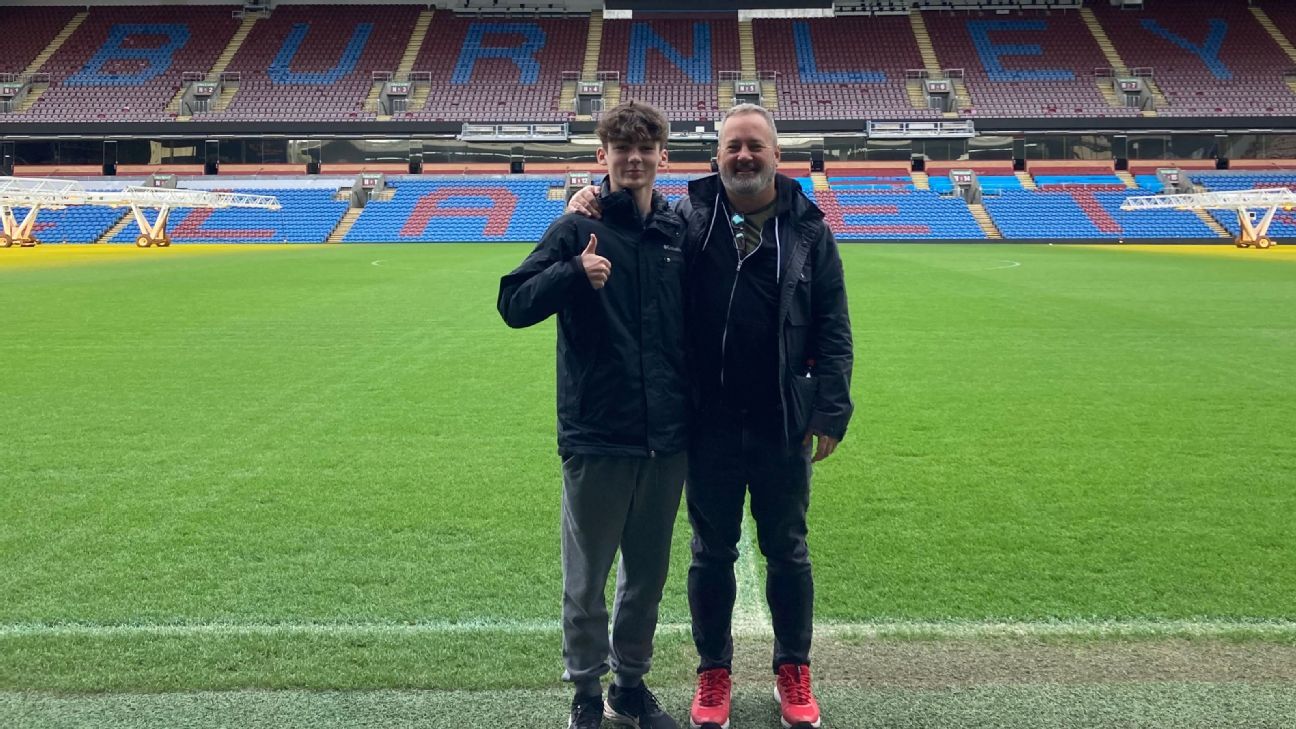
Chris spent two hours with us, showing us every nook and cranny of Turf Moor, as though he were revealing the secret parts of a great ship that he'd help build: We saw the executive offices, the trophy room (there was still some space on the shelves), the lounges. And then he led us down a corridor and into the first of the grandstands, the Bob Lord Stand, out into the cool and silver air, where Sammy and I could see the banks of seats, claret and blue, one for every four Burnley residents, and below them the most flawless pitch, green and freshly lined. That ground has seen sport on it since 1843 -- it was a cricket oval in its earliest iterations -- and it shimmered with the visions of countless sepia-tinted games. Chris took us down to the touchline, and I watched Sammy clock that grass, more perfect than any field he'd played on.
Chris took us around the entire stadium, stand by stand, first into the dressing room and Kompany's spare and tidy quarters. Chris asked Sammy if he wanted to walk down the players tunnel, and it had been a long time since Sammy had looked so much like a kid. We walked where his heroes walk. On our way to the pitch, Chris pointed out the hole in the wall that a frustrated opponent had punched into it -- "We'll be sending a bill for that," he said -- and Sammy ran his fingers over it, learning a little more what football means in a place where it's religion. Then we stepped out into the light.
Sammy stayed there for a long, long time. He put his hands in his coat pockets and stood and looked at every corner of Turf Moor, as though he needed to take personal account of each blade of grass. I was doing the same, but I looked around and saw what wasn't there. Normally, I love being in an empty stadium because of the fizz of its potential, the thrill of what's to come. I suspect that's where Sammy's head had gone -- that he was imagining himself making the same walk he'd just made, only in a kit with his name on it, about to play one of the biggest games of his life. But in that moment, I couldn't help casting back instead, to everything that had happened in my life, in my family's life, all the choices and accidents that had led us from here to there and back again. I wondered what my grandfather would have thought if he could have seen his great-grandson, the one with his curly hair, lost in dreamland in Turf Moor.
Source: https://www.espn.com/soccer/story/_/id/48956370/a-father-son-transatlantic-cross-generational-voyage-visit-burnley
