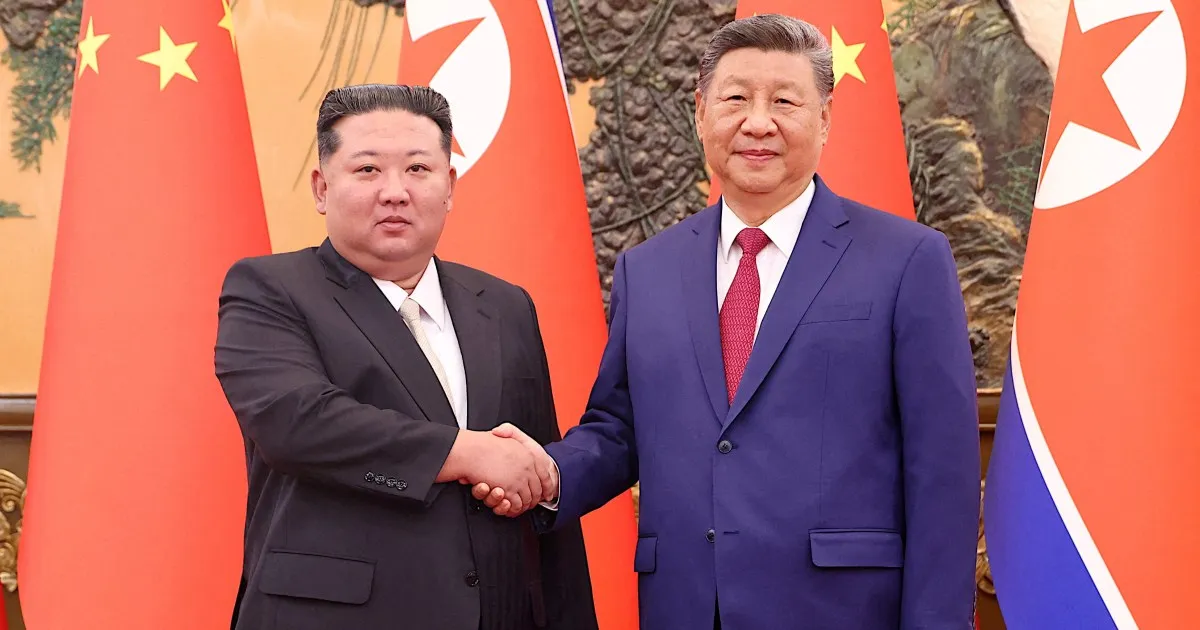
Chinese President Xi has been welcomed in Pyongyang for the first visit since 2019.
Chinese President Xi Jinping arrived in Pyongyang on Monday to the full theatre of North Korean state ceremony, with flags, flowers, military honours and crowds to welcome the leader of the country that has long been one of North Korea’s closest allies.
Kim Jong Un and his wife, Ri Sol Ju, greeted Xi and wife, Peng Liyuan, at Pyongyang’s international airport before the Chinese leader was taken to the capital’s main square, where portraits of Xi and Kim looked out over the choreographed display of friendship.
list 1 of 4Ohio police drag away football pitch invader in pre-World Cup friendly
list 2 of 4Could ex-ISIL fighters be used against Iran, as a Russian official claimed?
list 3 of 4Armenian PM Pashinyan declares victory in parliamentary elections
list 4 of 4Smoke rises in illegal Israeli settlement after Iranian missile attack
“Long Live the Unbreakable Friendship and Unity between North Korea and China,” one banner read, according to Chinese news outlet Xinhua.
Xi’s first visit to North Korea since 2019 comes as both governments are seeking to reaffirm a relationship that has survived famine, nuclear tensions, diplomatic strain and a shifting global order.
Their relationship has often been described with an old Chinese phrase: “As close as lips and teeth” – a metaphor famously first used in the 1950s by Chairman Mao Zedong to define the close ties of the historic allies .
Here’s a potted history of their close, and sometimes tumultuous, relationship.
The roots of the relationship pre-date the founding of both modern states, as many early North Korean leaders, including Kim Il Sung, had links to the Chinese Communist movement before the Democratic People’s Republic of Korea (DPRK) was established in 1948. A year later, on October 6, 1949, North Korea and the newly founded People’s Republic of China established formal diplomatic relations.
The alliance between them was soon tested by war, when North Korean forces were pushed back during the Korean War between North Korea and South Korea.
China entered the conflict, sending large numbers of troops from the People’s Volunteer Army across the Yalu River. The Chinese intervention helped prevent the collapse of North Korea and contributed to the stalemate that left the Korean Peninsula divided.
The human cost was immense, with China suffering casualties of between 180,000 to 400,000, while Korea was left devastated and partitioned. But from Beijing and Pyongyang’s perspective, the war forged a bond that still shapes the two nations’ collective memory.
In 1961, China and North Korea signed the Treaty of Friendship, Cooperation and Mutual Assistance. Its most important clause commits each side to assist the other if it comes under armed attack. The treaty remains significant because it is China’s only formal defence pact with another country.
Despite that, Beijing has not treated it as a blank cheque for Pyongyang, and it has not always trusted Beijing to act without calculation. That tension has run through the relationship for decades, particularly during the Sino-Soviet split, when North Korea tried to avoid taking sides between Beijing and Moscow.
Relations with China worsened during the Cultural Revolution, but improved in the 1970s. They cooled again when China rejected North Korean hopes of renewed conflict with the South, refusing assistance to invade South Korea.
One of the biggest periods of turbulence in the relationship came after China began opening its economy and expanding ties with countries that North Korea viewed with suspicion. Beijing’s decision to normalise relations with South Korea in 1992 was particularly unsettling for Pyongyang.
As China introduced market-oriented reforms while retaining state control over key parts of its economy, it opened up to global trade and foreign direct investment, and the neighbours began to follow increasingly different paths.
The collapse of the Soviet Union – Pyongyang’s principal backer – left North Korea increasingly isolated and dependent on China, creating new strains in a relationship once rooted in shared revolutionary ideals.
North Korea’s nuclear programme created another source of strain, with China repeatedly stating that it opposed nuclear weapons on the Korean Peninsula, and condemned North Korea’s nuclear weapons tests, including the first in 2006.
Beijing also did not oppose several rounds of United Nations sanctions against Pyongyang, even as it remained North Korea’s most important economic lifeline.
The current warmth between Xi and Kim follows several years of renewed contact. Kim has visited China several times since 2018, while Xi travelled to Pyongyang in June 2019.
While it has become increasingly rare for Xi to travel at all – most foreign leaders have had to travel to Beijing in recent years – he has taken the trouble to fly to Pyongyang for this latest visit.
Trade between the two countries is robust. In the first two months of 2026, bilateral trade rose 22 percent compared with the same period a year earlier, underlining the continued importance of their economic relationship.
China also accounts for the overwhelming majority of North Korea’s official trade. North Korea relies on China for fuel, food, machinery, vehicles, electronics and consumer goods. Chinese companies and ports also remain important gateways for North Korean exports. Those include minerals, seafood, iron and steel goods, watch components and wigs and false hair products. North Korea also continues to seek income from overseas labour, despite UN sanctions aimed at cutting off that revenue stream.
However, analysts say China may be concerned about deepening relations between North Korea and Russia – another reason Xi may have decided to personally travel to Pyongyang for this meeting.
As North Korea strengthens its military and political ties with Russia, China has reason to remind both Pyongyang and the wider world that Beijing remains central to North Korea’s future.
That economic relationship gives Beijing considerable influence, although Kim has repeatedly shown a willingness to pursue his own security strategy, even when it complicates China’s diplomatic objectives.
A closer relationship with Pyongyang could also strengthen Xi’s hand in any future discussions about the Korean Peninsula. United States President Donald Trump has repeatedly expressed interest in reviving diplomacy with Kim, even as tensions over North Korea’s nuclear programme have resurfaced.
Last week, Kim unveiled a new facility for producing nuclear materials and vowed to expand the country’s nuclear forces “at an exponential rate”, signalling that denuclearisation remains as distant as ever.
Ultimately, Beijing wants to avoid conflict on its border, maintain influence on the Korean Peninsula and ensure that North Korea does not drift too far into Moscow’s orbit. Xi’s visit is a reminder that, despite shifting geopolitical currents, the relationship between China and North Korea remains one of the most consequential partnerships in East Asia.
Source: https://www.aljazeera.com/news/2026/6/9/as-close-as-lips-and-teeth-the-highs-and-lows-of-china-north-korea-ties?traffic_source=rss